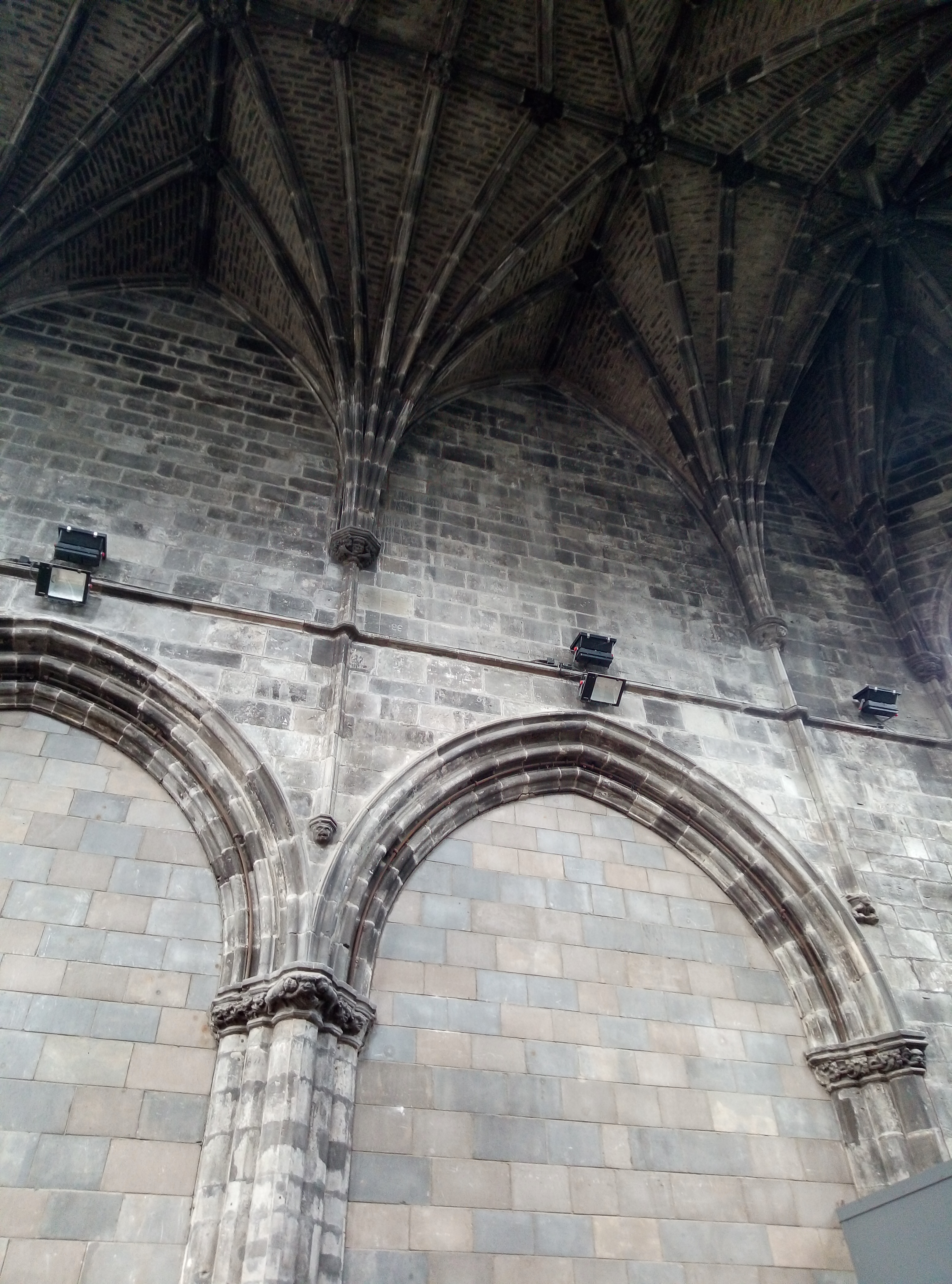
Image: Trinity College Church Apse by AlasdairW, sourced from Wikimedia Commons and licensed under CC BY-SA 4.0.
,_Trinity_College_Church_Apse_-_20230813144953.jpg)
Fragments of a royal collegiate church dismantled for the railway were rebuilt in a Victorian church and now survive as a secluded apse off Jeffrey Street.
Quick facts
- Date
- Medieval fabric of 1460–1531; reconstructed 1872; isolated as an apse in 1963
- Architect / designer
- Medieval work associated with John Halkerston; reconstruction by John Lessels
- Type
- Reconstructed medieval collegiate-church choir and apse with carved fragments
- Designation
- Listed building, Category A (LB25747)
- OS grid reference
- NT 26055 73738
Architecture and continuing use
A rectangular choir ends in a buttressed apse, with traceried windows, gargoyles, paterae and parapets in grey ashlar. Medieval carved capitals and other fragments are set into the reconstructed walls and surrounding enclosure.
Its story
Mary of Gueldres founded Trinity College Church in memory of James II. The railway removed it in 1848; numbered stones were stored and only partly rebuilt by John Lessels in 1872. Demolition of his wider church in 1963 left the present apse.
Why it is included
Category A status and the extraordinary story of dismantling, partial reconstruction and survival make the apse indispensable to Edinburgh’s railway and conservation history.
What to notice
- Medieval carved fragments reset across the walls.
- Traceried windows and gargoyles of the reconstructed choir.
- The confined close setting left by later redevelopment.
Reading the surroundings
The apse is not open to the public. View only from lawful public space where available, respect gates and neighbouring premises, and do not attempt entry.
Timeline
- 1460 Mary of Gueldres founded the collegiate church as a memorial to James II.
- 1848 Railway construction forced the church to be dismantled and its stones stored.
- 1872 John Lessels incorporated surviving medieval work into a new church in Chalmers Close.
- 1963 Demolition of the Victorian church left the choir and apse isolated.
What we know — and what remains uncertain
The monument is a nineteenth-century reconstruction containing genuine medieval fabric, not an intact medieval church standing on its original site.
Sources & further reading
- Historic Environment Scotland: Trinity College Church Apse, LB25747 — Designation category, mapped location, construction phases, fabric, authorship and architectural or historical interest.
- National Records of Scotland: the lost Trinity Collegiate Church — Documentary history of removal, reconstruction, later demolition and current closed status.
Location
OS grid reference NT 26055 73738 · Location confidence: High: the HES designation provides an official mapped National Grid Reference and the current source confirms the Place relationship or present identity. · Select the marker to open its satellite view in Google Maps. On desktop, drag Pegman (the yellow figure) onto a blue road. On mobile, turn on the Street View layer and tap a blue road. Other photo markers may be user-contributed.
Suggest a marker correction
Suggest a more accurate position
The teal marker is the current published position. The orange marker starts slightly to its right so both remain visible; this is only a visual starting position. Tap the correct place on the map or drag the orange marker. Sending this form creates a private review entry only; it does not move the published marker.
Check this area in Google Maps Choose the Satellite layer there if useful.
Map: © OpenStreetMap contributors. You can also enter checked coordinates below.