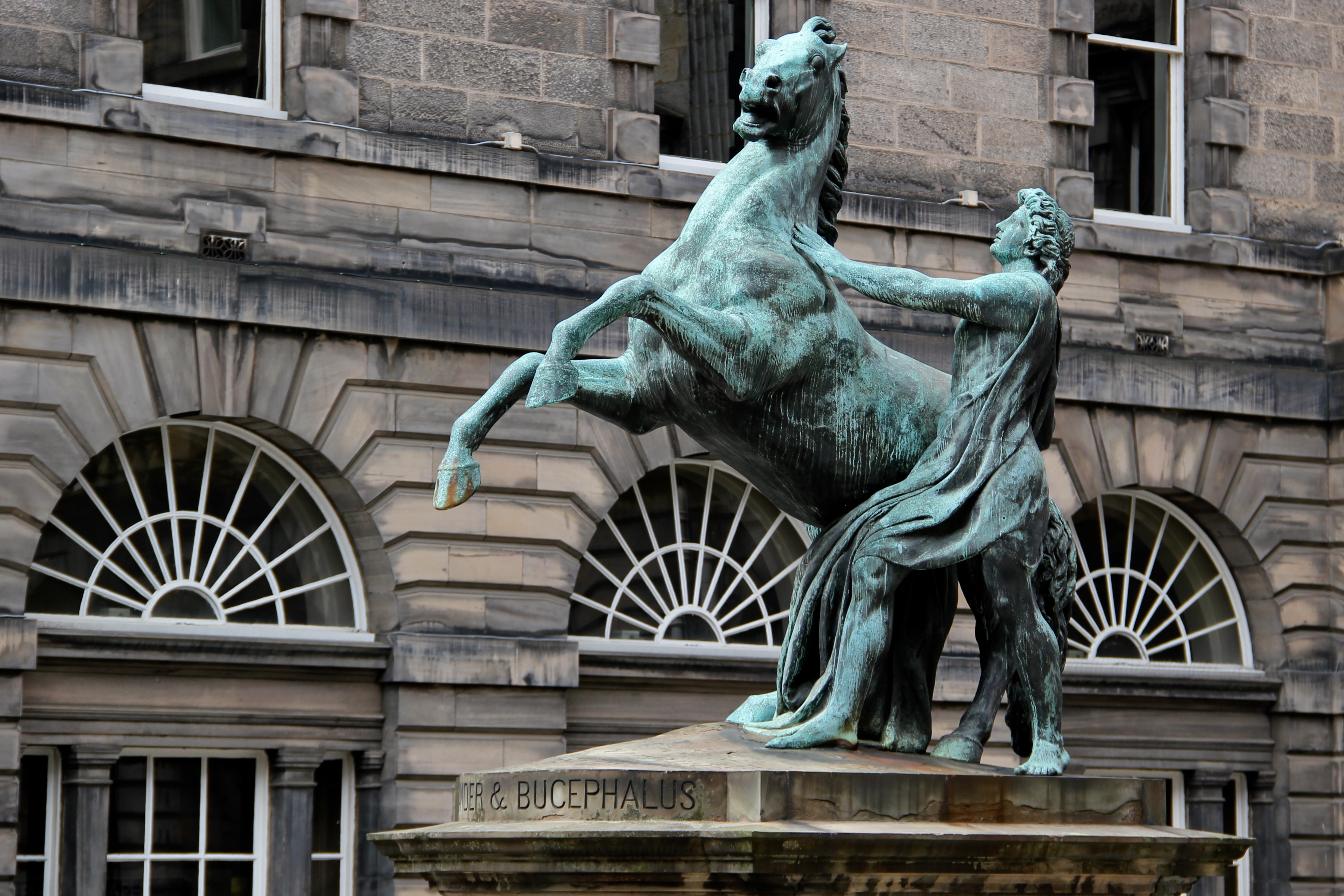
Image: Alexander and Bucephalus Statue by Stefan Schäfer, sourced from Wikimedia Commons and licensed under CC BY-SA 3.0.

Steell’s dramatic bronze horse and standing Alexander bring Romantic movement into the enclosed courtyard of Edinburgh City Chambers.
Quick facts
- Date
- Modelled 1832; cast 1883; moved to City Chambers courtyard 1916
- Architect / designer
- Sir John Steell
- Type
- Bronze group of Alexander taming Bucephalus on an ashlar plinth
- Designation
- Listed building, Category A (LB27855)
- OS grid reference
- NT 25768 73647
Architecture and continuing use
A rearing, unharnessed horse confronts the draped figure of Alexander on a low bow-ended plinth. The sculpture’s movement contrasts with the ordered elevations around the courtyard.
Its story
Steell modelled the group in 1832 and it was cast in 1883. Originally in St Andrew Square, it moved to the City Chambers courtyard in 1916 when the Gladstone Memorial required its former site.
Why it is included
The rearing horse, standing figure and low bow-ended plinth form a major nineteenth-century sculpture and an unusually dynamic element within Edinburgh’s civic architecture.
What to notice
- Horse’s rearing pose and unsupported movement.
- Alexander’s drapery and stance.
- Changing views created by the courtyard elevations.
Reading the surroundings
View only when lawful public access to the courtyard is available. Council business, ceremonies, security controls and events may restrict entry; do not climb the plinth.
Timeline
- 1832 Steell modelled the group.
- 1883 The sculpture was cast in bronze and installed in St Andrew Square.
- 1916 It moved to the City Chambers courtyard when the Gladstone Memorial occupied its former site.
- Present The civic monument remains in the courtyard, subject to building security and events.
Sources & further reading
- Historic Environment Scotland: Alexander and Bucephalus Statue, LB27855 — Designation status, mapped location, construction phases, fabric, authorship and architectural or historical interest.
- Canmore: Alexander and Bucephalus — Commissioning, casting, relocation, present setting and sculptural record.
- Capital Collections: Alexander and Bucephalus — City collection record identifying the sculpture and its City Chambers setting.
Location
OS grid reference NT 25768 73647 · Location confidence: High: the statutory designation supplies an official mapped National Grid Reference and the current source confirms the Place relationship or present identity. · Select the marker to open its satellite view in Google Maps. On desktop, drag Pegman (the yellow figure) onto a blue road. On mobile, turn on the Street View layer and tap a blue road. Other photo markers may be user-contributed.
Suggest a marker correction
Suggest a more accurate position
The teal marker is the current published position. The orange marker starts slightly to its right so both remain visible; this is only a visual starting position. Tap the correct place on the map or drag the orange marker. Sending this form creates a private review entry only; it does not move the published marker.
Check this area in Google Maps Choose the Satellite layer there if useful.
Map: © OpenStreetMap contributors. You can also enter checked coordinates below.