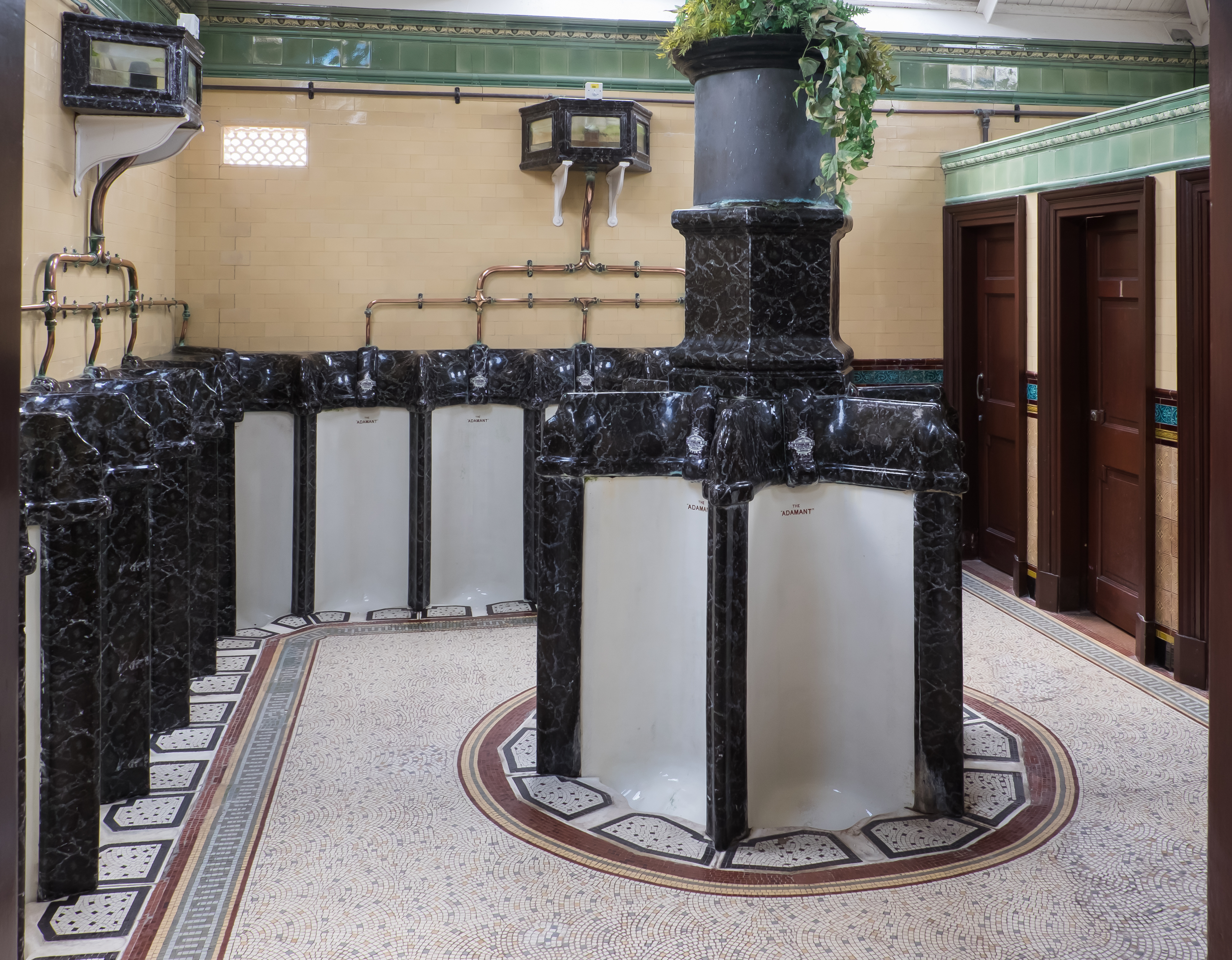


One of Scotland’s most remarkable everyday public interiors survives in coloured glazed brick beside Rothesay pier.
Quick facts
- Date
- Built in 1899; refurbished in the late twentieth century
- Architect / designer
- Commissioned by Rothesay Harbour Trustees; designer not identified in the designation
- Type
- Purpose-built public convenience with elaborate glazed-brick and decorative interior
- Designation
- Listed building, Category A (LB40448)
- OS grid reference
- NS 08835 64828
Architecture and continuing use
The low rectangular building uses patterned coloured glazed brick inside and out. Moulded segmental entrance arches, timber eaves and a richly fitted male lavatory transform an ordinary municipal function into a showpiece.
Its story
Rothesay Harbour Trustees commissioned the convenience in 1899 at the height of the town’s resort economy. A late twentieth-century refurbishment retained the exceptional decorative interior.
Sanitary fittings as civic display
HES’s account of the interior, inspected in 2010, records a central hexagonal urinal group surrounded by wall fittings, with glass-sided cisterns above. Patterned mosaic flooring includes the burgh crest at the entrance. Some fittings imitate stone: the dark dressings described as marble are a dark glaze on a clay body. This distinction is part of the craft of the interior. The later women’s accommodation occupies space formerly used for storage or an office, so its layout and fittings belong to a different phase.
What to notice
- Patterns of coloured glazed brick.
- Moulded segmental entrance surrounds.
- Surviving sanitary fittings and decorative screens where authorised access allows.
- Where authorised access allows, compare genuine marble basins with ceramic fittings finished to resemble dark stone.
Reading the surroundings
This is a functioning public facility. Observe signs, opening arrangements and privacy; never photograph people using it. Accessible provision and hours should be checked locally.
Timeline
- Built in 1899 Rothesay Harbour Trustees commissioned the convenience in 1899 at the height of the town’s resort economy. A late twentieth-century refurbishment retained the exceptional decorative interior.
- Present Council-owned public convenience and heritage attraction.
What we know — and what remains uncertain
The council asset register confirms ownership and identity, but day-to-day opening and the availability of each section can change.
Sources & further reading
- Historic Environment Scotland: Rothesay Victorian Toilets, LB40448 — Designation status, mapped location, construction phases, fabric, authorship and architectural or historical interest.
- Argyll and Bute Council: land and assets register — Council ownership, mapped identity and continuing public-convenience function.
- National Transport Trust: Rothesay Victorian Toilets — Independent public-history overview and heritage context.
Location
OS grid reference NS 08835 64828 · Location confidence: High: the statutory designation supplies an official mapped National Grid Reference and the current source confirms the Place relationship or present identity. · Select the marker to open its satellite view in Google Maps. On desktop, drag Pegman (the yellow figure) onto a blue road. On mobile, turn on the Street View layer and tap a blue road. Other photo markers may be user-contributed.
Suggest a marker correction
Suggest a more accurate position
The teal marker is the current published position. The orange marker starts slightly to its right so both remain visible; this is only a visual starting position. Tap the correct place on the map or drag the orange marker. Sending this form creates a private review entry only; it does not move the published marker.
Check this area in Google Maps Choose the Satellite layer there if useful.
Map: © OpenStreetMap contributors. You can also enter checked coordinates below.