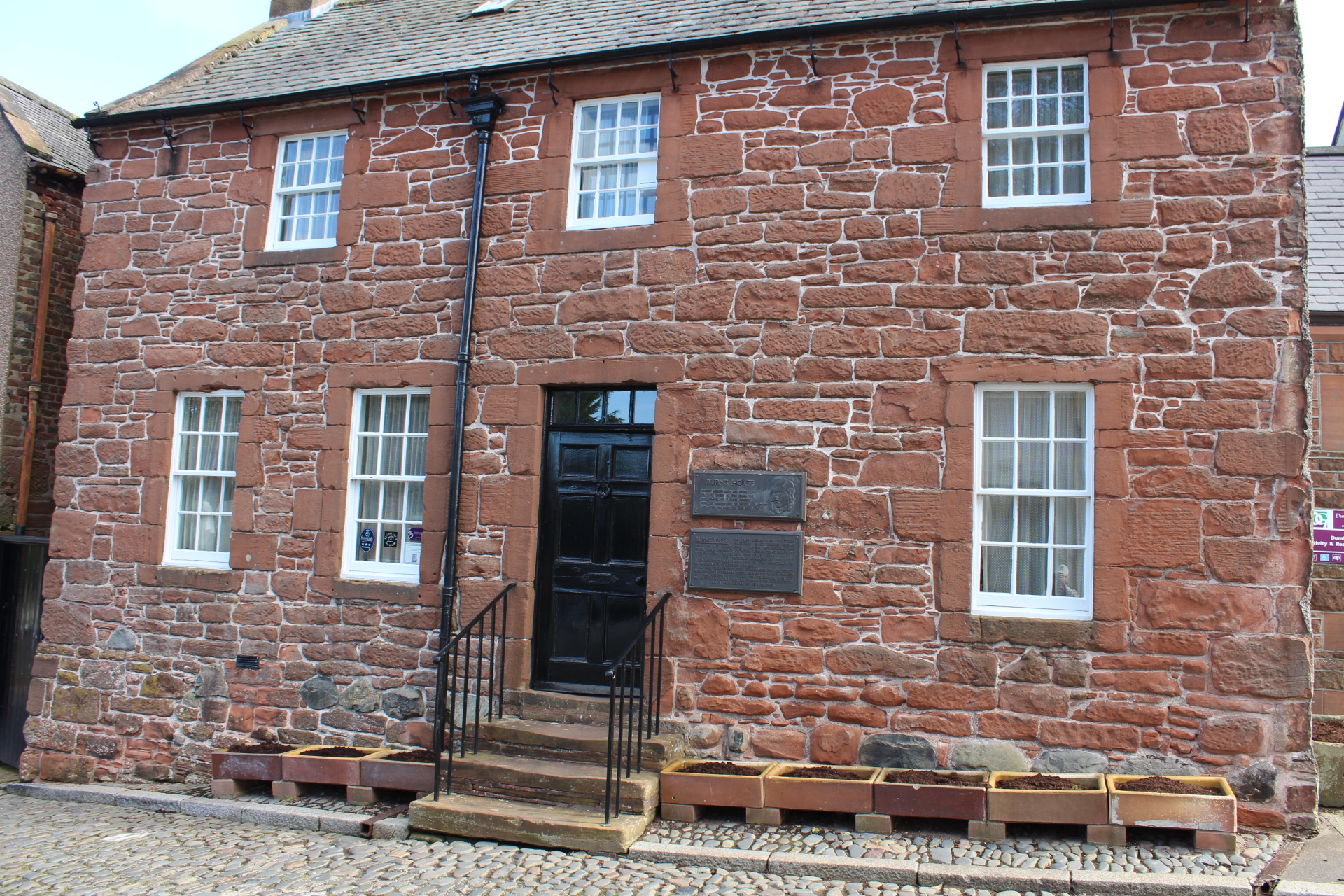
Image: Red sandstone front of Robert Burns House in Dumfries, with white sash windows, a black central door and commemorative plaques by Billy McCrorie / Geograph, licensed under CC BY-SA 2.0.

The modest sandstone house where Robert Burns lived from 1793 until his death in 1796 now preserves domestic scale within Dumfries’s literary landscape.
Quick facts
- Date
- Probably third quarter of the 18th century; museum restoration in 1935
- Architect / designer
- Original builder unknown; 1935 work by M Purdon Smith
- Type
- Eighteenth-century town house and literary museum
- Designation
- Category A listed Robert Burns House (LB26115)
- OS grid reference
- NX 97406 75806
A writer’s house
The two-storey red-sandstone frontage is restrained, with regular windows and simple domestic proportions. Interior rooms and displays make the physical scale of Burns’s final household more immediate than the later public monuments built around his reputation.
Its story
The house probably dates from the third quarter of the eighteenth century and may contain more than one construction phase. Burns moved here with his family in 1793 and died here in July 1796. M Purdon Smith directed renovation for museum use in 1935.
Why it is included
It gives Dumfries a domestic counterpart to the Robert Burns Centre and distinguishes the material evidence of Burns’s home from broader interpretation in a converted industrial building.
Exposed sandstone and a twentieth-century restoration
The sandstone now visible on the frontage was exposed when render was removed during M Purdon Smith’s 1935 renovation. Its present appearance therefore reflects the 1935 renovation as well as earlier fabric. The irregular masonry and the additional ground-floor window on one side also complicate an apparently balanced three-bay front. Inside, stone stairs and simple fireplaces preserve the scale of an ordinary town house. Compare these restrained details with the museum interpretation: the building is both a historic domestic place and a later presentation of the poet’s life.
What to notice
- The modest width and scale of the sandstone frontage.
- Evidence that the apparently simple house may contain several building phases.
- Inside during museum hours, how domestic rooms frame objects and stories from Burns’s final years.
- Look at the uneven masonry and window arrangement, remembering that the exposed-stone appearance dates partly from the 1935 renovation.
Reading the surroundings
The house is a small active museum on Burns Street. Historic dimensions constrain circulation and access; opening and accessibility information should be checked with the council service before visiting.
Timeline
- Third quarter of the 18th century The house was probably built, possibly in more than one phase.
- 1793 Robert Burns and his family moved into the house.
- 21 July 1796 Burns died here.
- 1935 M Purdon Smith directed renovation for museum use.
- Present The building remains a council-run literary museum.
What we know — and what remains uncertain
The designation describes the building as probably third-quarter eighteenth century and notes possible multiple phases. Its construction date remains approximate.
Sources & further reading
- Historic Environment Scotland: Robert Burns House, LB26115 — Designation, grid reference, approximate date, fabric, Burns occupancy and 1935 renovation.
- Dumfries and Galloway Council: Robert Burns House — Current museum use, address, visitor information and access context.
Location
OS grid reference NX 97406 75806 · Location confidence: High: the Category A designation supplies an exact grid reference and the council museum publishes the matching address. · Select the marker to open its satellite view in Google Maps. On desktop, drag Pegman (the yellow figure) onto a blue road. On mobile, turn on the Street View layer and tap a blue road. Other photo markers may be user-contributed.
Suggest a marker correction
Suggest a more accurate position
The teal marker is the current published position. The orange marker starts slightly to its right so both remain visible; this is only a visual starting position. Tap the correct place on the map or drag the orange marker. Sending this form creates a private review entry only; it does not move the published marker.
Check this area in Google Maps Choose the Satellite layer there if useful.
Map: © OpenStreetMap contributors. You can also enter checked coordinates below.