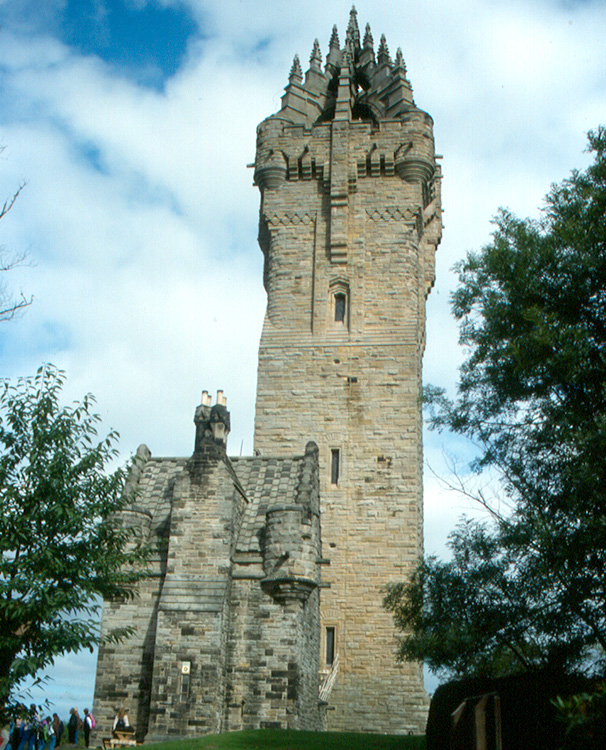
Image: National Wallace Monument by Roger Wollstadt, sourced from Wikimedia Commons and licensed under CC BY-SA 2.0.

John Thomas Rochead’s soaring Baronial tower turns the summit of Abbey Craig into a national memorial, a museum journey and one of Scotland’s most commanding architectural landmarks.
Quick facts
- Date
- Foundation stone laid 1861; begun 1862 and completed 1869
- Architect / designer
- John Thomas Rochead; sculpture by David Watson Stevenson and others
- Type
- National memorial tower with exhibition chambers and open crown
- Designation
- Listed building, Category A (LB41118)
- OS grid reference
- NS 80923 95667
Architecture and continuing use
The monument is a roughly 220-foot rubble-built tower whose mass is progressively enriched by turrets, bartizans, carved detail and an extraordinary open stone crown. Historic Environment Scotland describes four tall barrel-vaulted chambers within the tower. A bronze figure of Wallace by David Watson Stevenson occupies the great exterior niche, while sculptural portraits inside contribute to the building’s Victorian programme of national commemoration.
The ascent is architectural as well as physical. Three exhibition galleries—the Hall of Arms, Hall of Heroes and Royal Chamber—interrupt the narrow spiral stair before visitors emerge onto the Crown and its panoramic platform. Monument, museum and viewpoint were conceived as one experience.
Its story
The campaign for a monument to William Wallace grew through public subscription. The design was chosen by competition in 1858 from 106 entries. Rochead’s winning proposal was submitted anonymously under the motto “nothing on earth remains but fame”. The foundation stone was laid on 24 June 1861, the anniversary of Bannockburn, before a gathering which the monument’s official history estimates at about 80,000 people.
Construction began in 1862 and the monument was completed in 1869. Its position on Abbey Craig deliberately overlooks the landscape associated with the Battle of Stirling Bridge, connecting a nineteenth-century act of national remembrance with the geography of Wallace and Andrew Moray’s victory in 1297.
Why it is included
The National Wallace Monument is both a major work of Scottish Baronial architecture and a revealing document of Victorian historical memory. Its silhouette reshaped the Stirling landscape, while its galleries, sculpture and views continue to frame how visitors encounter Wallace, the Wars of Independence and the idea of national heroism.
What to notice
- The transition from the austere rubble tower to the increasingly elaborate upper stages and open crown.
- David Watson Stevenson’s bronze Wallace in the monumental exterior niche.
- The sequence of barrel-vaulted chambers and portrait sculpture inside.
- The carefully chosen sightlines over Stirling, the Forth and the Stirling Bridge battlefield landscape.
Reading the surroundings
The monument is a ticketed attraction open throughout the year, with seasonal hours. For September and October the operator currently advertises 9.30am–5pm, with last admission at 4pm; advance booking is advised, although walk-up tickets may be available. Winter opening can change at short notice in adverse weather.
The approach from the car park is steep and takes roughly 15–20 minutes on foot; a complimentary shuttle normally operates but cannot carry electric wheelchairs or mobility scooters. There are three steps at the entrance and the galleries and Crown are reached only by a narrow 246-step spiral stair without a handrail. The operator states that the historic tower is not fully wheelchair accessible. Visitors unable to climb can use the ground-floor Keeper’s Lodge facilities and introductory presentation. Check current arrangements before travelling.
Timeline
- 1858 Rochead won the architectural competition from 106 entries.
- 24 June 1861 The foundation stone was laid on Abbey Craig before a vast public gathering.
- 1862 Construction of the tower began.
- 1869 The monument was completed.
- Present The tower remains a year-round visitor attraction with three galleries and the open Crown.
What we know — and what remains uncertain
The building and its documented nineteenth-century campaign are well recorded. Its siting powerfully evokes Wallace’s relationship with the Stirling landscape, but the precise viewpoint from which Wallace surveyed the battlefield belongs to tradition rather than secure archaeological evidence. Displays, ticket prices, shuttle operation and access arrangements can change more quickly than the historic fabric.
Sources & further reading
- Historic Environment Scotland: Wallace Monument, Abbey Craig, LB41118 — Statutory description, authorship, construction dates, architecture and sculpture.
- National Wallace Monument: Our Story — Competition, fundraising and foundation-stone history.
- National Wallace Monument: Opening Times and Arrival — Current seasonal hours and operational cautions.
- National Wallace Monument: Accessibility — Approach, shuttle limitations, steps and ground-floor provision.
Explore further
Location
OS grid reference NS 80923 95667 · Location confidence: High: the statutory designation supplies an exact National Grid Reference and a current official, operator or responsible-organisation source confirms the Place relationship. · Select the marker to open its satellite view in Google Maps. On desktop, drag Pegman (the yellow figure) onto a blue road. On mobile, turn on the Street View layer and tap a blue road. Other photo markers may be user-contributed.
Suggest a marker correction
Suggest a more accurate position
The teal marker is the current published position. The orange marker starts slightly to its right so both remain visible; this is only a visual starting position. Tap the correct place on the map or drag the orange marker. Sending this form creates a private review entry only; it does not move the published marker.
Check this area in Google Maps Choose the Satellite layer there if useful.
Map: © OpenStreetMap contributors. You can also enter checked coordinates below.