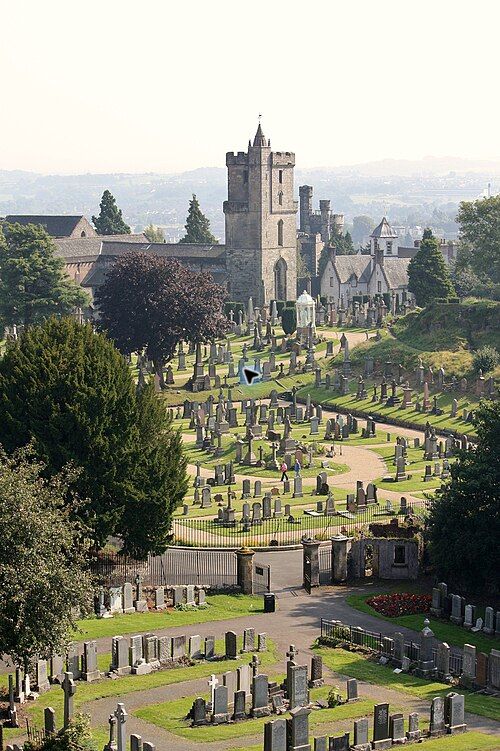
Image: Church of the Holy Rude by Postdlf, sourced from Wikimedia Commons and licensed under CC BY-SA 3.0.

Stirling’s late-medieval parish church is a rare surviving coronation setting: a fifteenth-century nave and tower, a higher early-sixteenth-century choir, exceptional timber roofs and an unbroken life of worship beneath Stirling Castle.
Quick facts
- Date
- Nave and lower tower 1456–c.1470; choir 1507–1540; major alterations and restorations 1803–1940
- Architect / designer
- Medieval masons; tower completed under master mason John Couttis in 1529; later work by James Millar, James Gillespie Graham, J. T. Rochead, James Collie, Thomas Ross and James Miller
- Type
- Medieval burgh parish church, still used for Church of Scotland worship
- Designation
- Listed building, Category A (LB41083)
- OS grid reference
- NS 79206 93710
A medieval church built in two principal campaigns
The church is cruciform, but its long profile also records two distinct medieval building campaigns. Historic Environment Scotland dates the five-bay nave and lower stages of the oblong west tower to 1456–c.1470. Circular arcade piers—except for the shafted eastern pair—carry a clerestory above vaulted aisles. The official church history describes the nave’s oak structure as Scotland’s oldest surviving hammer-beam roof; the designation records it more cautiously as an original wooden roof.
Chapels added variety to the plan. St Andrew’s Aisle, a vaulted rectangle in the angle of the north transept, was in place before 1483. St Mary’s Aisle occupied the north-west bay from 1484, though it was largely removed in 1818. The higher three-bay choir followed between 1507 and 1540 on the steeply sloping site. Its vaulted aisles, former triforium, three-sided apsed presbytery and pointed barrel vault make the east end architecturally distinct from the nave.
From burgh rebuilding to royal coronation
The parish was founded in the twelfth century, but the medieval predecessor was lost in the great fire that damaged Stirling in 1405. The standing church is therefore chiefly the result of later fifteenth- and early-sixteenth-century rebuilding. John Couttis was master mason when the plain battlemented tower was completed in 1529.
On 29 July 1567 the infant James VI was crowned here after Mary, Queen of Scots, abdicated. The event gives Holy Rude an unusual place in Scottish constitutional history, but it was not the building’s endpoint: its importance also lies in the continuing parish life that has sustained and altered it for centuries.
Division, alteration and reunion
A wall divided the church in 1656 so that eastern and western congregations could worship separately. That arrangement left a physical mark for almost three centuries. James Millar altered the East Church in 1803; James Gillespie Graham reshaped the West Church in 1818, removing the porch, western doorway and much of St Mary’s Aisle while introducing new tracery. J. T. Rochead added work in 1867, and James Collie altered the eastern clerestory in 1869, when the choir roof was lined internally.
Thomas Ross restored the West Church in 1911–14 and reconstructed the seventeenth-century pulpit. A larger 1936–40 campaign by James Miller removed the division wall and completed the crossing, transepts and porch, reuniting the interior. The result is not an untouched medieval survival but a legible record of worship, conflict, changing liturgy and conservation.
Why it matters
Holy Rude combines substantial late-medieval fabric, original timber roofing and a documented royal coronation with continued ecclesiastical use. Its position immediately below Stirling Castle connects court, burgh and parish. The long sequence of adaptation is part of its significance: medieval masonry and roofs coexist with post-Reformation subdivision, Georgian and Victorian interventions, twentieth-century reunification, monuments, bells and stained glass.
What to notice
- The contrast between the lower five-bay nave and the higher early-sixteenth-century choir.
- The nave’s timber roof, Gothic arcades and vaulted aisles.
- The battlemented west tower, completed in 1529 under John Couttis.
- The seventeenth-century pulpit, reconstructed during Thomas Ross’s 1911–14 restoration.
- James Ballantine’s nineteenth-century glass and Douglas Strachan’s 1945 south-transept window of the Seasons.
- Impact marks on the external masonry, associated by the church with seventeenth- and eighteenth-century conflict.
Visiting and access
Holy Rude remains an active Church of Scotland place of worship. Sunday worship is at 11:00 and visitors are welcome to attend. For the 2026 visitor season, the church advertises opening from 25 March to 1 November: Monday–Saturday 10:00–18:00 and Sunday 12:30–18:00, with last admission at 17:30. Admission is ticketed; scheduled guided tours are offered. The church warns that special events can require closures and specifically lists no visitor opening on Saturday 3 October 2026, so check the official page before travelling.
The church states that it is accessible: there are a few internal steps, with ramps in place. There are no toilets in the building. The approach from the city centre is uphill, there is no church parking, and nearby on-street spaces are limited. Worship, funerals and other church activity take priority over tourism.
Timeline
- 1129 The parish church is traditionally founded in the reign of David I.
- 1405 Fire destroys the earlier church and much of the town.
- 1456–c.1470 The present nave and lower tower are built.
- 1507–1540 The higher choir and presbytery are constructed; John Couttis completes the tower in 1529.
- 29 July 1567 The infant James VI is crowned here.
- 1656 A wall divides the building into East and West churches.
- 1803–1869 Successive campaigns alter both halves of the church.
- 1911–14 Thomas Ross restores the West Church.
- 1936–40 James Miller removes the division wall and reunifies the interior.
- Present Regular worship and seasonal heritage visiting continue.
What we know — and what remains uncertain
The designation and church interpretation agree on the broad sequence but use different shorthand dates for rebuilding after the 1405 fire. This account follows the more precise fabric dates in the statutory record while treating the church’s earlier date as part of its institutional history. Claims about individual impact marks or lost medieval work should be read as interpretation unless tied to specific fabric analysis.
Sources & further reading
- Historic Environment Scotland: Church of the Holy Rude, LB41083 — Category A designation, location, medieval fabric, named architects, later campaigns, bells, stained glass and coronation date.
- Church of the Holy Rude: plan your visit — 2026 opening times, ticketing, guided tours, accessibility, transport and facilities.
- Church of the Holy Rude: history — Official congregation and visitor interpretation of the foundation, fire, timber roof, coronation, division and conflict.
Location
OS grid reference NS 79206 93710 · Location confidence: High: the Category A designation supplies an exact grid reference for the church. · Select the marker to open its satellite view in Google Maps. On desktop, drag Pegman (the yellow figure) onto a blue road. On mobile, turn on the Street View layer and tap a blue road. Other photo markers may be user-contributed.
Suggest a marker correction
Suggest a more accurate position
The teal marker is the current published position. The orange marker starts slightly to its right so both remain visible; this is only a visual starting position. Tap the correct place on the map or drag the orange marker. Sending this form creates a private review entry only; it does not move the published marker.
Check this area in Google Maps Choose the Satellite layer there if useful.
Map: © OpenStreetMap contributors. You can also enter checked coordinates below.