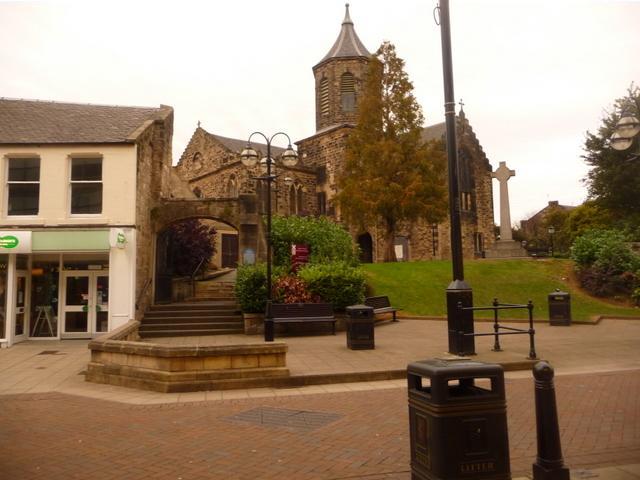
Image: Falkirk Trinity Church by Chris Downer, sourced via Wikimedia Commons and Geograph and licensed under CC BY-SA 2.0.

Falkirk’s living parish church brings together a medieval tower, William Adam’s eighteenth-century belfry and spire, and a richly furnished nineteenth-century worship space.
Quick facts
- Date
- Medieval tower; William Adam belfry and spire 1738–1741; church body 1810–1811; session house 1892–1893
- Architect / designer
- William Adam; James Gillespie Graham; Wardrop and Anderson; later work by George Deas Page
- Type
- Cruciform parish church and burial ground incorporating medieval fabric
- Designation
- Listed building, Category A (LB31167)
- OS grid reference
- NS 88729 80025
Architecture and continuing use
The central square tower is the principal survival from the medieval church. William Adam added its octagonal belfry and swept stone spire in 1738–41. Around the tower, James Gillespie Graham’s 1810–11 rebuilding created the present cruciform body in a restrained Gothic manner, with pointed openings, buttresses and a clear axial relationship to the historic burial ground. Wardrop and Anderson’s 1892–93 session house adds another distinct phase to the group.
Inside, the horseshoe gallery is carried on Roman Doric columns. Nineteenth- and early twentieth-century work includes George Deas Page’s 1878–83 renovation, an oak pulpit of 1896, stained glass including work associated with Christopher Whall and Ballantine & Allan, and a 1923 war-memorial doorpiece. A 13-bell carillon cast in Baltimore in 1926 adds an unusual musical layer. The church remains an active Church of Scotland place of worship and a base for community activity.
Its story
The site has a long ecclesiastical history, but its earliest foundation is not securely dated. Historic Environment Scotland records the church as property of Holyrood Abbey by 1166, while later tradition places Christian worship here much earlier. The medieval church was repeatedly altered; its tower survived when the body was replaced in the early nineteenth century.
In 1810 the Court of Session ruled that the old tower should be retained during rebuilding. Gillespie Graham’s new church opened in 1811, physically incorporating that decision into the present structure. Later repairs, furnishings and extensions record changing patterns of worship, commemoration and congregational life. Twentieth- and twenty-first-century unions produced the current Falkirk Trinity identity.
Why it is included
Category A status reflects exceptional continuity on a central burgh site, the survival of medieval fabric, and major work by William Adam, James Gillespie Graham, Wardrop and Anderson and other notable designers. The church, monuments and burial ground form a layered civic and religious ensemble rather than a building of a single period.
What to notice
- The contrast between the massive medieval square tower and Adam’s lighter octagonal belfry and swept spire.
- Gillespie Graham’s cruciform Gothic body wrapped around the retained tower.
- The horseshoe gallery on Roman Doric columns and the later pulpit, memorials and stained glass.
- The 1892–93 session house and the way successive additions meet the historic burial ground.
- Monuments in and around the church, including those associated with the Livingston family and Sir John de Graeme.
Reading the surroundings
The church stands within its historic burial ground at the heart of Falkirk. The congregation currently advertises Sunday worship at 10.30am and a shorter Wednesday service at 11.30am, subject to seasonal changes; it also states that tours can be arranged by appointment. Visitors should check the current programme or contact the church office before making a special journey. Worship takes priority, and access to historic interiors, thresholds and monuments may be constrained by services, events, safeguarding and uneven historic surfaces. Exterior appreciation from public paths should respect graves and active church use.
Timeline
- By 1166 Documentary evidence places the church in the possession of Holyrood Abbey.
- Medieval period The surviving square tower formed part of an earlier church; the congregation dates it to about 1450, while the statutory record uses the broader description “medieval”.
- 1738–1741 William Adam added the octagonal belfry and swept spire.
- 1810–1811 Following a court decision to retain the old tower, James Gillespie Graham rebuilt the main body of the church.
- 1878–1883 George Deas Page directed a major interior renovation.
- 1892–1893 Wardrop and Anderson added the session house.
- 1926 The 13-bell carillon was cast in Baltimore.
- Present Falkirk Trinity continues as an active Church of Scotland congregation with worship, community use and visits by arrangement.
What we know — and what remains uncertain
The documented medieval tower and ownership by Holyrood Abbey establish substantial antiquity. Claims for a seventh-century foundation and a specific founding by Malcolm Canmore belong to later tradition and should not be treated as securely dated fact. The familiar “Faw Kirk” explanation of Falkirk’s name is also one of several theories. Current worship times are published by the congregation, while tours require prior arrangement.
Sources & further reading
- Historic Environment Scotland: Falkirk Trinity Church, LB31167 — Statutory designation, mapped location, building phases, architectural description, interior fittings, monuments and assessment of early traditions.
- Falkirk Trinity Church: about us — Congregational account of the historic church and tours by appointment.
- Falkirk Trinity Church: worship — Current active use, advertised service times and visitor contact.
- Scotland’s Churches Trust: Falkirk Trinity Church — Supplementary architectural overview and denominational history.
Location
OS grid reference NS 88729 80025 · Location confidence: High: the statutory designation supplies an official mapped National Grid Reference and the current source confirms the Place relationship or present identity. · Select the marker to open its satellite view in Google Maps. On desktop, drag Pegman (the yellow figure) onto a blue road. On mobile, turn on the Street View layer and tap a blue road. Other photo markers may be user-contributed.
Suggest a marker correction
Suggest a more accurate position
The teal marker is the current published position. The orange marker starts slightly to its right so both remain visible; this is only a visual starting position. Tap the correct place on the map or drag the orange marker. Sending this form creates a private review entry only; it does not move the published marker.
Check this area in Google Maps Choose the Satellite layer there if useful.
Map: © OpenStreetMap contributors. You can also enter checked coordinates below.