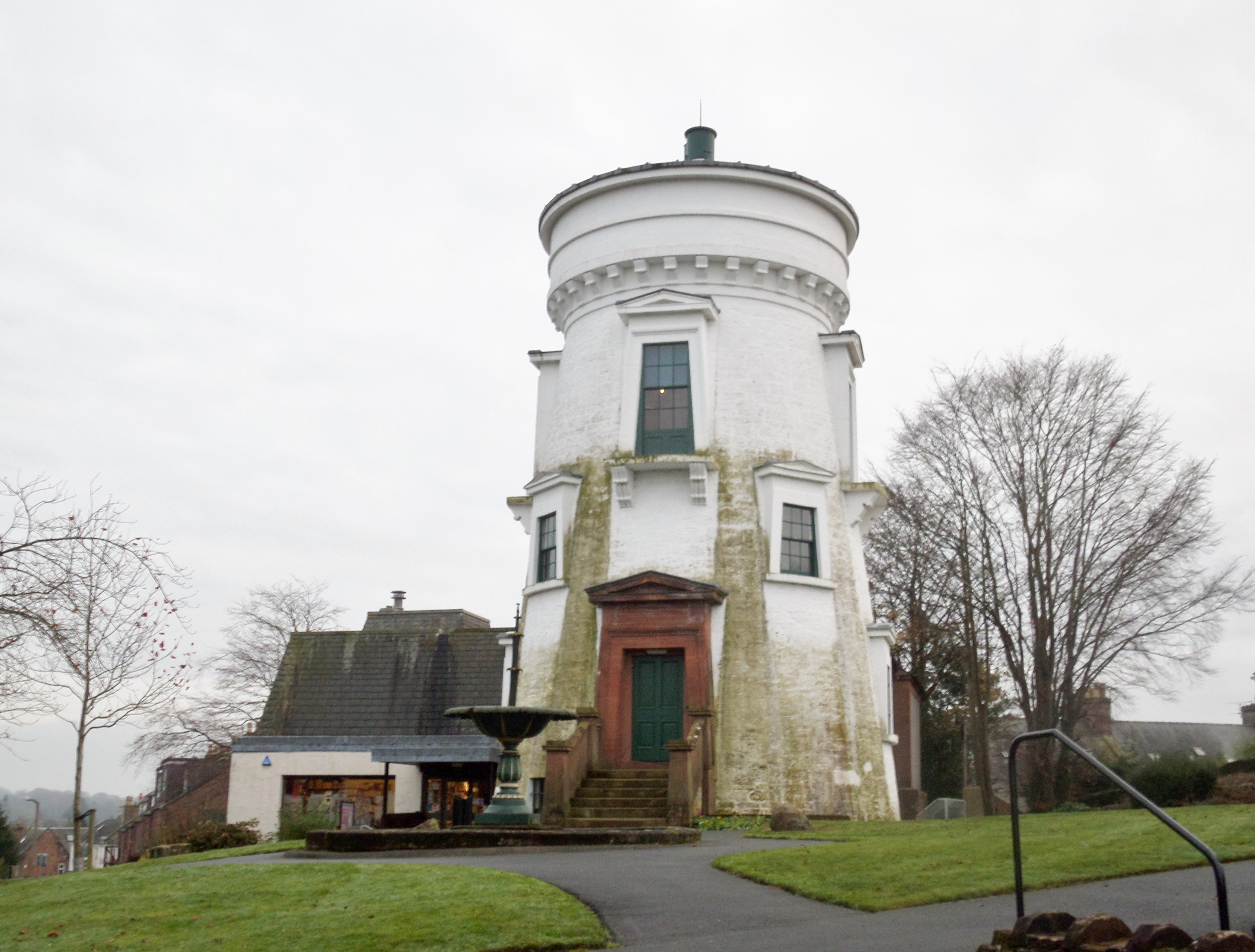
Image: Dumfries Museum and Camera Obscura by Rosser1954, sourced from Wikimedia Commons and licensed under CC BY-SA 4.0.

Dumfries Museum’s tower began as a windmill. Walter Newall adapted it for an observatory in 1835–36, leaving a spiral route up to the camera obscura.
Quick facts
- Date
- Windmill in existence by 1796; remodelled as an observatory in 1835–1836
- Architect / designer
- Walter Newall for the observatory conversion
- Type
- Former windmill converted to observatory, museum and camera obscura
- Designation
- Category A listed museum observatory (LB26135)
- OS grid reference
- NX 96987 75713
Design and construction
A battered rubble windmill tower existed by 1796. Its tapering walls and robust masonry reflect the loads and motion of milling machinery. Walter Newall remodelled it in 1835–36 as an observatory, adding finely worked ashlar, classically framed openings, balconies and a deep parapet.
The camera-obscura apparatus crowns the tower above later museum accommodation. In suitable light it directs a live optical image of the surrounding townscape into a darkened viewing space, making the building itself part of the instrument.
What to notice
- Battered rubble walls belonging to the earlier windmill.
- The change from rough masonry to Newall’s ashlar observatory work.
- Greek Revival window surrounds and bracketed balconies.
- The camera-obscura housing at the summit.
- Views that explain the tower’s commanding site.
Change and conservation
A diary entry of September 1796 places the windmill here decades before the observatory. The prospect of Halley’s comet helped prompt the conversion. The observatory opened on 1 August 1836, with the camera obscura installed that year. The tower retains the instrument above its concealed roof, while later museum galleries extend south from the foot of the mill.
Location and Photos
The museum is on Rotchell Road. The tower is reached by stairs. The museum suspends camera demonstrations in rain or high winds.
Sources & further reading
- Historic Environment Scotland: Dumfries Museum Observatory, LB26135 — Newall’s conversion, the 1796 diary reference, Halley’s comet, opening date, camera installation and southern museum extension.
- Dumfries and Galloway Council: Dumfries Museum — Current museum and camera-obscura use, weather dependence and access information.
Location
OS grid reference NX 96987 75713 · Location confidence: High: the Category A designation provides an exact grid reference and the council museum publishes the same observatory location. · Select the marker to open its satellite view in Google Maps. On desktop, drag Pegman (the yellow figure) onto a blue road. On mobile, turn on the Street View layer and tap a blue road. Other photo markers may be user-contributed.
Suggest a marker correction
Suggest a more accurate position
The teal marker is the current published position. The orange marker starts slightly to its right so both remain visible; this is only a visual starting position. Tap the correct place on the map or drag the orange marker. Sending this form creates a private review entry only; it does not move the published marker.
Check this area in Google Maps Choose the Satellite layer there if useful.
Map: © OpenStreetMap contributors. You can also enter checked coordinates below.