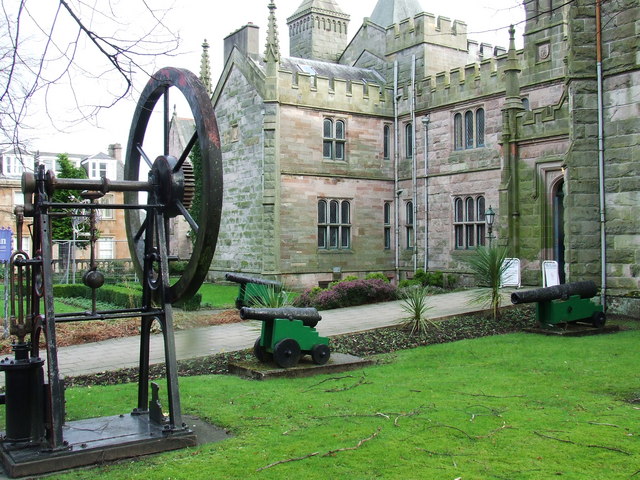
Image: Stone Gothic Revival front of the Watt Institution in Greenock, seen behind a preserved steam engine by Thomas Nugent / Geograph, licensed under CC BY-SA 2.0.

An exceptionally early library-and-museum complex built in several phases, combining public learning, local collections and a commemoration of James Watt that now requires fuller historical context.
Quick facts
- Date
- Library 1832–1837; wings 1847; public hall and museum 1876; art-gallery extension 1955; conservation completed 2020
- Architect / designer
- Edward Blore; 1876 extension by Alexander Adamson; later additions and alterations
- Type
- Library, museum, art gallery and archive
- Designation
- Category A listed building (LB34148)
- OS grid reference
- NS 27383 76551
A public institution made over generations
The Watt Institution is not one building campaign but a connected civic complex. Edward Blore’s Tudor-Gothic library forms the early core; later wings, museum, public hall and art gallery record the growth of Greenock’s collections and cultural ambitions across more than a century.
Its story
James Watt donated books in 1816 towards a proposed scientific library. The library was built in 1832–1837, with Blore’s side wings added in 1847. Alexander Adamson designed the public-hall and museum extension opened in 1876, and an art-gallery extension followed in 1955. Conservation and refurbishment culminated in the restoration of features including tall chimneys, rooflights and the original institutional name.
Why it is included
It connects architecture with the growth of public libraries, museums and archives, while also allowing the directory to address how civic commemoration changes as historical knowledge deepens.
What to notice
- The Tudor-Gothic library core, with its centre porch, bay windows and emphatic chimneys.
- The way successive wings and extensions reveal the institution’s expanding functions.
- The restored original name, Watt Institution, and the questions raised by whom and what a civic building commemorates.
Reading the surroundings
The Institution stands on Kelly Street within walking distance of Greenock’s central civic buildings. The operator’s current visitor page should be checked before travel because the building was temporarily closed for accessibility-related works when this draft was reviewed.
Timeline
- 1816 James Watt donated books towards a proposed scientific library in Greenock.
- 1832–1837 Edward Blore’s library building was constructed.
- 1847 Side wings designed by Blore were added.
- 1876 Alexander Adamson’s public hall and museum extension opened.
- 1955 An art-gallery extension expanded the cultural complex.
- 2019–2020 The institution reopened in stages following major structural renovation and conservation, completed in 2020.
- 2025–2026 The building closed temporarily for lift installation and associated accessibility works; the current visitor page should be checked before travel.
What we know — and what remains uncertain
Historic Environment Scotland records conservation as completed in February 2020, while Inverclyde Council’s institutional history says the building reopened in 2019; this draft treats reopening and completion as stages rather than a contradiction. The designation’s revised history also records that James Watt was involved in trading enslaved people and benefited through his family from the transatlantic slave economy. The building’s commemoration of engineering achievement must therefore be presented alongside, not apart from, that history. Visitor access is temporary and should be rechecked before publication.
Sources & further reading
- Historic Environment Scotland: Watt Institution, LB34148 — Designation, building phases, architects, architectural description, conservation and revised historical context including links to slavery.
- Trove: Watt Institution, LB34148 — National designation cross-reference and precise location.
- Inverclyde Council: Watt Institution — about us — Institutional history, component services, council management and reopening after structural renovation.
- Inverclyde Council: visit the Watt Institution — Current temporary closure and advice to check access before visiting.
- Inverclyde Council: Watt Library — Library opening date, subscription history and later public-library role.
Location
OS grid reference NS 27383 76551 · Location confidence: High: Historic Environment Scotland and Trove give matching national-grid and coordinate locations. · Select the marker to open its satellite view in Google Maps. On desktop, drag Pegman (the yellow figure) onto a blue road. On mobile, turn on the Street View layer and tap a blue road. Other photo markers may be user-contributed.
Suggest a marker correction
Suggest a more accurate position
The teal marker is the current published position. The orange marker starts slightly to its right so both remain visible; this is only a visual starting position. Tap the correct place on the map or drag the orange marker. Sending this form creates a private review entry only; it does not move the published marker.
Check this area in Google Maps Choose the Satellite layer there if useful.
Map: © OpenStreetMap contributors. You can also enter checked coordinates below.