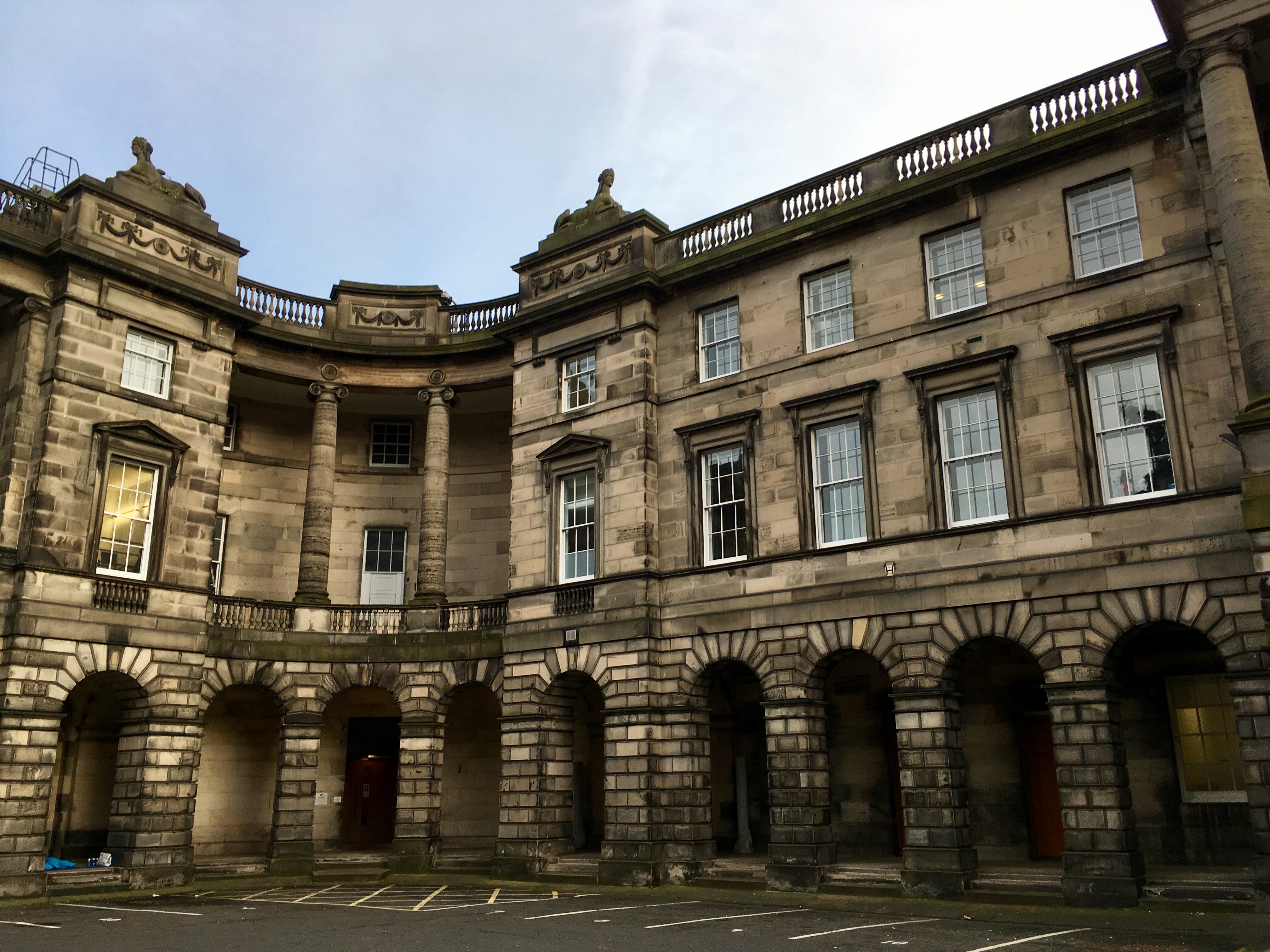
Image: The Supreme Courts of Scotland by LornaMCampbell, sourced from Wikimedia Commons and licensed under CC BY-SA 4.0.

Behind a long Classical screen, Scotland’s highest civil and criminal courts occupy a layered complex around the medieval heart of the Old Town.
Quick facts
- Date
- Major external rebuilding 1803–1810; additions and alterations 1827–1838 and later
- Architect / designer
- Robert Reid; William Burn; William Nixon; William Thomas Oldrieve
- Type
- Classical court complex incorporating the historic Parliament Hall
- Designation
- Listed building, Category A (LB27699)
- OS grid reference
- NT 25753 73530
Architecture and continuing use
The public front is an imposing ashlar composition with a central hexastyle portico above a continuous rusticated arcade. The steep site drops many storeys towards the Cowgate, enclosing older Parliament Hall within a complex repeatedly altered for court use.
Its story
Robert Reid reshaped the Parliament Square fronts in the early nineteenth century. William Burn and later government architects altered the complex while retaining Parliament Hall, built for the pre-Union Parliament of Scotland.
Why it is included
It brings constitutional history, court ceremony and continuing public administration together in a building complex that has evolved for centuries.
What to notice
- The long arcaded base and central Classical portico.
- The contrast between the Parliament Square frontage and the steep Cowgate side.
- How the court buildings frame St Giles’ Cathedral and Parliament Square.
Reading the surroundings
The courts are working judicial buildings with security controls. Public access depends on court business and current rules; consult the Scottish Courts and Tribunals Service before visiting.
Timeline
- Major external rebuilding 1803–1810 Robert Reid reshaped the Parliament Square fronts in the early nineteenth century.
- Present Working home of the Court of Session and High Court of Justiciary, with associated court offices.
What we know — and what remains uncertain
“Parliament House” can refer to the wider court complex or its historic hall. The listing excludes specified later Cowgate extensions.
Sources & further reading
- Historic Environment Scotland: The Supreme Courts of Scotland, LB27699 — Designation category, mapped location, construction phases, fabric, authorship and architectural interest.
- Scottish Courts and Tribunals Service: Supreme Courts — Current judicial use, court identity, address, opening hours and security context.
Location
OS grid reference NT 25753 73530 · Location confidence: High: the statutory designation supplies a mapped National Grid Reference and a current official operator, responsible public body or institutional source confirms the Place relationship and present identity. · Select the marker to open its satellite view in Google Maps. On desktop, drag Pegman (the yellow figure) onto a blue road. On mobile, turn on the Street View layer and tap a blue road. Other photo markers may be user-contributed.
Suggest a marker correction
Suggest a more accurate position
The teal marker is the current published position. The orange marker starts slightly to its right so both remain visible; this is only a visual starting position. Tap the correct place on the map or drag the orange marker. Sending this form creates a private review entry only; it does not move the published marker.
Check this area in Google Maps Choose the Satellite layer there if useful.
Map: © OpenStreetMap contributors. You can also enter checked coordinates below.