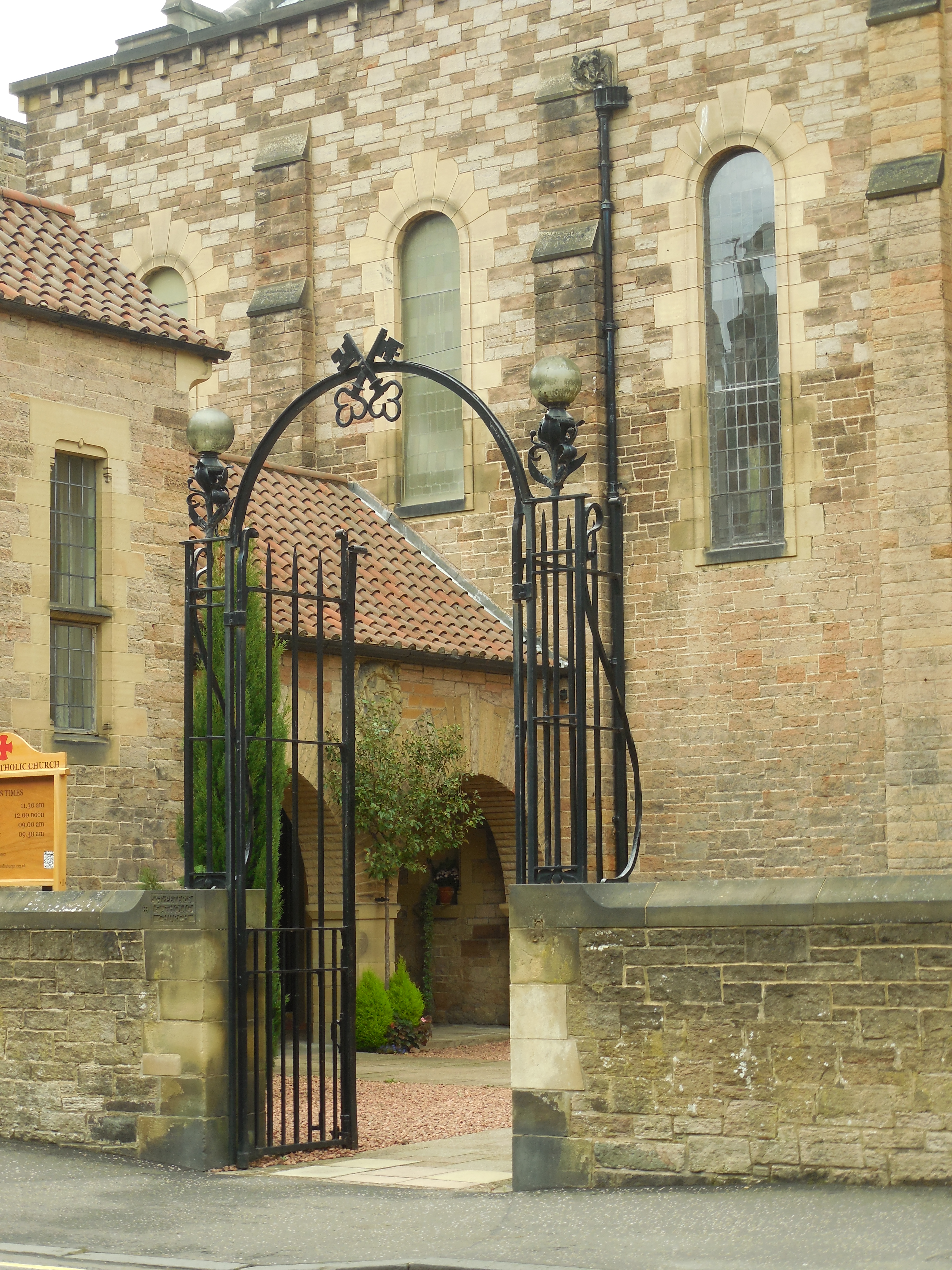


Lorimer’s inventive Italianate church and slender campanile continue to frame an active Catholic parish.
Quick facts
- Date
- Built 1906–1907; nave completed 1928–1929
- Architect / designer
- Robert Lorimer
- Type
- Italianate Roman Catholic hall church with campanile and courtyard
- Designation
- Listed building, Category A (LB27257)
- OS grid reference
- NT 24734 71481
Architecture and continuing use
Rubble and yellow ashlar form a large round-arched hall church, canted apse and transepts; linked domestic ranges shape a southern courtyard.
Its story
Robert Lorimer began the church in 1906–1907 and completed the nave in 1928–1929. It remains a parish of the Archdiocese of St Andrews and Edinburgh.
A symbolic interior altered after Vatican II
The nave’s round arches stand on square piers beneath a strongly beamed timber ceiling, with a wagon-roofed centre and lower side panels. Lorimer’s scheme also coordinated symbolic fittings and artworks. Later reordering moved elements: the painted rood screen was placed against the apse wall, while Brangwyn’s Confession of St Peter painting moved from the apse to the west. These changes mean the present arrangement is not an intact original composition. Compare the surviving architectural framework with the position of individual furnishings, using parish interpretation for the later liturgical history.
What to notice
- Slender Italianate campanile.
- Round-arched nave windows.
- The courtyard formed by church, offices and presbytery.
- Compare the nave’s square piers and timber ceiling with relocated artworks and screen elements in the apse and at the west end.
Reading the surroundings
This is an active church. Use current Mass times or arrange access, and respect worship and pastoral activity.
Timeline
- Built 1906–1907 Robert Lorimer began the church in 1906–1907 and completed the nave in 1928–1929. It remains a parish of the Archdiocese of St Andrews and Edinburgh.
- Present Active Roman Catholic parish church.
What we know — and what remains uncertain
The interior was substantially altered after Vatican II; surviving Lorimer work should not be confused with later reordering.
Sources & further reading
- Historic Environment Scotland: St Peter’s Roman Catholic Church, Morningside, LB27257 — Designation category, mapped location, construction phases, fabric, authorship and architectural interest.
- St Peter’s RC Church Edinburgh — Current parish identity, worship and contact information.
- Scotland’s Churches Trust: St Peter’s Morningside — Independent architectural account, access context and church status.
Location
OS grid reference NT 24734 71481 · Location confidence: High: the HES designation provides an official mapped National Grid Reference and the current source confirms the Place relationship or present identity. · Select the marker to open its satellite view in Google Maps. On desktop, drag Pegman (the yellow figure) onto a blue road. On mobile, turn on the Street View layer and tap a blue road. Other photo markers may be user-contributed.
Suggest a marker correction
Suggest a more accurate position
The teal marker is the current published position. The orange marker starts slightly to its right so both remain visible; this is only a visual starting position. Tap the correct place on the map or drag the orange marker. Sending this form creates a private review entry only; it does not move the published marker.
Check this area in Google Maps Choose the Satellite layer there if useful.
Map: © OpenStreetMap contributors. You can also enter checked coordinates below.