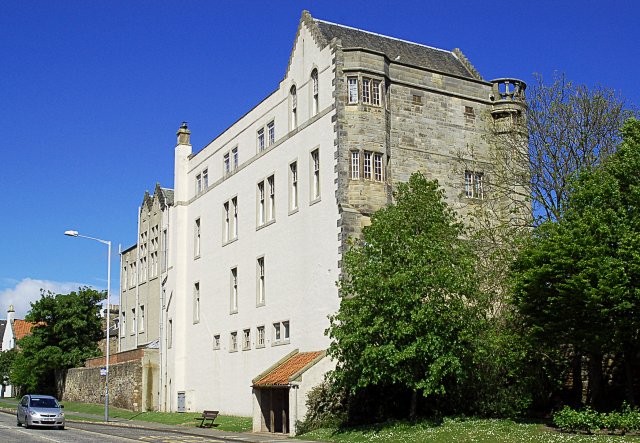
Image: St Leonard’s Chapel by Jim Bain, sourced from Wikimedia Commons and licensed under CC BY-SA 2.0.

A small medieval chapel near the cathedral precinct remains part of University worship, its plain rubble walls preserving a long sequence of rebuilding, monuments and carefully managed public access.
Quick facts
- Date
- Parish church by about 1200; refounded with St Leonard’s College in 1512; substantially early sixteenth-century in its present form; altered in the 1760s and 1853; re-roofed 1910; restored 1952
- Architect / designer
- Medieval builders unknown; 1952 restoration by Ian G. Lindsay
- Type
- University chapel, formerly a parish and collegiate church
- Designation
- Category A listed building (LB40666); formerly scheduled
- OS grid reference
- NO 51272 16602
A modest building with a long institutional life
St Leonard’s is much smaller than St Salvator’s Chapel, but its history reaches back to a parish church recorded around 1200. It was refounded as part of St Leonard’s College in 1512 and continues in ecclesiastical use. The surviving chapel is chiefly early sixteenth-century in form, though repeated alteration has shortened and simplified the western end.
The chapel’s plain scale is part of its character. A rectangular rubble-built body, square-headed openings and an intimate collegiate interior make it feel distinct from the taller, more ceremonially prominent St Salvator’s. Historic Environment Scotland records internal dimensions of about 79¾ by 20½ feet.
Architecture and change
The present fabric does not reproduce a single medieval moment. A former tall west tower and spire were demolished in the 1760s. In 1853 the west wall was moved east, further changing the chapel’s length and western appearance. The roof was renewed in 1910, and Ian G. Lindsay restored the building in 1952.
These interventions are historically important in their own right: they show how a small collegiate chapel was repeatedly adapted so that it could remain usable. The interior also contains monuments to Peter Bruce, Robert Stewart and Robert Wilkie, dating from the late sixteenth and early seventeenth centuries.
College, worship and memory
After its refoundation in 1512, the chapel served St Leonard’s College and became part of the University’s religious and ceremonial landscape. Although the college itself was later absorbed into the United College, the chapel survived as a place of worship. Historic Environment Scotland’s statement of special interest is concise but significant: it identifies the building as ecclesiastical and still in that use.
Today the University Chaplaincy describes St Leonard’s as one of its two chapels. It hosts worship, weddings, memorial and carol services, concerts and recitals. The scale is intimate—about 60 seats—so public access must be planned around services, school grounds and other bookings.
Why it matters
St Leonard’s makes the University’s pre-Reformation collegiate history tangible in a building that still serves worship. Its value lies not in grandeur but in continuity: medieval origins, early modern monuments, later structural change and present chaplaincy life remain legible together.
What to notice
- The long, narrow rubble-built body and its restrained square-headed openings.
- The shortened west end, which reflects the loss of the tower and spire and the 1853 rebuilding.
- The close-set collegiate seating within a chapel designed for a small community.
- The monuments to Peter Bruce, Robert Stewart and Robert Wilkie, which connect the interior to post-Reformation university life.
Visiting and access
The chapel stands within the grounds of St Leonards School and should not be approached as an unrestricted visitor attraction. The University states that interior visits are by appointment through the Chaplaincy office. There is one small step at the entrance.
Members of the public are welcome at advertised services. For the current 2026 Martinmas semester, the University lists Compline on Thursdays at 10pm from 17 September to 26 November, with exceptions on 22 October and 5 November; other Orthodox and special services are advertised separately. These arrangements can change, so check the current worship page before travelling and respect both worship and the surrounding school setting.
Timeline
- About 1200 A parish church stood here.
- 1512 The church was refounded as part of St Leonard’s College.
- Early sixteenth century The chapel took substantially its present rectangular form.
- 1760s The tall west tower and spire were demolished.
- 1853 The west wall was moved east, shortening the chapel.
- 1910 The building was re-roofed.
- 1952 Ian G. Lindsay carried out a restoration.
- Present The University Chaplaincy uses the chapel for worship, ceremonies, concerts and recitals, with visits by appointment and public attendance at advertised services.
What we know — and what remains uncertain
The official designation securely records the main phases and named monuments, but it is not a complete archaeological history. The chapel’s medieval origins, sixteenth-century rebuilding and later repairs overlap, so surviving fabric should not be assigned to a single date without more detailed investigation. Access is appointment- and service-dependent rather than generally open.
Sources & further reading
- Historic Environment Scotland: St Leonard’s Chapel, LB40666 — Category, location, medieval origins, building phases, monuments and former scheduled status.
- University of St Andrews Chaplaincy: University chapels — Current worship, ceremonial, concert and recital uses.
- University of St Andrews Chaplaincy: worship — Current appointment-only visiting arrangement, accessibility note and advertised public services.
Location
OS grid reference NO 51272 16602 · Location confidence: High: the Category A designation supplies an exact grid reference for the chapel. · Select the marker to open its satellite view in Google Maps. On desktop, drag Pegman (the yellow figure) onto a blue road. On mobile, turn on the Street View layer and tap a blue road. Other photo markers may be user-contributed.
Suggest a marker correction
Suggest a more accurate position
The teal marker is the current published position. The orange marker starts slightly to its right so both remain visible; this is only a visual starting position. Tap the correct place on the map or drag the orange marker. Sending this form creates a private review entry only; it does not move the published marker.
Check this area in Google Maps Choose the Satellite layer there if useful.
Map: © OpenStreetMap contributors. You can also enter checked coordinates below.