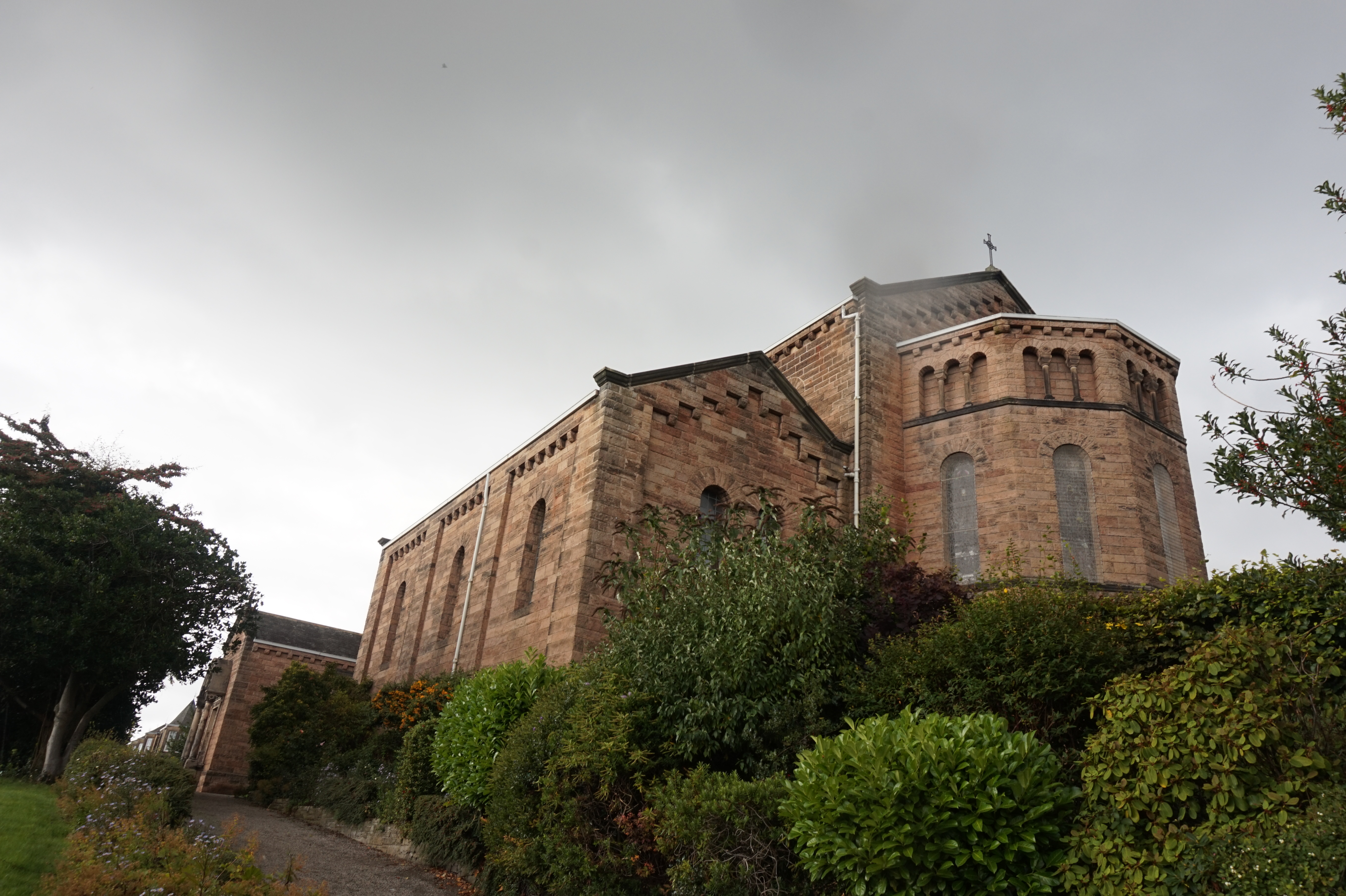


Pink sandstone, a broad nave and low aisles lead to a semi-domed apse in MacGregor Chalmers’s Italian Romanesque church.
Quick facts
- Date
- Built 1911–1913; later halls and rooms
- Architect / designer
- Peter MacGregor Chalmers
- Type
- Italian Romanesque church with apsidal east end and extensive carving
- Designation
- Listed building, Category A (LB27297)
- OS grid reference
- NT 20558 72858
Architecture and continuing use
Pink sandstone, a broad nave front, low aisles and a semi-domed apse create a carefully modelled composition enriched by carving, stained glass and fine fittings.
Its story
The First World War interrupted plans for a tall tower, leaving the church intentionally incomplete in silhouette but rich in craftsmanship.
Carved themes along the nave
Pairs of high windows stand above successive arches, joining daylight to the rhythm of the nave. Columns and square piers carry capitals arranged around Christian themes rather than repeated as purely ornamental carving. At the entrance, four carved supports beneath the vestibule dome represent musical praise through instruments. The sanctuary floor uses a contrasting marble pattern, giving the east end another material emphasis. The side aisles continue towards small chapels, while later halls use similar stone outside. Read the worship space and community additions as related but distinct parts of the complex.
What to notice
- Broad nave front and low flanking aisles.
- Romanesque arches and carved stonework.
- Semi-domed apse, side chapels and later community accommodation.
- Themed nave capitals and musical carvings at the entrance dome.
Reading the surroundings
Attend worship, a public event or arrange a visit; accessibility information is available from the church.
Timeline
- 1911–1913 MacGregor Chalmers’s church was built with its nave, aisles and apsidal east end.
- First World War Work on the intended campanile did not proceed.
- Later work Halls and rooms extended the community accommodation.
- Present Active Church of Scotland parish church and community venue.
What we know — and what remains uncertain
Room access depends on worship and bookings; contact the church before a specialist visit.
Sources & further reading
- Historic Environment Scotland: St Anne’s Parish Church, Corstorphine, LB27297 — Designation status, mapped location, construction phases, fabric, authorship and architectural or historical interest.
- St Anne’s Parish Church: building and room use — Current church use, refurbishment, accessibility and community facilities.
- Scotland’s Churches Trust: St Anne’s — Architectural overview and visitor arrangements.
Location
OS grid reference NT 20558 72858 · Location confidence: High: the statutory designation supplies an official mapped National Grid Reference and the current source confirms the Place relationship or present identity. · Select the marker to open its satellite view in Google Maps. On desktop, drag Pegman (the yellow figure) onto a blue road. On mobile, turn on the Street View layer and tap a blue road. Other photo markers may be user-contributed.
Suggest a marker correction
Suggest a more accurate position
The teal marker is the current published position. The orange marker starts slightly to its right so both remain visible; this is only a visual starting position. Tap the correct place on the map or drag the orange marker. Sending this form creates a private review entry only; it does not move the published marker.
Check this area in Google Maps Choose the Satellite layer there if useful.
Map: © OpenStreetMap contributors. You can also enter checked coordinates below.