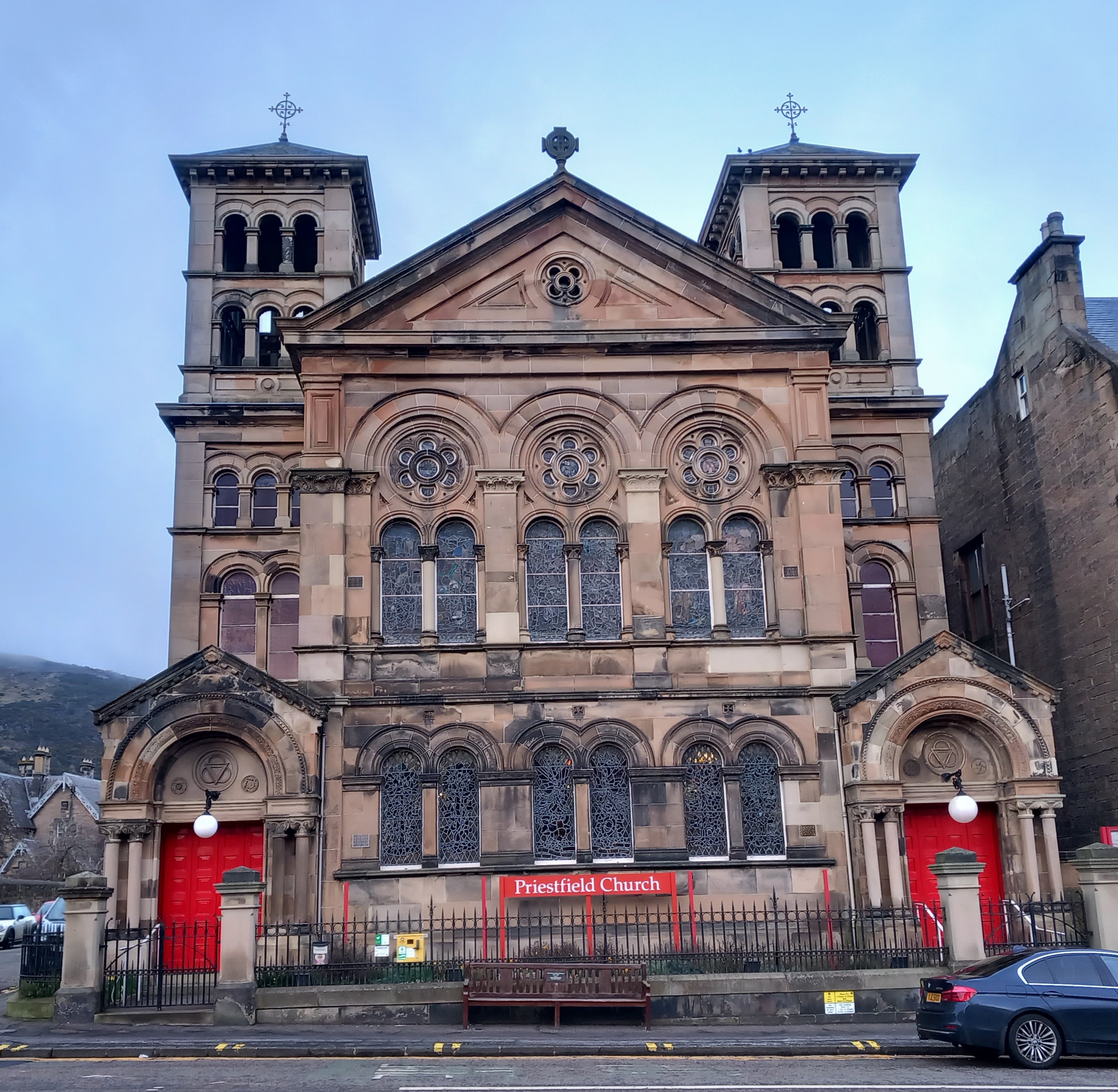
Twin towers and a broad rose window give this Lombardic church exceptional presence, while congregational union has changed how the building is used.
Quick facts
- Date
- 1877–1879
- Architect / designer
- Sutherland and Walker; stained glass by Alexander Strachan, Douglas Hamilton and Mary Wood
- Type
- Lombardic Romanesque church with halls, twin towers and memorial glass
- Designation
- Listed building, Category A (LB30267)
- OS grid reference
- NT 27028 72107
Architecture and continuing use
Cream polished ashlar faces the principal elevations of a Latin-cross church. Arcaded pilasters, carved waterleaf capitals, paired towers and plate-traceried rose windows enrich the street front; halls and vestry spaces extend behind.
Its story
Built as Rosehall United Presbyterian Church after a limited competition, the building later became Priestfield Parish Church. In 2025 three congregations formed Newington Trinity, retaining Priestfield as one of the new parish’s buildings.
A Romanesque vocabulary carried indoors
The Lombardic detail continues beyond the twin-towered front. HES records blind arcading across the timber gallery fronts, a centrally placed pulpit with Romanesque carving and radial seating directed towards the east end. Carved waterleaf capitals link the interior to the exterior stonework. The fittings also reveal several dates: the pulpit belongs to the original church, John Rhind’s font is dated 1881, and the stained-glass scheme was presented in 1921 as a war memorial.
What to notice
- Paired square towers flanking the west front.
- Large plate-traceried rose windows.
- First World War memorial glass presented by Sir John Cowan.
- Gallery-front arcading and carved pulpit echoing the Romanesque detail outside.
Reading the surroundings
The building remains connected with an active congregation, but service locations and activities may change. Check Newington Trinity information and do not assume unrestricted interior access.
Timeline
- 1877–1879 Sutherland and Walker built the church in a Lombardic Romanesque design.
- 1921 Sir John Cowan presented memorial stained glass for his son and other war dead.
- 1 January 2025 Priestfield joined two neighbouring congregations to form Newington Trinity.
- 2026 The united congregation continues to publish Priestfield building contact information.
What we know — and what remains uncertain
The united parish’s worship pattern is evolving; check its current programme for services at Priestfield.
Sources & further reading
- Historic Environment Scotland: Priestfield Church, LB30267 — Designation category, mapped location, construction phases, fabric, authorship and architectural or historical interest.
- Priestfield Church and Newington Trinity — Current congregational union, building address and continuing church connection.
Location
OS grid reference NT 27028 72107 · Location confidence: High: the HES designation provides an official mapped National Grid Reference and the current source confirms the Place relationship or present identity. · Select the marker to open its satellite view in Google Maps. On desktop, drag Pegman (the yellow figure) onto a blue road. On mobile, turn on the Street View layer and tap a blue road. Other photo markers may be user-contributed.
Suggest a marker correction
Suggest a more accurate position
The teal marker is the current published position. The orange marker starts slightly to its right so both remain visible; this is only a visual starting position. Tap the correct place on the map or drag the orange marker. Sending this form creates a private review entry only; it does not move the published marker.
Check this area in Google Maps Choose the Satellite layer there if useful.
Map: © OpenStreetMap contributors. You can also enter checked coordinates below.