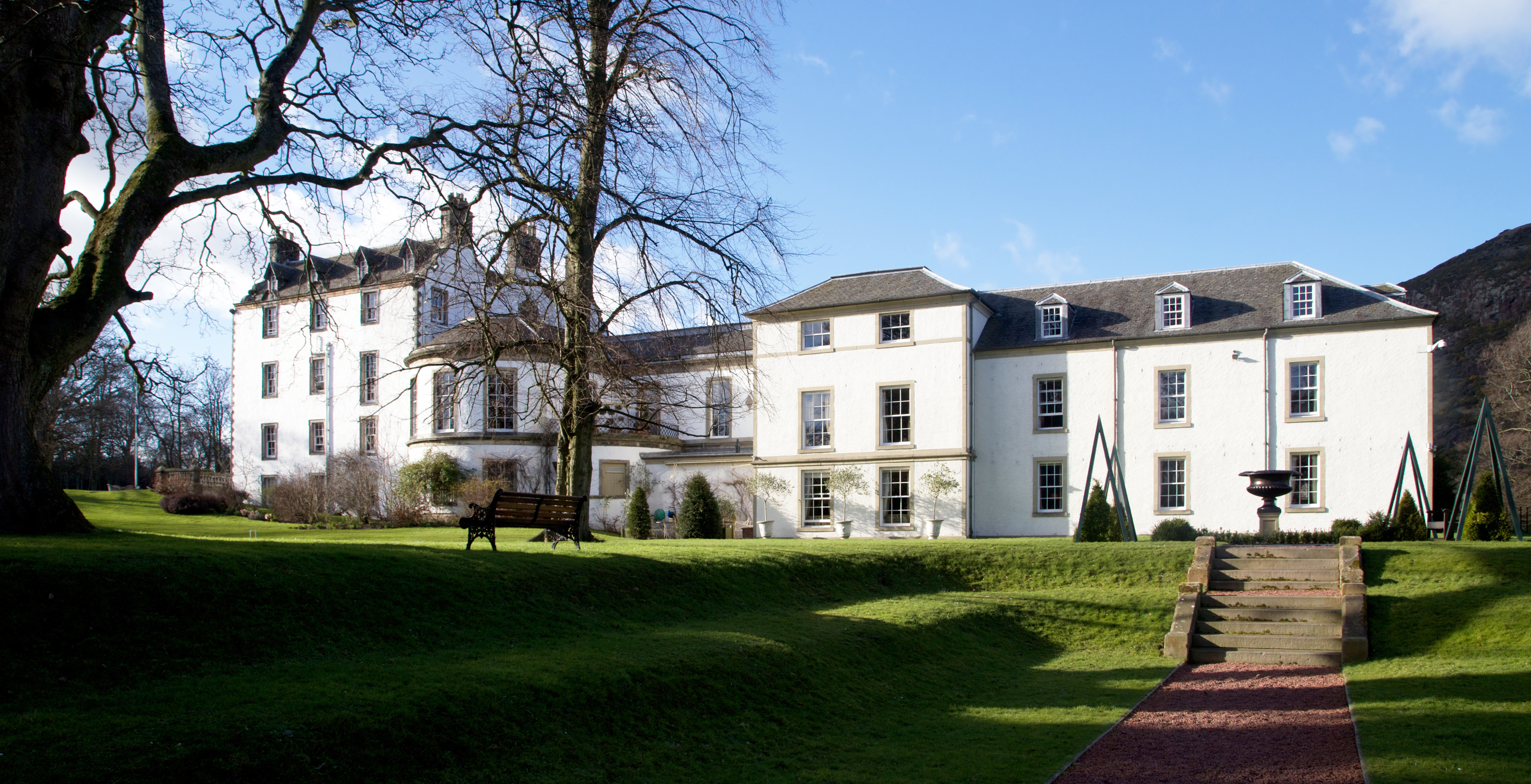
Image: Prestonfield House, Edinburgh by Tom Parnell, 21 February 2015, sourced from Wikimedia Commons and licensed under CC BY-SA 4.0.

One of Edinburgh’s most theatrical seventeenth-century houses remains in active hospitality use amid gardens at the foot of Arthur’s Seat.
Quick facts
- Date
- Built in 1687; enlarged in the nineteenth century; hotel use since 1958
- Architect / designer
- Possibly Sir William Bruce; later work includes James Gillespie Graham and MacGibbon and Ross
- Type
- Dutch-Classical mansion with curvilinear gables, historic interiors and designed grounds
- Designation
- Listed building, Category A (LB28107)
- OS grid reference
- NT 27804 72105
Architecture and continuing use
Harled walls, sandstone dressings and curvilinear gables frame a near-symmetrical mansion. The interior preserves marble floors, plasterwork, painted panelling and leather hangings, while terraces and garden features extend the composition outdoors.
Its story
The house replaced an earlier Priestfield residence destroyed during anti-Catholic unrest. It may have been designed by Sir William Bruce for Sir James Dick and was later altered before opening as a hotel in 1958.
Why it is included
It combines major Restoration-period architecture, exceptionally rich interiors, long family ownership and a viable modern use that visitors can experience.
A changed stair and layered decorative rooms
The original grand stair was removed in the early nineteenth century, leaving its western landing as a balcony while a secondary northern stair took over access above. The Dutch black-and-white marble floors survived this change. Elsewhere, painted timber panelling and elaborate fireplaces preserve another scale of craftsmanship, while later bowed dining rooms flank an oval-domed vestibule. These details show that the rich interior is a sequence of alterations, not a single intact 1687 arrangement. The designation’s historic room names do not necessarily describe present hotel uses, and guest accommodation remains private.
What to notice
- Curvilinear gables and buckle quoins.
- The early-nineteenth-century porte-cochère.
- Surviving decorative interiors linked to late-seventeenth-century craftsmen.
- Where hospitality access permits, compare surviving marble and panelling with the later stair arrangement and bowed-room additions.
Reading the surroundings
The house and grounds operate as a hotel, restaurant and events venue. Public hospitality areas depend on booking and current arrangements; guest and service spaces remain private.
Timeline
- Built in 1687 The house replaced an earlier Priestfield residence destroyed during anti-Catholic unrest.
- Present Five-star hotel, restaurant and events venue.
What we know — and what remains uncertain
HES expresses the attribution of the 1687 design to Sir William Bruce as possible. It should not be treated as a securely documented commission.
Sources & further reading
- Historic Environment Scotland: Prestonfield House, LB28107 — Designation category, mapped location, construction phases, fabric, authorship and architectural interest.
- Prestonfield House: history — Official account of ownership, rebuilding, interiors, hotel conversion and current hospitality use.
Location
OS grid reference NT 27804 72105 · Location confidence: High: the statutory designation supplies a mapped National Grid Reference and a current official operator, responsible public body or institutional source confirms the Place relationship and present identity. · Select the marker to open its satellite view in Google Maps. On desktop, drag Pegman (the yellow figure) onto a blue road. On mobile, turn on the Street View layer and tap a blue road. Other photo markers may be user-contributed.
Suggest a marker correction
Suggest a more accurate position
The teal marker is the current published position. The orange marker starts slightly to its right so both remain visible; this is only a visual starting position. Tap the correct place on the map or drag the orange marker. Sending this form creates a private review entry only; it does not move the published marker.
Check this area in Google Maps Choose the Satellite layer there if useful.
Map: © OpenStreetMap contributors. You can also enter checked coordinates below.