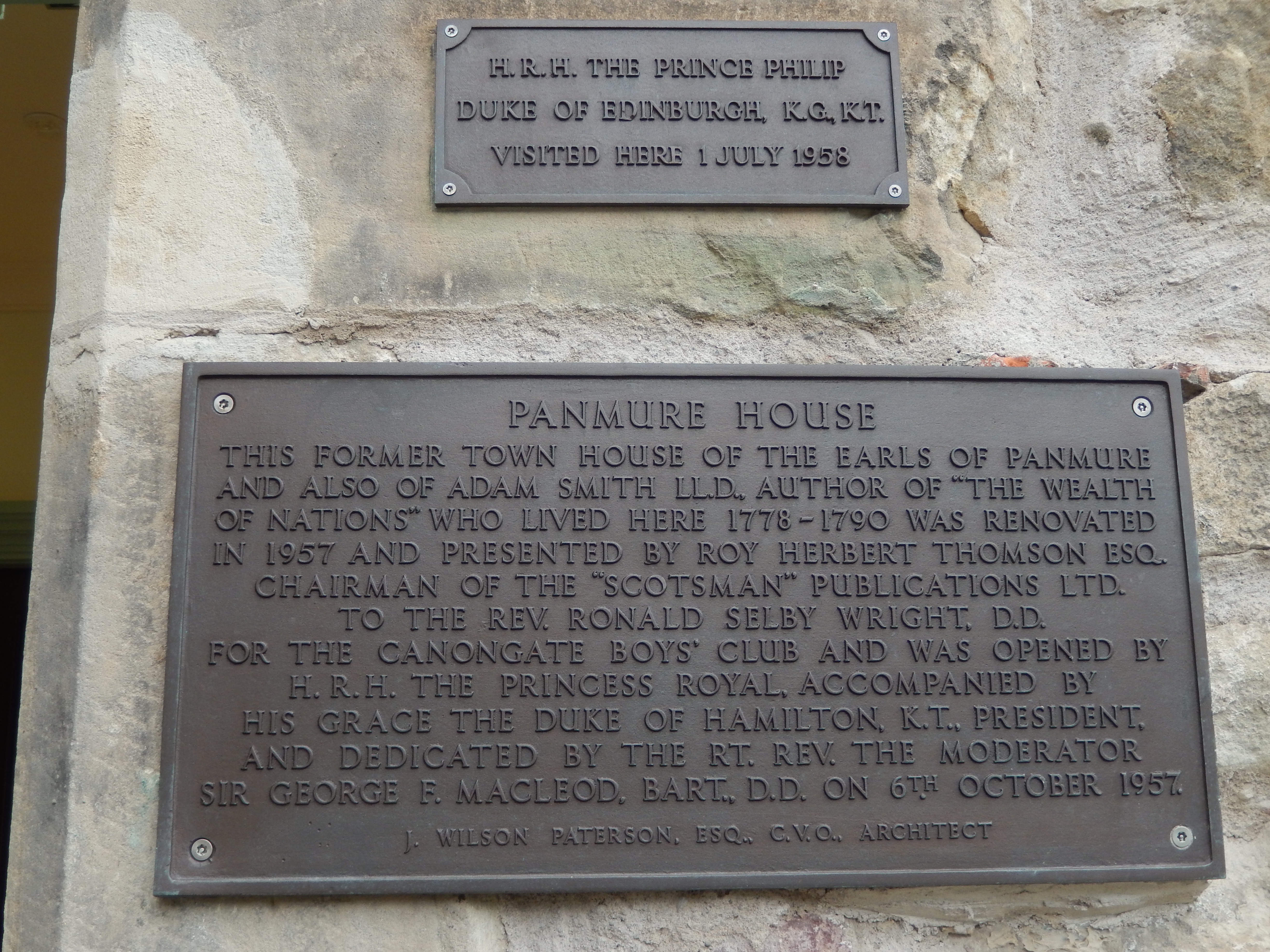


Set behind the Canongate, this crowstepped town house is closely associated with Adam Smith and now hosts debate in his name.
Quick facts
- Date
- Built about 1690; renovated 1956–1957; restored for present use in the twenty-first century
- Architect / designer
- Original designer not identified; 1950s work by J. Wilson Paterson
- Type
- L-plan crowstepped seventeenth-century town house
- Designation
- Listed building, Category A (LB28431)
- OS grid reference
- NT 26510 73872
Architecture and continuing use
A two-storey rubble L-plan gathers around a raised courtyard and fore-stair. Regular windows, crowsteps and restrained stone dressings give the rear-land house quiet authority.
Its story
Built about 1690 for the Earls of Panmure, the house became Adam Smith’s home from 1778 until 1790. Later renovation and extensive restoration adapted it for academic and public events.
Why it is included
Its domestic form, Canongate setting and association with Smith connect Edinburgh’s architecture to Enlightenment intellectual history.
What the restored rooms represent
The present rooms are a considered reconstruction of late eighteenth-century interiors, rather than an intact setting left by Adam Smith. Panmure House’s own restoration account describes tulipwood panelling, new stone fireplaces, oak floors and lime plaster, with modern structure and services concealed behind the finishes. A new stone stair links the spaces, while the excavated basement accommodates an interpretation suite. Original roof timbers survive separately in the attic, marked with Roman numerals. The distinction between surviving fabric and new work is central to understanding the restoration.
What to notice
- The raised courtyard and fore-stair at the re-entrant angle.
- Crowstepped gables and regular west elevation.
- Its secluded position behind the Canongate street frontage.
Reading the surroundings
Access is normally through advertised events or arrangements rather than continuous visitor opening. Lochend Close is narrow and stepped; check the official programme.
Timeline
- Built about 1690 Built about 1690 for the Earls of Panmure, the house became Adam Smith’s home from 1778 until 1790.
- Present Heriot-Watt University and Edinburgh Business School centre for research, debate and events.
What we know — and what remains uncertain
The 1950s work extensively reconstructed the interior, so the intact historic exterior and Smith association should not be confused with wholly surviving seventeenth-century rooms.
Sources & further reading
- Panmure House: history and renovation — Reconstructed interiors, new finishes and stair, interpretation suite and surviving roof timbers.
- Historic Environment Scotland: Panmure House, LB28431 — Designation category, exact grid reference, construction phases, fabric, authorship and significance.
- Panmure House — Current Edinburgh Business School ownership, research and event mission, address and programme.
Location
OS grid reference NT 26510 73872 · Location confidence: High: the statutory designation supplies an exact National Grid Reference and the current official, operator or responsible-organisation source confirms the Place relationship. · Select the marker to open its satellite view in Google Maps. On desktop, drag Pegman (the yellow figure) onto a blue road. On mobile, turn on the Street View layer and tap a blue road. Other photo markers may be user-contributed.
Suggest a marker correction
Suggest a more accurate position
The teal marker is the current published position. The orange marker starts slightly to its right so both remain visible; this is only a visual starting position. Tap the correct place on the map or drag the orange marker. Sending this form creates a private review entry only; it does not move the published marker.
Check this area in Google Maps Choose the Satellite layer there if useful.
Map: © OpenStreetMap contributors. You can also enter checked coordinates below.