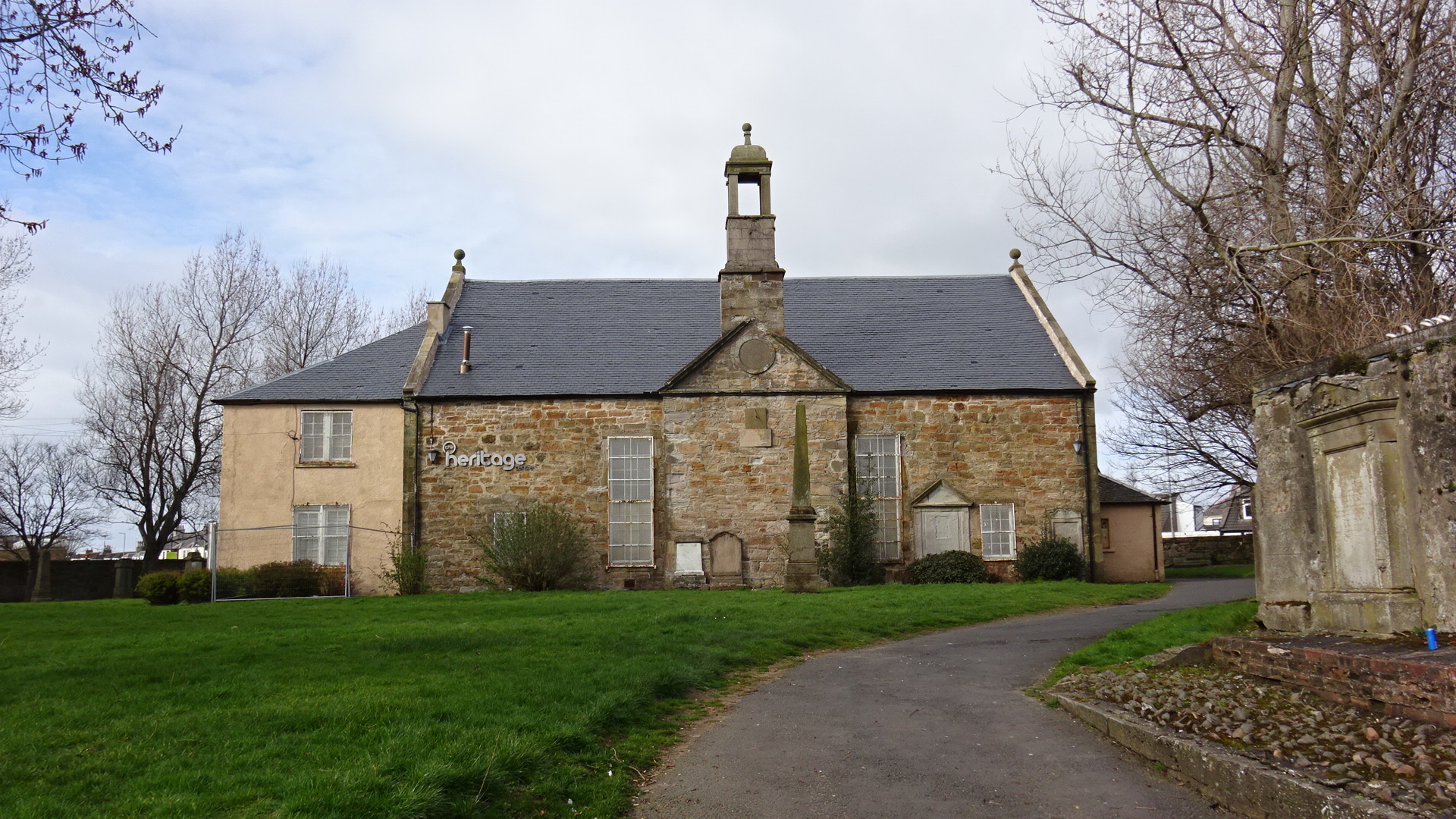


Ardrossan’s eighteenth-century parish church in Saltcoats now houses North Ayrshire’s artefact and art collections and a reading library.
Quick facts
- Date
- Built 1744; rebuilt after storm damage in 1774
- Architect / designer
- Builders unknown
- Type
- Eighteenth-century parish church adapted as a museum
- Designation
- Listed building, Category B (LB40487)
- OS grid reference
- NS 24530 41400
Architecture and history
A rectangular rubble church is marked by a pedimented west projection and belfry. Its simple meeting-house form remains legible within the old graveyard despite adaptation for exhibition and research use.
From parish church to museum
The museum houses most of North Ayrshire’s artefact and art collections, alongside a small reading library. Its work includes identifying objects and helping with Treasure Trove finds, as well as mounting exhibitions. The former church therefore accommodates both public displays and the investigation of material brought in from the surrounding area.
History
Built in 1744 as the third parish church for Ardrossan, the building was damaged by storm and rebuilt in 1774. Worship resumed by 1776 and continued until 1908. Museum use began in 1957.
What to notice
- The pedimented west projection.
- The small belfry above the former church entrance.
- The relationship between museum building and old graveyard.
Location and Photos
The Heritage Centre is on Manse Street, Saltcoats. Admission is free. The museum’s visitor information states that its public accommodation is on one level, with a small incline at the entrance; the linked museum page gives opening days.
Timeline
- 1744 A third Ardrossan parish church was built at Saltcoats.
- 1774 Storm damage prompted rebuilding of the church.
- 1908 Regular congregational use of the building ended.
- 1957 The former church began its museum role.
Sources & further reading
- Historic Environment Scotland: North Ayrshire Heritage Centre, LB40487 — Church chronology, rubble construction, west projection and belfry; museum use from 1957.
- North Ayrshire Heritage Centre — Museum collections, reading library, object identification and Treasure Trove support; current admission and step-free public accommodation.
- North Ayrshire Heritage: Saltcoats — Local-authority historical context for the church and town.
- Trove search: Old Ardrossan Parish Church Saltcoats museum — National collection search for site records, surveys and archive material.
- Ardrossan Parish Church: St Cuthbert’s history — Earlier parish buildings and reuse of their materials.
Location
OS grid reference NS 24530 41400 · Location confidence: High for the current national designation point; public text separately states access, component-identity and current-use uncertainty. · Select the marker to open its satellite view in Google Maps. On desktop, drag Pegman (the yellow figure) onto a blue road. On mobile, turn on the Street View layer and tap a blue road. Other photo markers may be user-contributed.
Suggest a marker correction
Suggest a more accurate position
The teal marker is the current published position. The orange marker starts slightly to its right so both remain visible; this is only a visual starting position. Tap the correct place on the map or drag the orange marker. Sending this form creates a private review entry only; it does not move the published marker.
Check this area in Google Maps Choose the Satellite layer there if useful.
Map: © OpenStreetMap contributors. You can also enter checked coordinates below.