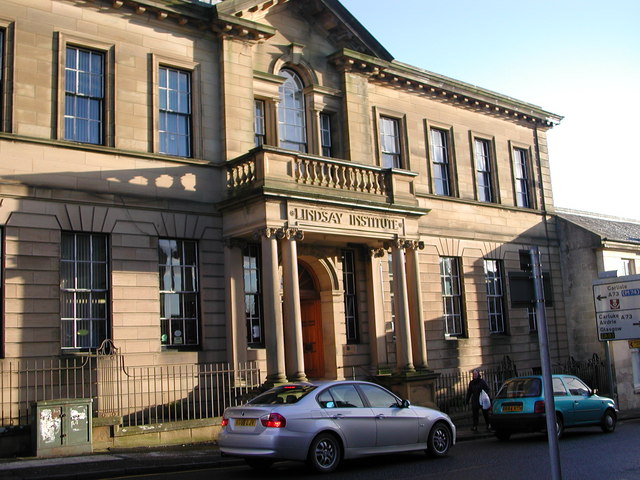


A refined Neo-Georgian institute continues its public educational purpose as Lanark Library.
Quick facts
- Date
- 1912
- Architect / designer
- Traill and Stewart
- Type
- Neo-Georgian library and institute
- Designation
- Listed building, Category B (LB37013)
- OS grid reference
- NS 88057 43753
Architecture and continuing use
A symmetrical stone front, classical doorway and well-proportioned sash windows give the compact building a scholarly civic character. Its domestic scale helps it mediate between houses and larger public buildings on Hope Street.
Its story
The Lindsay Institute belongs to an era when endowed libraries and institutes widened access to reading and learning. Continued library use preserves that civic purpose while services and internal layouts evolve.
Why it is included
Architectural quality, educational history and a direct continuity of public benefit support Category B inclusion.
What to notice
- The carefully proportioned Hope Street front.
- The classical entrance and restrained ornament.
- Its scale beside the larger court buildings.
Reading the surroundings
South Lanarkshire Leisure and Culture publishes library opening times and services. Some activities, local studies or computer use may require booking.
Timeline
- 1912 Traill and Stewart completed the Lindsay Institute.
- 1971 Statutory listing recognised the architectural interest of the building.
- 2022 The official list address was updated to reflect current place information.
What we know — and what remains uncertain
The date when particular internal rooms changed function is not established here; current public-library use is independently confirmed.
Sources & further reading
- Historic Environment Scotland: Lindsay Institute and Lanark Library, LB37013 — Designation status, mapped location, date, fabric, authorship and architectural or historical interest.
- South Lanarkshire Leisure and Culture: Lanark Library — Current address, opening hours, library services and continuing public use.
Location
OS grid reference NS 88057 43753 · Location confidence: High: the statutory designation supplies an official mapped National Grid Reference and the current source confirms the Lanark relationship or present identity. · Select the marker to open its satellite view in Google Maps. On desktop, drag Pegman (the yellow figure) onto a blue road. On mobile, turn on the Street View layer and tap a blue road. Other photo markers may be user-contributed.
Suggest a marker correction
Suggest a more accurate position
The teal marker is the current published position. The orange marker starts slightly to its right so both remain visible; this is only a visual starting position. Tap the correct place on the map or drag the orange marker. Sending this form creates a private review entry only; it does not move the published marker.
Check this area in Google Maps Choose the Satellite layer there if useful.
Map: © OpenStreetMap contributors. You can also enter checked coordinates below.