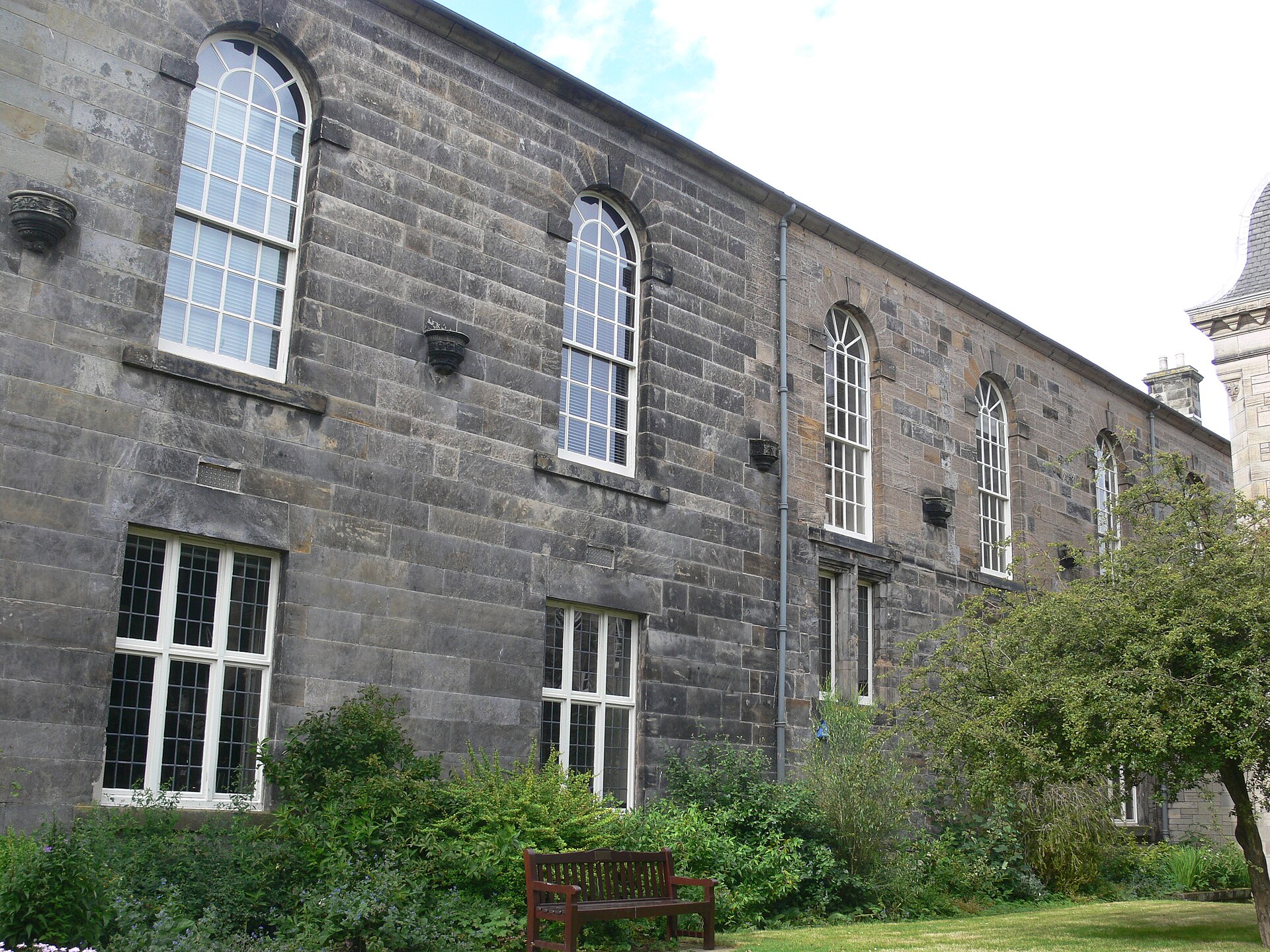
Image: King James Library from St Mary’s Quadrangle by Remi Mathis, 30 June 2012, sourced from Wikimedia Commons and licensed under CC BY-SA 3.0.

The University of St Andrews’ seventeenth-century common library survives as a working study space and ceremonial interior, carrying four centuries of scholarship within St Mary’s College.
Quick facts
- Date
- Begun after the royal foundation of 1612; opened as a library in 1642; reconstructed 1764–1767; west extension 1828–1830; later alterations in the 1890s and 1904
- Architect / designer
- John Gardner, wright; west extension by Robert Reid; Senate Room remodelling by Sir Robert Rowand Anderson
- Type
- University library, teaching and ceremonial building
- Designation
- Category A listed building (LB40687)
- OS grid reference
- NO 51021 16588
A royal foundation in a working college
King James VI and I established a common library for the University in 1612, supported by gifts from the royal family, the Archbishop of Canterbury and the royal librarian. Financial and building delays meant that the South Street library did not open until 1642. The historic complex remains in academic use.
The building now forms part of St Mary’s Quadrangle and contains the King James Library, St Mary’s College Library and Parliament Hall. Historic Environment Scotland lists the original library building at Category A, recognising both its early university history and its sequence of distinguished alterations.
Architecture and interiors
The two-storey ashlar front is ordered by pedimented end bays and niches at first-floor level. Ground-floor windows inserted in the 1890s show that the exterior continued to adapt as library use changed. On the south wall, sixteenth-century carved stones from St Mary’s Chapel add an earlier layer of collegiate history.
Upstairs, the galleried Upper Hall is the defining interior. Fluted pine columns in a Roman Doric manner support the gallery, while a coved ceiling gives the room height and composure. John Gardner’s reconstruction of 1764–1767 established much of the form seen today. Robert Reid extended the building west in a deliberately matching style in 1828–1830, and Sir Robert Rowand Anderson remodelled the Senate Room in 1904.
Books, teaching and ceremony
The Upper Hall was allocated to the mathematician and astronomer James Gregory between 1668 and 1674. The Copyright Act of 1709 entitled the University to claim copies of books registered at Stationers’ Hall, helping to explain the strength of its eighteenth-century printed collections. In 1783 the University’s college libraries were formally integrated into the common library.
Further library extensions followed in 1889–1890 and 1907–1908. Growth eventually required a new main library on North Street, opened in 1976, but the King James Library retained academic and ceremonial functions.
Why it matters
The building links royal patronage, the development of a shared university collection and the practical evolution of library architecture. Its significance lies in the combination of early seventeenth-century purpose, Georgian remodelling, nineteenth-century expansion and continued use by the institution for which it was built.
What to notice
- The pedimented end bays and first-floor niches that organise the South Street elevation.
- The contrast between the restrained ashlar exterior and the warm timber gallery of the Upper Hall.
- The reused sixteenth-century carved stones from St Mary’s Chapel.
- The way Robert Reid’s west extension continues the earlier architectural language rather than advertising itself as a separate building.
Visiting and access
This is a working University library, with access centred on University use and advertised public events. The University’s current information states that St Mary’s and King James libraries are available to University staff and students; published opening hours describe those library services. The King James study space is reached only by stairs, while the ground floor of St Mary’s Library has step-free access.
St Mary’s Quadrangle and the exterior can be appreciated from public routes. Public events sometimes use the King James Library; availability is governed by the University’s live programme. Anyone hoping to enter for a specific event should check the University’s current listing and booking conditions.
Timeline
- 1612 King James VI and I founded the University’s common library through royal gifts and support.
- 1642 The South Street building opened as a library.
- 1668–1674 James Gregory used the Upper Hall as his workplace.
- 1764–1767 John Gardner reconstructed the building; Samuel Johnson visited soon afterwards in 1773.
- 1783 The college libraries were formally integrated into the common library.
- 1828–1830 Robert Reid extended the building west.
- 1890s Ground-floor windows were inserted as the working library evolved.
- 1904 Sir Robert Rowand Anderson remodelled the Senate Room.
- 1976 A new main University Library opened on North Street; the historic library retained specialist, study and ceremonial roles.
What we know — and what remains uncertain
The statutory entry gives a precise architectural sequence for the listed original building, but the names “King James Library”, “St Mary’s College Library” and “Parliament Hall” refer to distinct spaces within a complex that has changed over time. Current access is institutional and event-dependent; no general interior heritage opening should be inferred.
Sources & further reading
- Historic Environment Scotland: University Library Original Building, LB40687 — Category, location, construction phases, exterior and interior fabric, and named designers.
- University of St Andrews Library: history — Royal foundation, 1642 opening, collection growth, later extensions and continuing institutional history.
- University of St Andrews Library: St Mary’s and King James Library — Current users, facilities, access limitations and published opening hours.
- University of St Andrews Events: King James Library — Current venue identity and advertised public-event position.
Location
OS grid reference NO 51021 16588 · Location confidence: High: the statutory designation supplies a mapped National Grid Reference and a current official operator, responsible public body or institutional source confirms the Place relationship and present identity. · Select the marker to open its satellite view in Google Maps. On desktop, drag Pegman (the yellow figure) onto a blue road. On mobile, turn on the Street View layer and tap a blue road. Other photo markers may be user-contributed.
Suggest a marker correction
Suggest a more accurate position
The teal marker is the current published position. The orange marker starts slightly to its right so both remain visible; this is only a visual starting position. Tap the correct place on the map or drag the orange marker. Sending this form creates a private review entry only; it does not move the published marker.
Check this area in Google Maps Choose the Satellite layer there if useful.
Map: © OpenStreetMap contributors. You can also enter checked coordinates below.