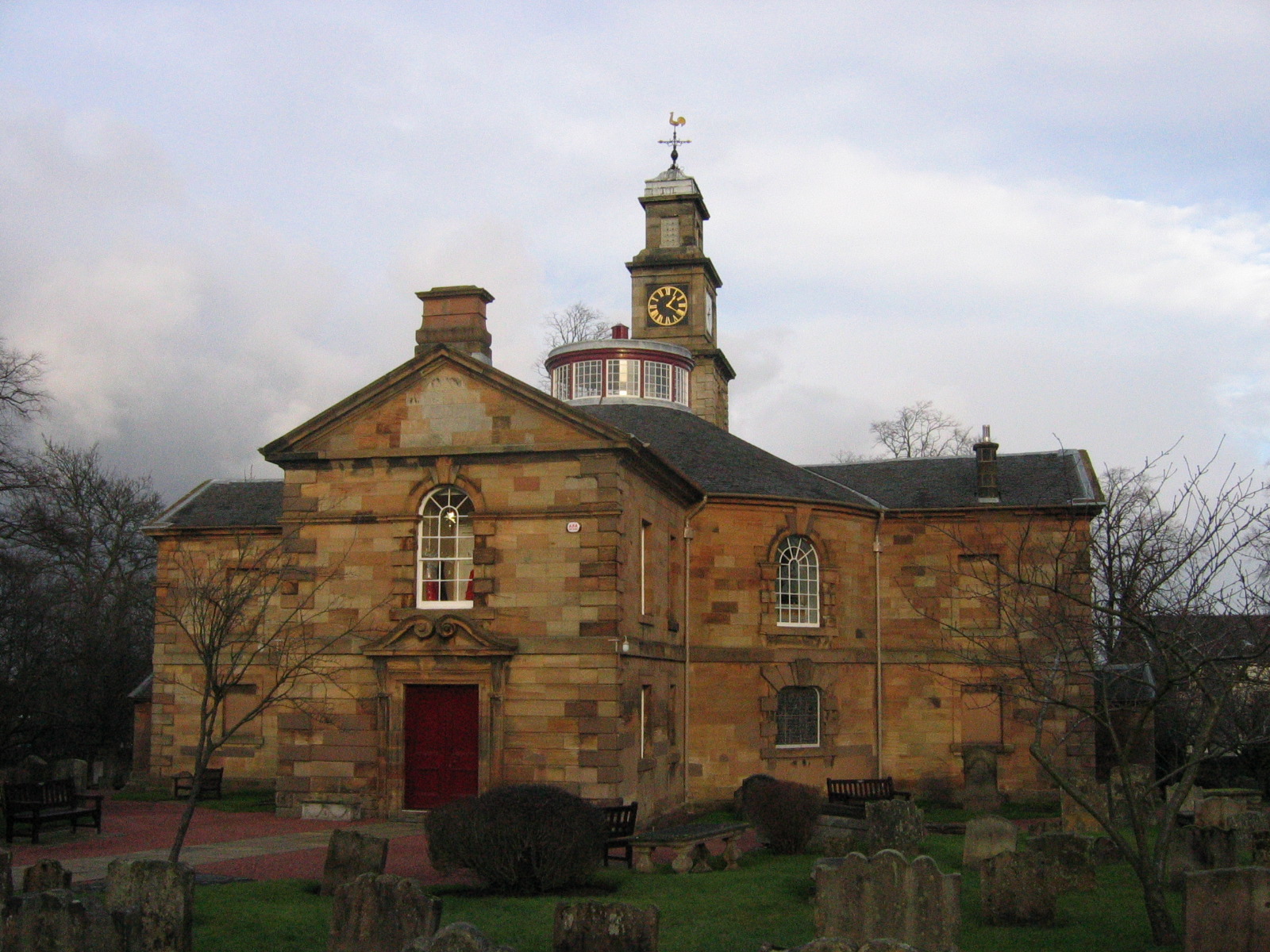
William Adam’s only church uses a compact classical plan and controlled symmetry, remaining the oldest Hamilton building still serving its original purpose.
Quick facts
- Date
- 1732–1734; cupola added 1841; interior recast 1926
- Architect / designer
- William Adam; later work by Alexander Cullen, Lochhead and Brown
- Type
- Classical parish church
- Designation
- Listed building, Category A (LB34473)
- OS grid reference
- NS 72327 55534
Architecture and continuing use
The church is arranged as a distinctive classical volume with carefully ordered openings, restrained stone detail and a small roof cupola. Galleries and later fittings shape the interior, while the churchyard contains early sculpture and memorials that link it to the settlement before the present building.
Its story
A medieval collegiate church near Hamilton Palace was dismantled as the ducal landscape changed. William Adam designed its replacement in 1732, and worship began in 1734. A cupola was added in 1841 and the interior was recast in 1926. Recent congregational unions have retained this building as a living church.
Why it is included
Category A listing recognises William Adam’s singular ecclesiastical design, strong survival and nearly three centuries of continuous parish use.
What to notice
- The balanced classical elevations rather than conventional Gothic church forms.
- The small cupola added above the eighteenth-century roof.
- Churchyard monuments that connect several phases of Hamilton’s history.
Reading the surroundings
Attend advertised worship or contact the congregation. Respect services, funerals and the active churchyard, and do not assume gallery or ancillary-room access.
Timeline
- 1732 Construction began after removal of the earlier collegiate church.
- 1734 The congregation first worshipped in William Adam’s building.
- 1841 Renovation added the small roof cupola.
- 1926 A major campaign recast parts of the interior.
What we know — and what remains uncertain
The building contains several later phases, and individual fittings should not automatically be attributed to Adam. Current event access changes with parish use.
Sources & further reading
- Historic Environment Scotland: Hamilton Old Parish Church, LB34473 — Current designation status, official mapped location, date, fabric and significance.
- Trove designation: LB34473 — Parallel national designation identity and archival context.
- Hamilton Old Parish Church: official site — First-party current worship, congregation and building-history information.
- National Records of Scotland: Hamilton Old kirk session — Archival context for the parish and successive church buildings.
Location
OS grid reference NS 72327 55534 · Location confidence: High: the current national designation supplies an exact mapped National Grid Reference; public text separately states access and current-use uncertainty. · Select the marker to open its satellite view in Google Maps. On desktop, drag Pegman (the yellow figure) onto a blue road. On mobile, turn on the Street View layer and tap a blue road. Other photo markers may be user-contributed.
Suggest a marker correction
Suggest a more accurate position
The teal marker is the current published position. The orange marker starts slightly to its right so both remain visible; this is only a visual starting position. Tap the correct place on the map or drag the orange marker. Sending this form creates a private review entry only; it does not move the published marker.
Check this area in Google Maps Choose the Satellite layer there if useful.
Map: © OpenStreetMap contributors. You can also enter checked coordinates below.
Hamilton Old Parish Church. Photograph: Supergolden, December 2005. CC BY-SA 2.5.
