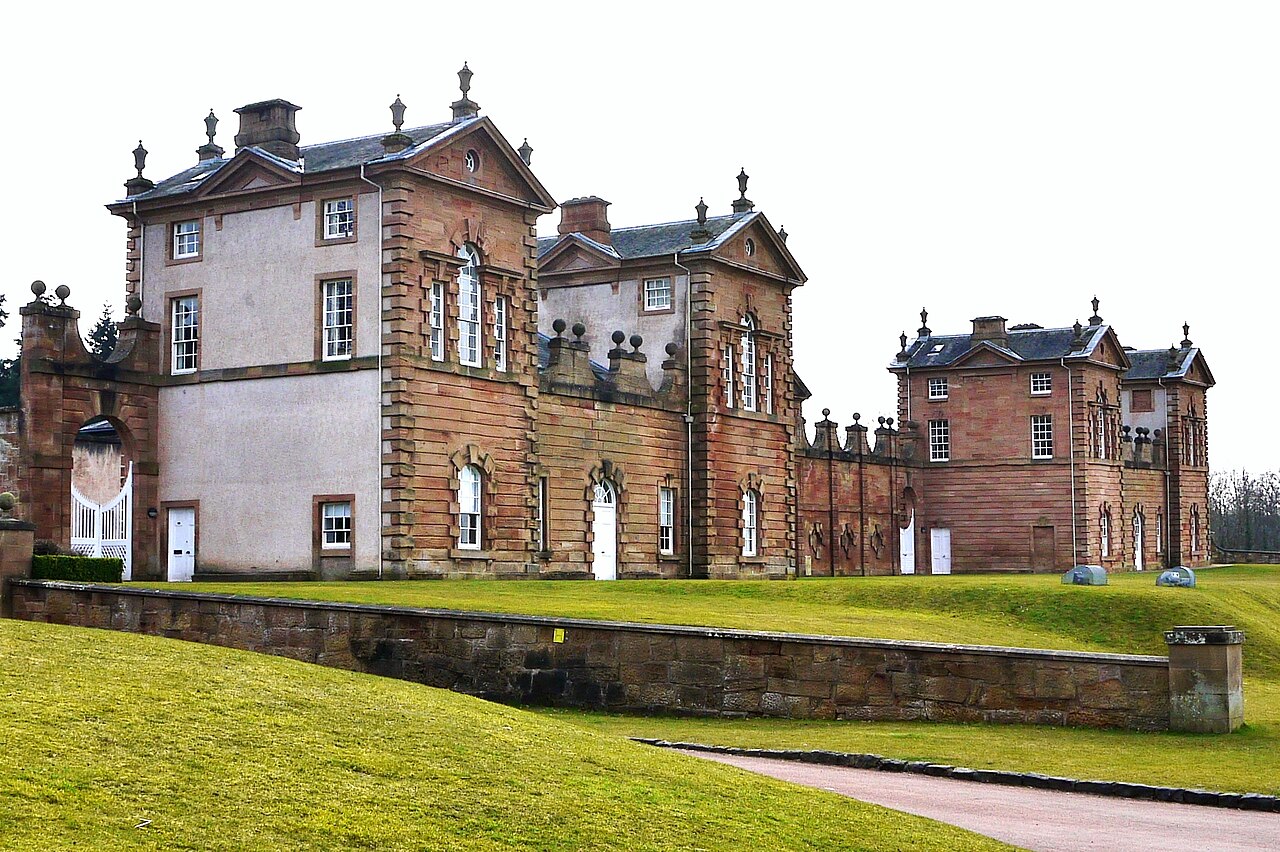
William Adam turned a hunting lodge and dog kennel into a spectacular Baroque eyecatcher, now restored as the architectural centre of Chatelherault Country Park.
Quick facts
- Date
- Designed 1731; built 1732–1743; restored 1978–1987
- Architect / designer
- William Adam; plasterwork associated with Thomas Clayton
- Type
- Baroque hunting lodge, kennel and ornamental landscape buildings
- Designation
- Listed building, Category A (LB12485)
- OS grid reference
- NS 73644 53930
Architecture and continuing use
Four two-storey ranges linked by screen walls create an extraordinarily long symmetrical front. One side held the Duke’s apartment and banqueting room, the other the kennels. Courtyard, ha-ha, mock fortification and leopard house extend architecture into the landscape.
Its story
Adam designed Chatelherault in 1731 to terminate the grand avenue from Hamilton Palace, and building continued from 1732 to 1743. After palace demolition and mining damage, the lodge declined. Public acquisition in 1978 enabled a major restoration, completed before the building and park opened in 1987.
Why it is included
Category A listing recognises a nationally important William Adam design, rare pairing of elite apartment and animal accommodation, and successful restoration within its designed landscape.
What to notice
- The long symmetrical façade designed as an eyecatcher.
- Contrasting ducal apartment and former kennel ranges.
- Courtyard walls, ha-ha and playful mock-fortified details.
Reading the surroundings
Use country-park opening information and visitor-centre guidance. Some rooms, tours and event areas have separate arrangements; paths in the wider gorge can be steep or muddy.
Timeline
- 1731 William Adam prepared the design for the Hamilton hunting lodge.
- 1732–1743 Builders completed the linked ranges and landscape structures.
- 1978 Public acquisition began the modern rescue campaign.
- 1987 The restored lodge and country park opened to visitors.
What we know — and what remains uncertain
Some original interior decoration was lost before restoration. Modern visitor uses do not make every historic room or landscape feature continuously accessible.
Sources & further reading
- Historic Environment Scotland: Chatelherault Hunting Lodge, LB12485 — Current designation status, official mapped location, date, fabric and significance.
- Trove designation: LB12485 — Parallel national designation identity and archival context.
- South Lanarkshire Council: Chatelherault Country Park — First-party current park, visitor-centre and facility information.
- South Lanarkshire Leisure and Culture: Chatelherault tours — First-party current lodge-tour and guided-walk information.
Location
OS grid reference NS 73644 53930 · Location confidence: High: the current national designation supplies an exact mapped National Grid Reference; public text separately states access and current-use uncertainty. · Select the marker to open its satellite view in Google Maps. On desktop, drag Pegman (the yellow figure) onto a blue road. On mobile, turn on the Street View layer and tap a blue road. Other photo markers may be user-contributed.
Suggest a marker correction
Suggest a more accurate position
The teal marker is the current published position. The orange marker starts slightly to its right so both remain visible; this is only a visual starting position. Tap the correct place on the map or drag the orange marker. Sending this form creates a private review entry only; it does not move the published marker.
Check this area in Google Maps Choose the Satellite layer there if useful.
Map: © OpenStreetMap contributors. You can also enter checked coordinates below.
Chatelherault Hunting Lodge. Photograph: Graham Laird, 4 March 2013. CC BY-SA 3.0.
