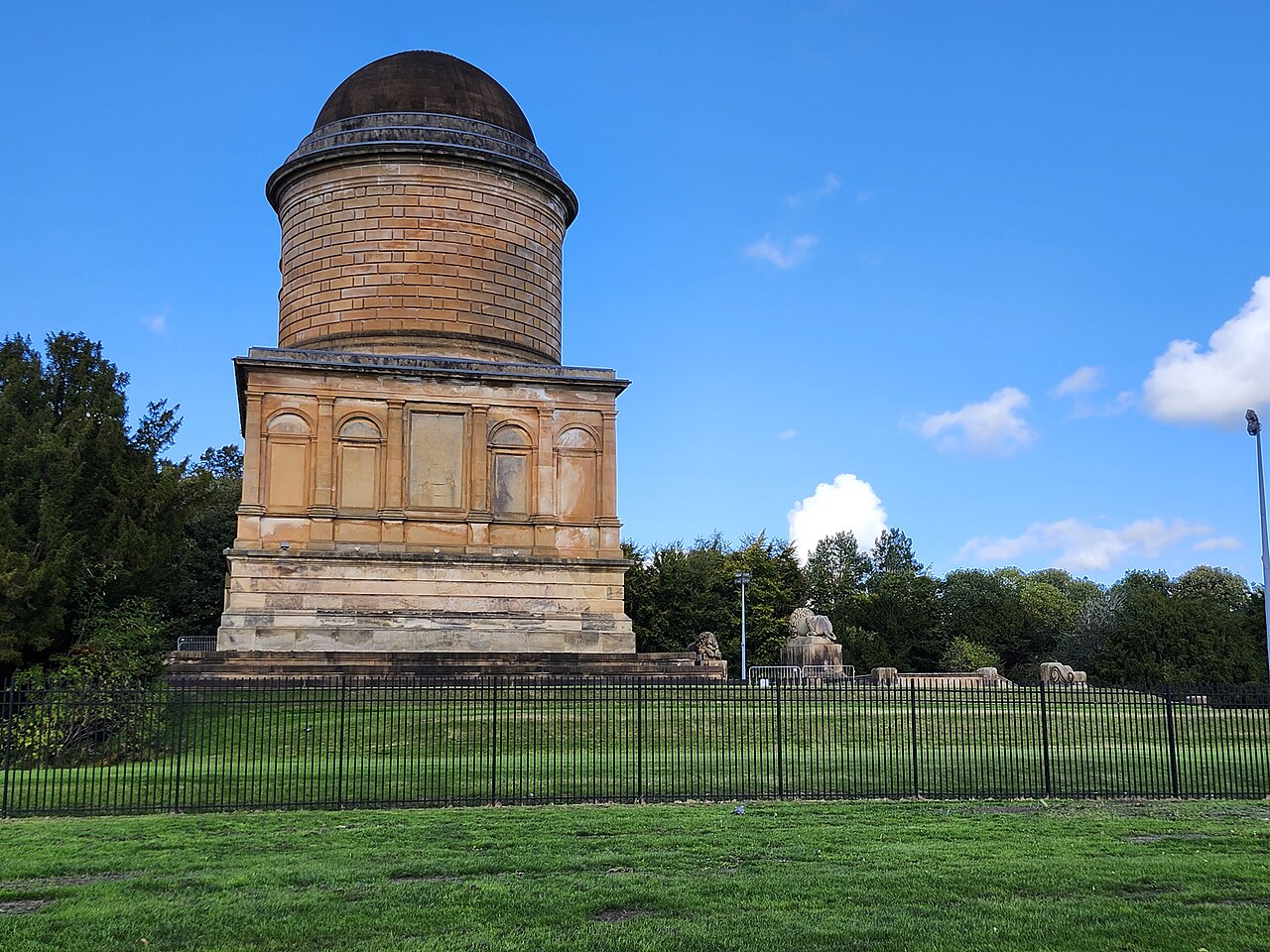
Image: Hamilton Mausoleum by Andrew_the_Aviator, sourced from Wikimedia Commons and licensed under CC BY-SA 4.0.

A 36.5-metre domed mausoleum survives the lost Hamilton Palace, combining bronze doors, coloured marble, a crypt and famously prolonged acoustics.
Quick facts
- Date
- Begun 1840; principal construction 1845–1855
- Architect / designer
- David Hamilton and David Bryce, with strong direction from the 10th Duke of Hamilton
- Type
- Monumental domed mausoleum
- Designation
- Listed building, Category A (LB34518)
- OS grid reference
- NS 72690 56316
Architecture and continuing use
A massive circular drum rises to a stone dome above a richly finished chapel and lower crypt. Bronze doors, international marbles, sculpture and a geometric floor turn funerary architecture into ducal display. The scale was intended to answer the former palace landscape.
Its story
The 10th Duke began planning the mausoleum around 1840. David Hamilton worked on the foundations and crypt from 1845, and David Bryce continued after 1848. The Duke was buried there in 1852, but mining subsidence led to removal and reburial of the family in the 1920s. The empty monument is now interpreted on guided tours.
What to notice
- The huge stone dome rising above the palace grounds.
- Bronze doors derived from Renaissance Florentine models.
- Marble floor and crypt niches seen on an authorised tour.
Reading the surroundings
Interior access is by booked tour and is unsuitable for some mobility needs. Check current conditions with Low Parks Museum; do not attempt entry outside managed arrangements.
Timeline
- 1845 David Hamilton began the foundations and crypt.
- 1848 David Bryce took over the evolving design.
- 1852 The 10th Duke was placed in the completed funerary setting.
- 1920s Mining risk prompted removal and reburial of the Hamilton family.
What we know — and what remains uncertain
Several architects and the Duke shaped the final design, so authorship is shared rather than singular. Tours depend on conditions and advance booking.
Sources & further reading
- Historic Environment Scotland: Hamilton Mausoleum, LB34518 — Current designation status, official mapped location, date, fabric and significance.
- Trove designation: LB34518 — Parallel national designation identity and archival context.
- South Lanarkshire Leisure and Culture: Hamilton Mausoleum — First-party current visitor, history and management information.
- South Lanarkshire Leisure and Culture: Mausoleum tours — First-party booking, access and tour information.
Location
OS grid reference NS 72690 56316 · Location confidence: High: the current national designation supplies an exact mapped National Grid Reference; public text separately states access and current-use uncertainty. · Select the marker to open its satellite view in Google Maps. On desktop, drag Pegman (the yellow figure) onto a blue road. On mobile, turn on the Street View layer and tap a blue road. Other photo markers may be user-contributed.
Suggest a marker correction
Suggest a more accurate position
The teal marker is the current published position. The orange marker starts slightly to its right so both remain visible; this is only a visual starting position. Tap the correct place on the map or drag the orange marker. Sending this form creates a private review entry only; it does not move the published marker.
Check this area in Google Maps Choose the Satellite layer there if useful.
Map: © OpenStreetMap contributors. You can also enter checked coordinates below.