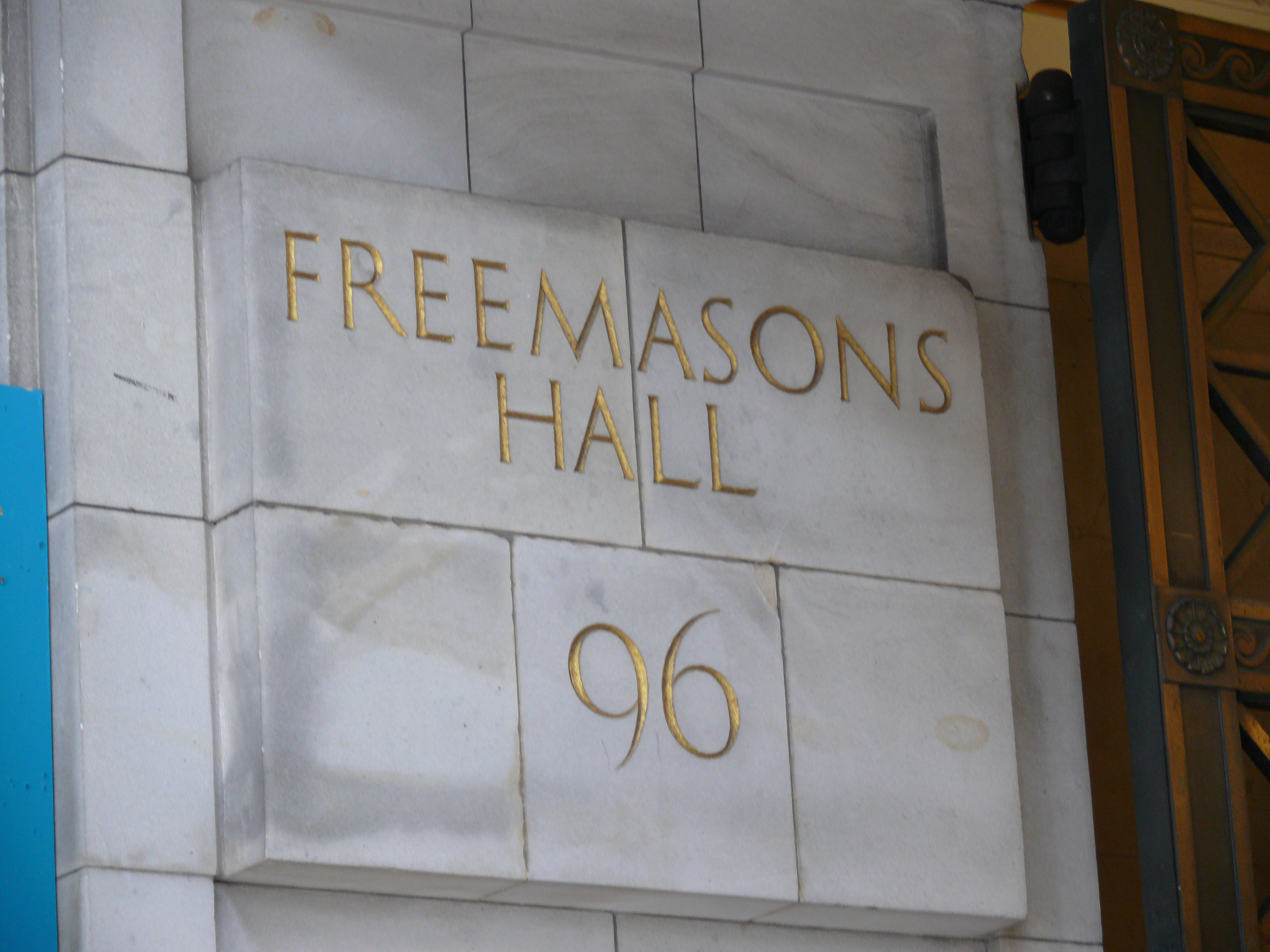
Image: Freemasons’ Hall, Edinburgh by Ad Meskens, 16 August 2010, sourced from Wikimedia Commons and licensed under CC BY-SA 3.0.

A monumental classical front announces the national headquarters of Scottish Freemasonry on George Street.
Quick facts
- Date
- Built 1910–1912
- Architect / designer
- A. Hunter Crawford; sculpture by John Thomas
- Type
- Monumental classical Masonic hall
- Designation
- Listed building, Category A (LB30024)
- OS grid reference
- NT 25010 73903
Architecture and continuing use
Silvery polished sandstone, a rusticated base, coupled Roman Doric entrance columns and giant upper pilasters give the six-bay elevation exceptional gravity.
Its story
A. Hunter Crawford designed the present hall in 1910–1912 to replace an earlier building by David Bryce. It remains the Grand Lodge’s headquarters.
From marble vestibule to temple
The entrance sequence develops the formality of the street front indoors. HES records grey Echaillon marble lining the vestibule, black marble columns and a staircase articulated by successive classical orders. Beyond lies a five-bay temple with lower aisles, original hanging wreath-shaped lights and specialist woodwork by Scott Morton. The latter includes the oak case for the 1913 Brindley and Foster organ. Materials, lighting and joinery give the ceremonial interior a coordinated design.
What to notice
- Coupled Doric entrance columns.
- Latticed bronze doors.
- Giant pilasters and carved upper-floor panels.
Reading the surroundings
This is an institutional headquarters. General access to halls and collections depends on current Grand Lodge arrangements and prior enquiry.
Timeline
- Built 1910–1912 A. Hunter Crawford designed the present hall in 1910–1912 to replace an earlier building by David Bryce. It remains the Grand Lodge’s headquarters.
- Present Headquarters of the Grand Lodge of Scotland with archive, library and museum collections.
What we know — and what remains uncertain
Public museum access is developing and should be confirmed directly rather than assumed.
Sources & further reading
- Historic Environment Scotland: Freemasons’ Hall, Edinburgh, LB30024 — Designation category, mapped location, construction phases, fabric, authorship and architectural interest.
- Grand Lodge of Scotland — Current headquarters address, contact details and institutional role.
Location
OS grid reference NT 25010 73903 · Location confidence: High: the HES designation provides an official mapped National Grid Reference and the current source confirms the Place relationship or present identity. · Select the marker to open its satellite view in Google Maps. On desktop, drag Pegman (the yellow figure) onto a blue road. On mobile, turn on the Street View layer and tap a blue road. Other photo markers may be user-contributed.
Suggest a marker correction
Suggest a more accurate position
The teal marker is the current published position. The orange marker starts slightly to its right so both remain visible; this is only a visual starting position. Tap the correct place on the map or drag the orange marker. Sending this form creates a private review entry only; it does not move the published marker.
Check this area in Google Maps Choose the Satellite layer there if useful.
Map: © OpenStreetMap contributors. You can also enter checked coordinates below.