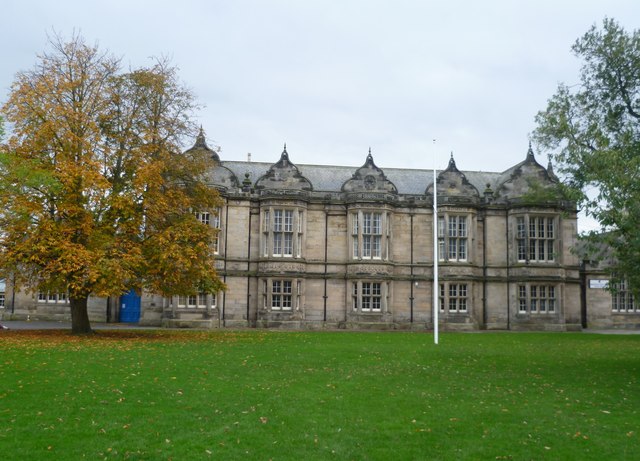
Image: Former Madras College Main Building by kim traynor, sourced from Wikimedia Commons and licensed under CC BY-SA 2.0.

William Burn’s cloistered school quadrangle is being adapted as the historic centre of a major university teaching and research project.
Quick facts
- Date
- Built in 1832
- Architect / designer
- William Burn
- Type
- Neo-Jacobean quadrangular school with cloister, oriels and ashlar elevations
- Designation
- Listed building, Category A (LB40703)
- OS grid reference
- NO 50773 16438
Architecture and continuing use
Ashlar and slate enclose a quadrangle with round-arched cloisters on three sides. The two-storey north range uses projecting bays and court-facing oriels to give the former school a collegiate character.
Its story
William Burn designed the building in 1832 for Madras College. After the school moved, the University of St Andrews acquired the site and secured approval for New College, retaining and adapting the listed fabric.
Why it is included
It links an influential Scottish educational foundation with a major present-day conservation and reuse project.
What to notice
- Round-arched quadrangle cloister.
- Neo-Jacobean gables and court-facing oriels.
- How new work is being integrated with the historic ranges.
Reading the surroundings
This is a controlled redevelopment site. Follow barriers and project notices and consult the university’s project page; no construction access is implied.
Timeline
- Built in 1832 William Burn designed the building in 1832 for Madras College. After the school moved, the University of St Andrews acquired the site and secured approval for New College, retaining and adapting the listed fabric.
- Present University of St Andrews redevelopment site for the approved New College project.
What we know — and what remains uncertain
The university has approved and funded the development, but construction programmes and future opening arrangements can change.
Sources & further reading
- Historic Environment Scotland: Former Madras College Main Building, LB40703 — Designation status, mapped location, construction phases, fabric, authorship and architectural or historical interest.
- University of St Andrews: New College development — Current ownership, approved redevelopment, programme and intended university use.
Location
OS grid reference NO 50773 16438 · Location confidence: High: the statutory designation supplies an official mapped National Grid Reference and the current source confirms the Place relationship or present identity. · Select the marker to open its satellite view in Google Maps. On desktop, drag Pegman (the yellow figure) onto a blue road. On mobile, turn on the Street View layer and tap a blue road. Other photo markers may be user-contributed.
Suggest a marker correction
Suggest a more accurate position
The teal marker is the current published position. The orange marker starts slightly to its right so both remain visible; this is only a visual starting position. Tap the correct place on the map or drag the orange marker. Sending this form creates a private review entry only; it does not move the published marker.
Check this area in Google Maps Choose the Satellite layer there if useful.
Map: © OpenStreetMap contributors. You can also enter checked coordinates below.