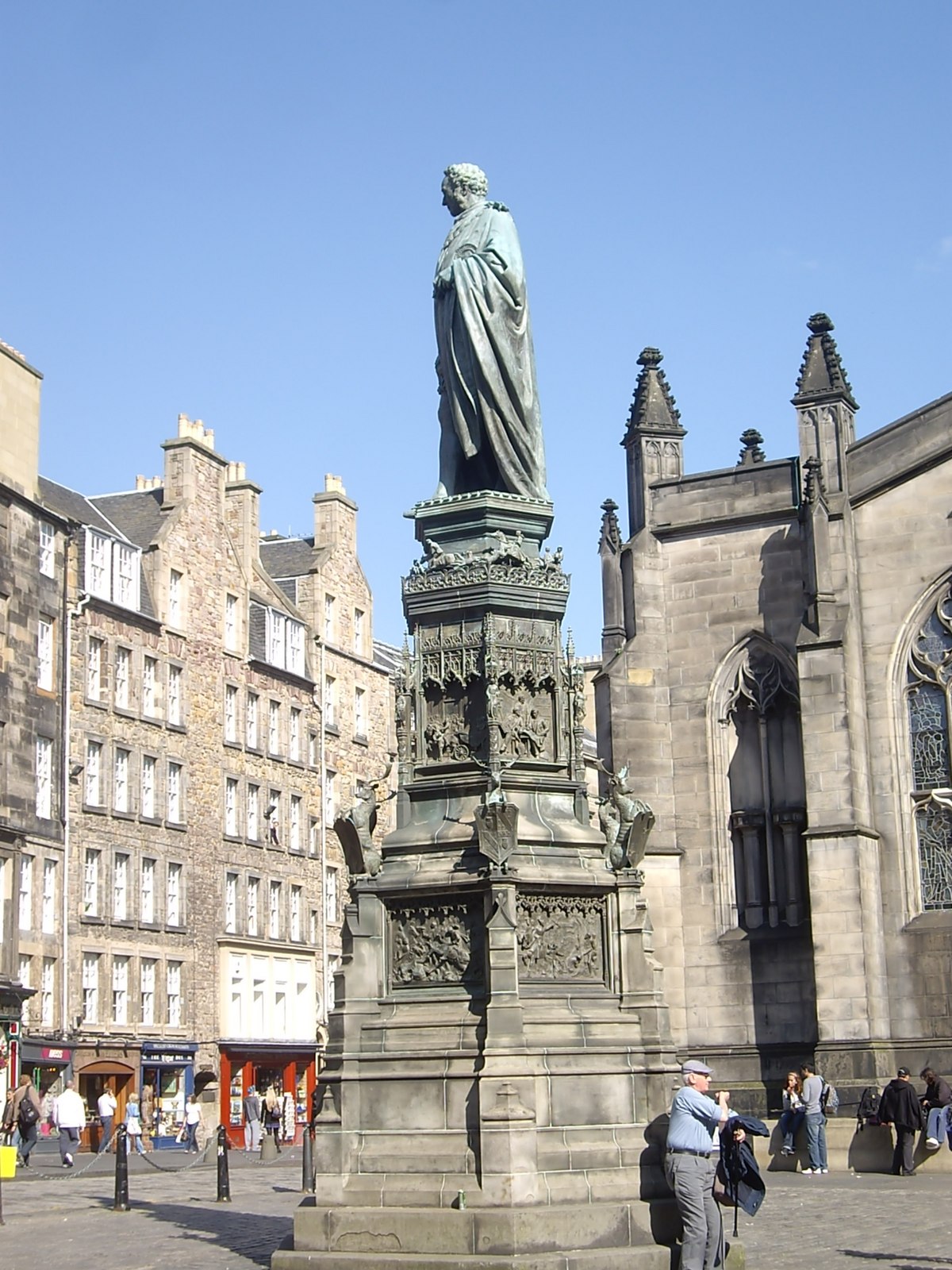
Image: Fifth Duke of Buccleuch Memorial by Stanley Howe, sourced from Wikimedia Commons and licensed under CC BY-SA 2.0.

A standing duke rises above one of Edinburgh’s most elaborate sculptural pedestals, crowded with narrative reliefs, virtues, huntsmen and heraldry.
Quick facts
- Date
- Designed 1885–1888; unveiled 1888
- Architect / designer
- Sir Joseph Boehm and Sir Robert Rowand Anderson, with several Scottish sculptors
- Type
- Bronze standing figure on a richly sculpted Gothic stone pedestal
- Designation
- Listed building, Category A (LB27844)
- OS grid reference
- NT 25675 73581
Architecture and continuing use
Boehm’s bronze figure stands on Rowand Anderson’s tall hexagonal pedestal. Multiple sculptors supplied bronze panels and corner figures, turning the base into a densely layered historical programme.
Its story
A public subscription commissioned the memorial after the duke’s death. Edinburgh Town Council approved the Parliament Square site and designs, and accepted custody after the unveiling in February 1888.
Why it is included
The bronze figure, hexagonal Gothic pedestal, narrative panels and allegorical figures make this an exceptional collaboration between architecture and sculpture. Its programme also exposes elite Victorian ideas of land, family and national service.
Reading the pedestal before the figure
The six-sided base separates life-story panels from allegorical figures representing the duke’s virtues. Several sculptors contributed: HES identifies work by Stuart Burnett and Birnie Rhind, with ornamental cresting by D. W. and W. G. Stevenson. Deer motifs mark the buttressed corners. Moving around the monument from public space reveals a collaborative programme rather than a single portrait pedestal. Its scenes present a favourable family narrative, so the elaborate workmanship should be read alongside the commemorative viewpoint it was commissioned to express.
What to notice
- Hexagonal pedestal and Gothic cresting.
- Narrative panels by different sculptors.
- Six heraldic bucks and allegorical figures.
- Narrative panels, allegorical figures and heraldic deer motifs arranged around the pedestal.
Reading the surroundings
View from public space while respecting court security, ceremonies, crowds and traffic on the High Street. Do not climb the pedestal.
Timeline
- 1885–1888 A public subscription funded the memorial, and Edinburgh Town Council approved the Parliament Square site and designs.
- February 1888 The monument was unveiled and passed into the Town Council’s custody.
- Present It remains a public monument in West Parliament Square.
Sources & further reading
- Historic Environment Scotland: Fifth Duke of Buccleuch Memorial, LB27844 — Designation status, mapped location, construction phases, fabric, authorship and architectural or historical interest.
- Canmore: Fifth Duke of Buccleuch memorial — Detailed sculptors, panels, commissioning, unveiling and civic-custody history.
- Edinburgh World Heritage: Old Town — Wider public-realm and World Heritage context for Parliament Square.
Location
OS grid reference NT 25675 73581 · Location confidence: High: the statutory designation supplies an official mapped National Grid Reference and the current source confirms the Place relationship or present identity. · Select the marker to open its satellite view in Google Maps. On desktop, drag Pegman (the yellow figure) onto a blue road. On mobile, turn on the Street View layer and tap a blue road. Other photo markers may be user-contributed.
Suggest a marker correction
Suggest a more accurate position
The teal marker is the current published position. The orange marker starts slightly to its right so both remain visible; this is only a visual starting position. Tap the correct place on the map or drag the orange marker. Sending this form creates a private review entry only; it does not move the published marker.
Check this area in Google Maps Choose the Satellite layer there if useful.
Map: © OpenStreetMap contributors. You can also enter checked coordinates below.