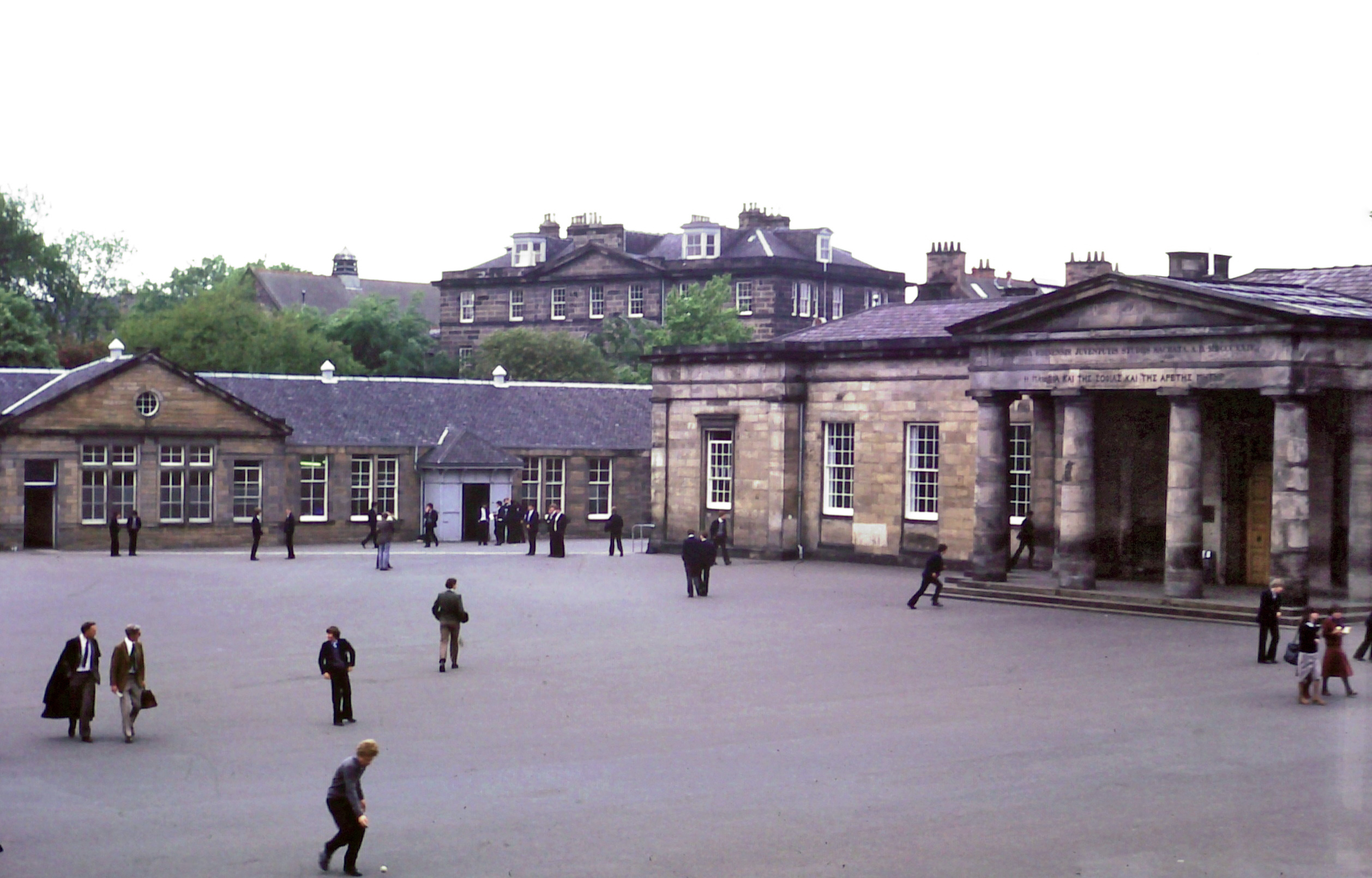
Image: Edinburgh Academy Main Building by Kim Traynor, sourced from Wikimedia Commons and licensed under CC BY-SA 4.0.

A severe Greek Doric front gives architectural form to an early purpose-built school that has remained in continuous educational use.
Quick facts
- Date
- Built 1823–1836; school opened in 1824
- Architect / designer
- William Burn; later hall work by A. F. Balfour Paul
- Type
- Long, low Greek Revival school centred on a six-column Doric portico
- Designation
- Listed building, Category A (LB27973)
- OS grid reference
- NT 24885 74852
Architecture and continuing use
The thirteen-bay single-storey façade is centred on six unfluted Doric columns and a pediment inscribed in Greek and Latin. Behind it, an inverted T-plan gathers classrooms around an oval assembly hall lit by a roof lantern.
Its story
New Town subscribers established the Academy to provide a classical education. Cost forced Burn’s original two-storey proposal into a simpler single-storey scheme, opened in 1824 and completed in 1836.
Why it is included
It is an important early Scottish school campus and one of the buildings that fixed Edinburgh’s nineteenth-century identity as a modern Athens.
What to notice
- The long horizontal façade and heavyweight central portico.
- Greek and Latin inscriptions expressing the founding curriculum.
- The open forecourt that preserves the building’s formal approach.
Reading the surroundings
This is an active school subject to safeguarding controls. View from public space unless the Academy explicitly advertises an event or authorised visit.
Timeline
- Built 1823–1836 New Town subscribers established the Academy to provide a classical education.
- Present Principal historic building of the active independent Edinburgh Academy.
What we know — and what remains uncertain
Several later campus buildings and alterations are legally excluded from this listing; the record concerns the main historic building.
Sources & further reading
- Historic Environment Scotland: Edinburgh Academy Main Building, LB27973 — Designation category, mapped location, construction phases, fabric, authorship and architectural interest.
- Edinburgh Academy: institutional identity and address — Official confirmation that the Academy remains based at 42–48 Henderson Row and operates as an active educational institution.
Location
OS grid reference NT 24885 74852 · Location confidence: High: the HES designation supplies a mapped National Grid Reference and a current operator, council, court, school, congregation or institutional source confirms the Place relationship and present identity. · Select the marker to open its satellite view in Google Maps. On desktop, drag Pegman (the yellow figure) onto a blue road. On mobile, turn on the Street View layer and tap a blue road. Other photo markers may be user-contributed.
Suggest a marker correction
Suggest a more accurate position
The teal marker is the current published position. The orange marker starts slightly to its right so both remain visible; this is only a visual starting position. Tap the correct place on the map or drag the orange marker. Sending this form creates a private review entry only; it does not move the published marker.
Check this area in Google Maps Choose the Satellite layer there if useful.
Map: © OpenStreetMap contributors. You can also enter checked coordinates below.