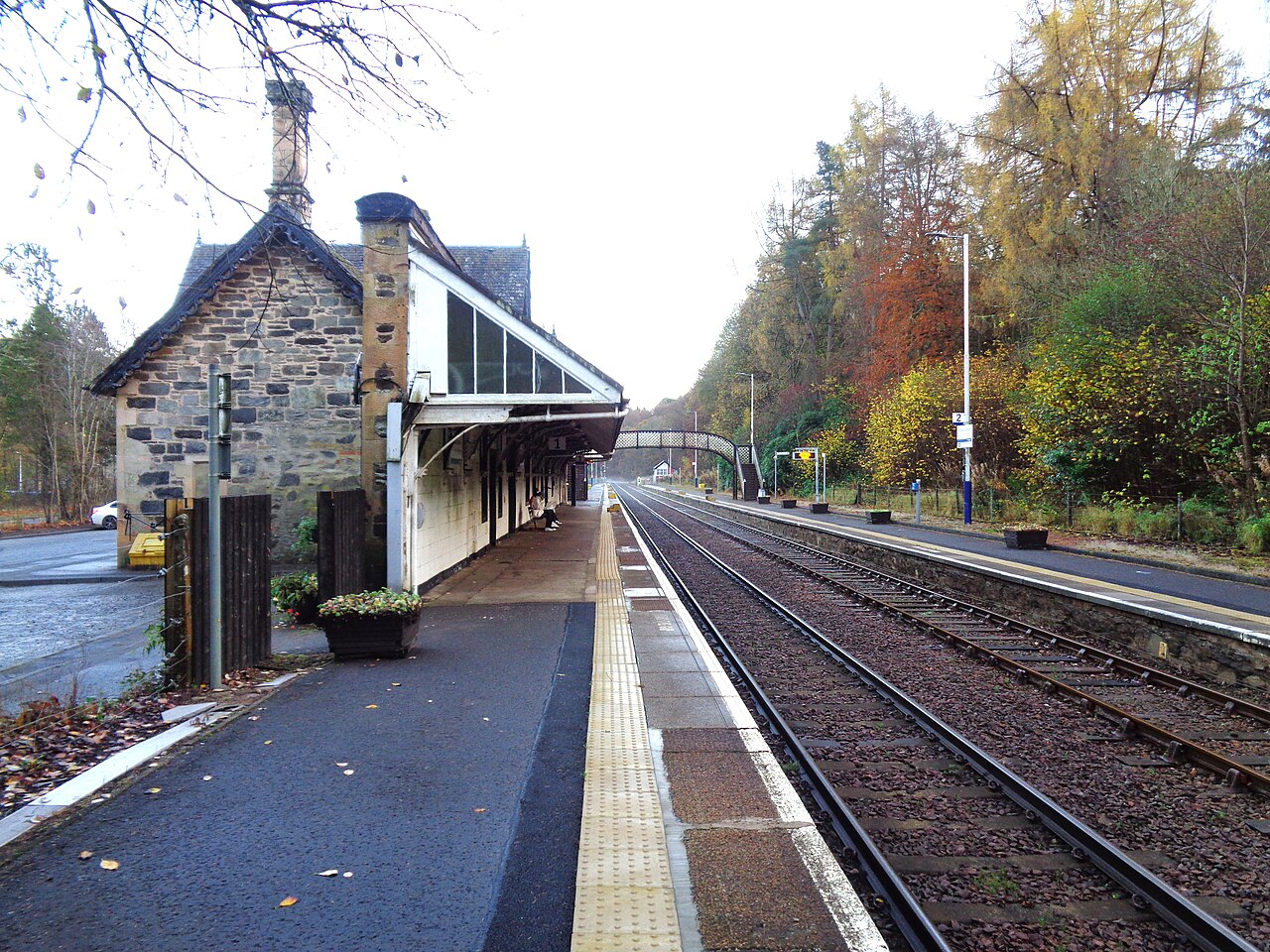
Image: Dunkeld and Birnam Station by Rosser1954, sourced from Wikimedia Commons and licensed under CC BY 4.0.

Andrew Heiton’s richly gabled resort station still serves Highland Main Line passengers beside its historic lattice footbridge.
Quick facts
- Date
- 1856; later additions
- Architect / designer
- Andrew Heiton Junior
- Type
- Railway station and lattice footbridge
- Designation
- Listed building, Category A (LB11139)
- OS grid reference
- NO 03084 41676
Architecture and continuing use
Seven near-symmetrical whinstone bays are animated by sandstone dressings, pointed porch arches, advanced gables, decorative bargeboards and tall chimney stacks. A long platform awning rests on cast-iron brackets, and a steel-and-cast-iron lattice footbridge links the platforms.
Its story
The Perth and Dunkeld Railway opened the station on 7 April 1856 as its northern terminus. Extension to Pitlochry in 1863 placed it on the through Highland route. The station and footbridge survive in operational railway use, accompanied by a separately listed 1919 signal box.
Why it is included
Category A listing recognises an outstanding and unusually complete resort station by Andrew Heiton Junior, with architecture scaled to Dunkeld and Birnam’s nineteenth-century visitor economy.
What to notice
- Pointed arches and decorative bargeboards at the entrance porch.
- The long bracketed platform awning.
- Lattice girders forming the historic footbridge.
Reading the surroundings
This is a working railway. Stay behind platform lines, use only designated crossings and never enter tracks. ScotRail warns that the station is unsuitable for many mobility-impaired passengers; check assistance and alternatives before travel.
Timeline
- 7 April 1856 The station opened as the terminus of the Perth and Dunkeld Railway.
- 1863 Extension to Pitlochry placed the station on a through Highland route.
- 1919 The nearby Highland Railway signal box was added.
- 2026 ScotRail continued to manage passenger services and station facilities.
What we know — and what remains uncertain
Historic fabric and operational equipment overlap, but this record does not infer ownership or use of every room within the station building.
Sources & further reading
- Historic Environment Scotland: Dunkeld and Birnam Station, LB11139 — Current designation status, official mapped location, date, fabric and architectural or archaeological interest.
- Trove designation: LB11139 — Parallel national record identity and archival context.
- ScotRail: Dunkeld and Birnam Station — Current station management, facilities, train information and accessibility warning.
Location
OS grid reference NO 03084 41676 · Location confidence: High: the current national designation supplies an exact mapped National Grid Reference; public text separately states access and current-use uncertainty. · Select the marker to open its satellite view in Google Maps. On desktop, drag Pegman (the yellow figure) onto a blue road. On mobile, turn on the Street View layer and tap a blue road. Other photo markers may be user-contributed.
Suggest a marker correction
Suggest a more accurate position
The teal marker is the current published position. The orange marker starts slightly to its right so both remain visible; this is only a visual starting position. Tap the correct place on the map or drag the orange marker. Sending this form creates a private review entry only; it does not move the published marker.
Check this area in Google Maps Choose the Satellite layer there if useful.
Map: © OpenStreetMap contributors. You can also enter checked coordinates below.