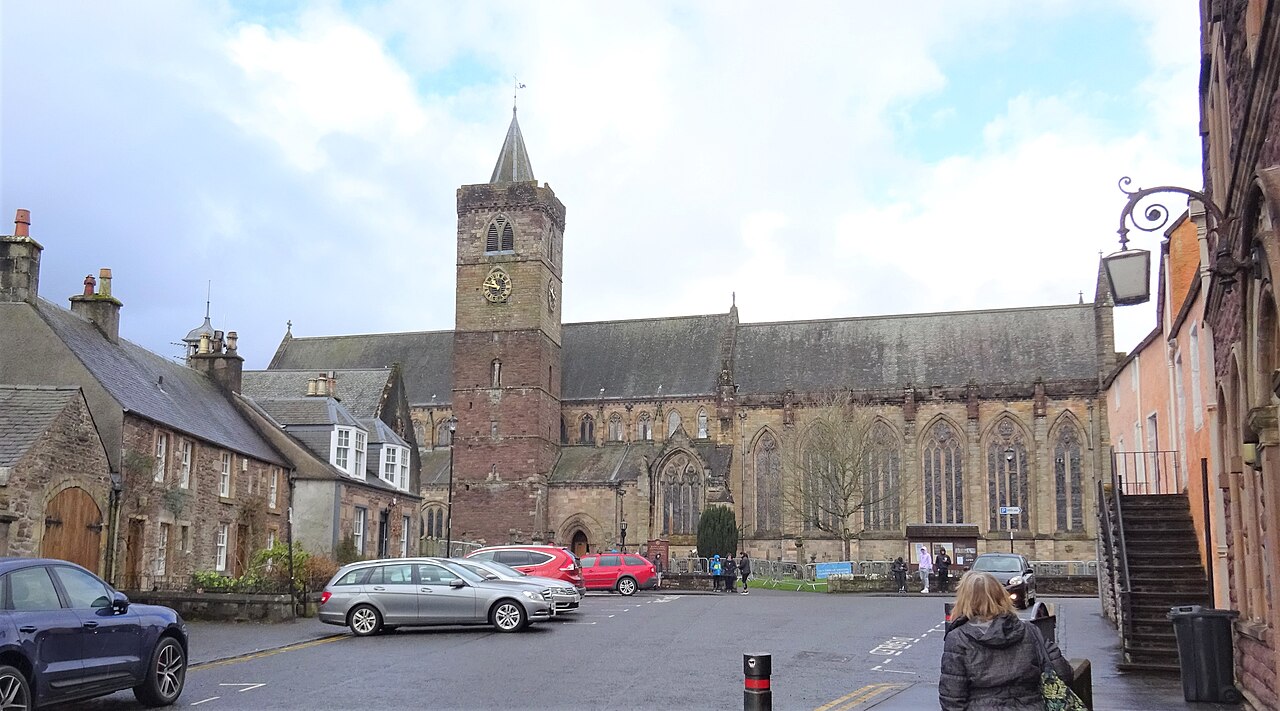
Image: Dunblane Cathedral by Rosser1954, sourced from Wikimedia Commons and licensed under CC BY-SA 4.0.

A largely intact early-Gothic cathedral unites medieval stonework, a Romanesque tower and a carefully judged Victorian restoration.
Quick facts
- Date
- Mid- to late 13th century; restored 1889–93
- Architect / designer
- Medieval masons; restoration by Sir Robert Rowand Anderson
- Type
- Early Gothic cathedral with Romanesque tower and churchyard
- Designation
- Listed building, Category A (LB26361)
- OS grid reference
- NN 78153 01381
Architecture and continuing use
An eight-bay aisled nave, long choir, Lady Chapel and six-stage tower are built in yellow and red sandstone. Pointed arcades, transitional tracery, carved stalls and rich late-nineteenth- and twentieth-century glass survive inside.
Its story
The cathedral rose chiefly in the thirteenth century around an older tower. After the Reformation the nave roof fell, leaving the choir as the parish church; Rowand Anderson restored the whole building between 1889 and 1893.
Why it is included
Category A status, medieval completeness, outstanding fittings and continuing worship make the cathedral the defining architectural record for Dunblane.
What to notice
- The west front’s three tall windows and carved vesica.
- Romanesque lower tower beneath later Gothic stages.
- Medieval choir stalls alongside Rowand Anderson and Lorimer fittings.
Reading the surroundings
The cathedral is both a working church and an HES visitor site. Check current opening, avoid disruption to worship and treat the churchyard and scheduled buried remains with care.
Timeline
- Mid-13th century The principal nave and choir established the cathedral’s early-Gothic form.
- About 1600 Loss of the nave roof confined parish worship to the choir.
- 1889–93 Rowand Anderson reinstated the full church and furnished its restored spaces.
- 2026 Worship and managed public visiting continue in parallel.
What we know — and what remains uncertain
The listed building excludes the separately scheduled buried remains, and church or conservation activity can alter visitor access.
Sources & further reading
- Historic Environment Scotland: Dunblane Cathedral, LB26361 — Designation category, mapped location, construction phases, fabric, authorship and architectural or historical interest.
- Historic Environment Scotland: Dunblane Cathedral — Current visitor status, opening and national significance.
- Dunblane Cathedral congregation — Current worship and congregational identity.
Location
OS grid reference NN 78153 01381 · Location confidence: High: the statutory designation supplies an official mapped National Grid Reference and the current source confirms the Place relationship or present identity. · Select the marker to open its satellite view in Google Maps. On desktop, drag Pegman (the yellow figure) onto a blue road. On mobile, turn on the Street View layer and tap a blue road. Other photo markers may be user-contributed.
Suggest a marker correction
Suggest a more accurate position
The teal marker is the current published position. The orange marker starts slightly to its right so both remain visible; this is only a visual starting position. Tap the correct place on the map or drag the orange marker. Sending this form creates a private review entry only; it does not move the published marker.
Check this area in Google Maps Choose the Satellite layer there if useful.
Map: © OpenStreetMap contributors. You can also enter checked coordinates below.