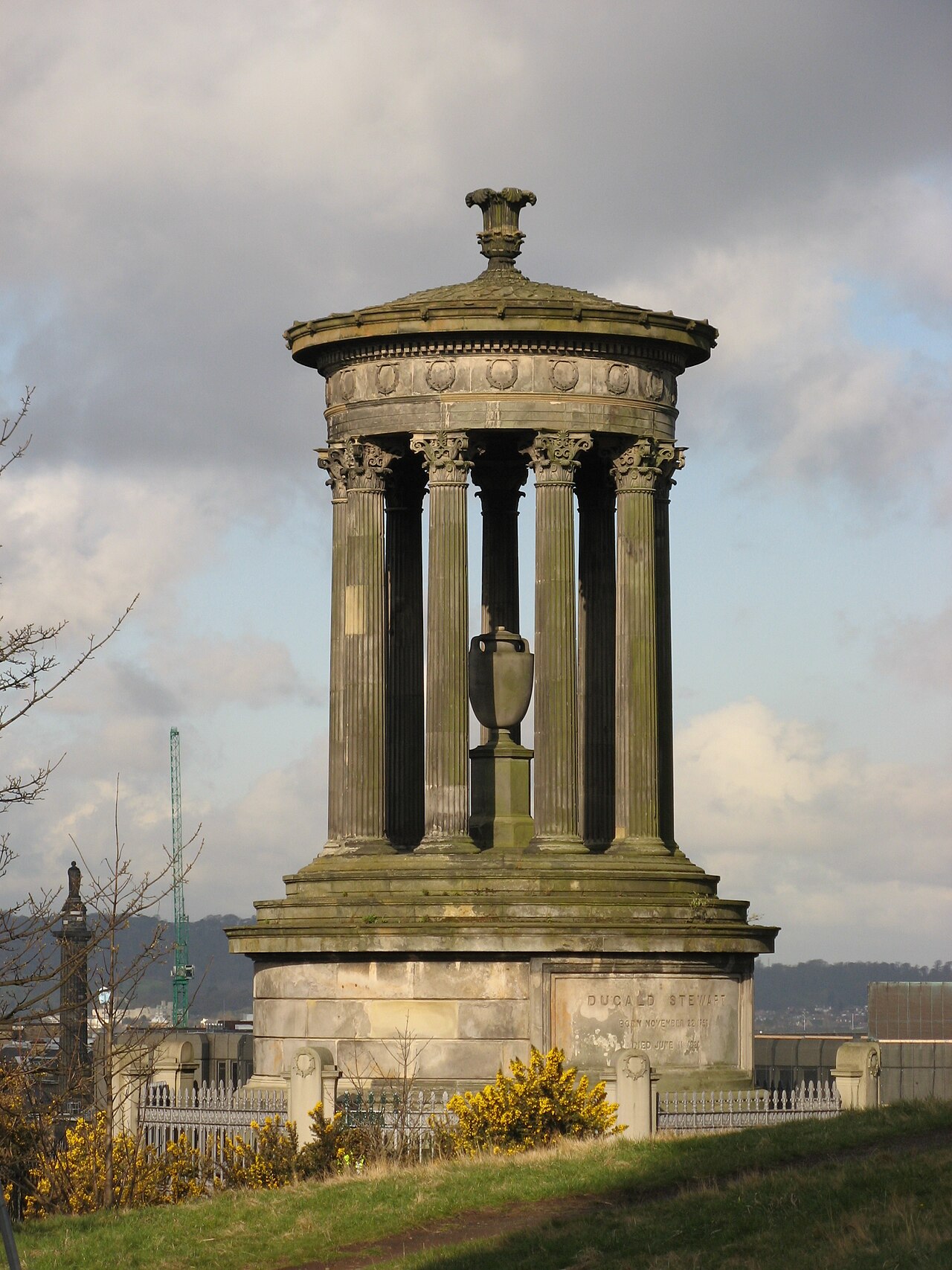
Image: Dugald Stewart Monument by Jonathan Oldenbuck, sourced from Wikimedia Commons and licensed under CC BY-SA 3.0.


William Henry Playfair’s nine-columned memorial to the philosopher Dugald Stewart turns an ancient Athenian model into one of the defining silhouettes of Calton Hill.
Quick facts
- Date
- 1830–31; completed by September 1831
- Architect / designer
- William Henry Playfair
- Commissioned by
- Royal Society of Edinburgh
- Type
- Neo-Greek commemorative monument
- Designation
- Listed building, Category A (LB27835)
- OS grid reference
- NT 26138 74132
Architecture
The monument rises from a circular polished-ashlar podium. A projecting base course and moulded chamfer lead to banded rustication, while a recessed panel on the north-east side records Stewart’s name and his dates, 1753–1828. Above it, three moulded steps form the crepidoma—the stepped base associated with a classical temple.
Nine fluted Corinthian columns form an open ring around a central urn. Their richly carved capitals carry an architrave, a frieze of wreaths, a dentilled cornice and a rim of antefixae. A shallow stone dome closes the composition and supports a second, open urn with a plume-like finial. The contrast between the weighty rusticated base and the open colonnade is essential to the design: from across the city, light and skyline remain visible through the monument.
The present polygonal enclosure has stone piers ornamented with wreaths and cast-iron railings. Historic Environment Scotland records it as restored; the original railings and piers were removed at an unknown date, so the surviving enclosure should not be read uncritically as untouched 1831 fabric.
Dugald Stewart and the commission
Dugald Stewart (1753–1828) was an Edinburgh-born writer and philosopher associated with the later Scottish Enlightenment. Historic Environment Scotland records him as Professor of Moral Philosophy at the University of Edinburgh from 1786 to 1828; he also taught economics, natural philosophy, Greek and logic. His lectures and publications, including Elements of the Philosophy of the Human Mind, helped extend Edinburgh’s reputation as a centre of philosophical teaching.
After Stewart’s death, the Royal Society of Edinburgh commissioned a public memorial. The prominent Calton Hill site was selected in 1830, and the Town Council granted permission that August. The work was completed by September 1831. Its exposed position made it part of a deliberate city-scale composition rather than a monument intended to be understood only at close range.
An Athenian model in Edinburgh
Playfair based the design on the Choragic Monument of Lysicrates in Athens, erected in the fourth century BC to commemorate victory in a dramatic chorus competition. The Athenian building had become widely known in Britain through James Stuart and Nicholas Revett’s Antiquities of Athens, published from 1762.
The choice was more than a general classical quotation. Historic Environment Scotland suggests that the discreet reference to a choragic prize was apt for Stewart, who was celebrated as an orator and teacher. That connection is plausible and well established in the designation record, but no surviving statement from Playfair is cited there to prove that it was his explicit intention.
Setting and significance
The memorial stands near the western edge of Calton Hill, where its circular outline frames views towards Princes Street, the Old Town and Edinburgh Castle. It contributes to a remarkable group of nineteenth-century monuments and observatory buildings that helped make the hill the clearest expression of Edinburgh’s “Athens of the North” identity.
Its importance lies in the combination of architecture, commemoration and townscape. It is a particularly refined work by Playfair, one of Scotland’s leading Greek Revival architects, and a memorial to an intellectual rather than to a monarch or military victory. Its small scale is amplified by the skyline position: the monument functions as both an object on the hill and a foreground device in views across the city.
What to notice
- The nine fluted Corinthian columns, seen alternately as a dense screen and an open frame as you walk around the monument.
- The wreaths on the frieze and on the piers of the restored enclosure.
- The inscribed north-east panel, which fixes Stewart’s identity and dates in the heavy podium.
- The two urn forms: the central memorial urn within the colonnade and the smaller plumed urn above the dome.
- The way Edinburgh Castle, the Old Town and the New Town appear through and beside the columns.
Visiting and access
The monument is viewed from the public open space of Calton Hill; there is no public interior. Approaches involve sloping or stepped paths, and surfaces can be uneven or slippery in poor weather. The hillside includes steep drops and exposed edges, so visitors should remain outside the railings and avoid climbing on the masonry. Current park information should be checked where weather, events or maintenance may affect access.
Timeline
- 1753 Dugald Stewart is born in Edinburgh.
- 1786 Stewart begins the period recorded by Historic Environment Scotland as Professor of Moral Philosophy at the University of Edinburgh.
- 1828 Stewart dies on 11 June.
- August 1830 Edinburgh Town Council grants permission for the Royal Society of Edinburgh’s proposed memorial on Calton Hill.
- September 1831 Playfair’s monument is complete.
- Date unknown The original enclosing railings and stone piers are removed; the present polygonal enclosure is restored fabric.
- 1966 The monument is added to the statutory list at Category A.
- Present It remains a public outdoor monument and one of Calton Hill’s best-known skyline features.
What we know — and what remains uncertain
The commission, architect, dates, materials and ancient model are well documented. The removal date of the original railings and piers is not known. The association between the choragic form and Stewart’s oratory is a persuasive interpretation recorded by Historic Environment Scotland, rather than a documented quotation from Playfair. Outdoor public access does not imply access within the railings or onto the structure.
Sources & further reading
- Historic Environment Scotland: Dugald Stewart’s Monument, LB27835 — Designation, architecture, commission, chronology, enclosure history and statement of special interest.
- City of Edinburgh Council, Edinburgh Outdoors: monuments on Calton Hill — Current park setting and civic account of the monument.
Location
OS grid reference NT 26138 74132 · Location confidence: High: the statutory designation supplies an official mapped National Grid Reference and the current source confirms the Place relationship or present identity. · Select the marker to open its satellite view in Google Maps. On desktop, drag Pegman (the yellow figure) onto a blue road. On mobile, turn on the Street View layer and tap a blue road. Other photo markers may be user-contributed.
Suggest a marker correction
Suggest a more accurate position
The teal marker is the current published position. The orange marker starts slightly to its right so both remain visible; this is only a visual starting position. Tap the correct place on the map or drag the orange marker. Sending this form creates a private review entry only; it does not move the published marker.
Check this area in Google Maps Choose the Satellite layer there if useful.
Map: © OpenStreetMap contributors. You can also enter checked coordinates below.