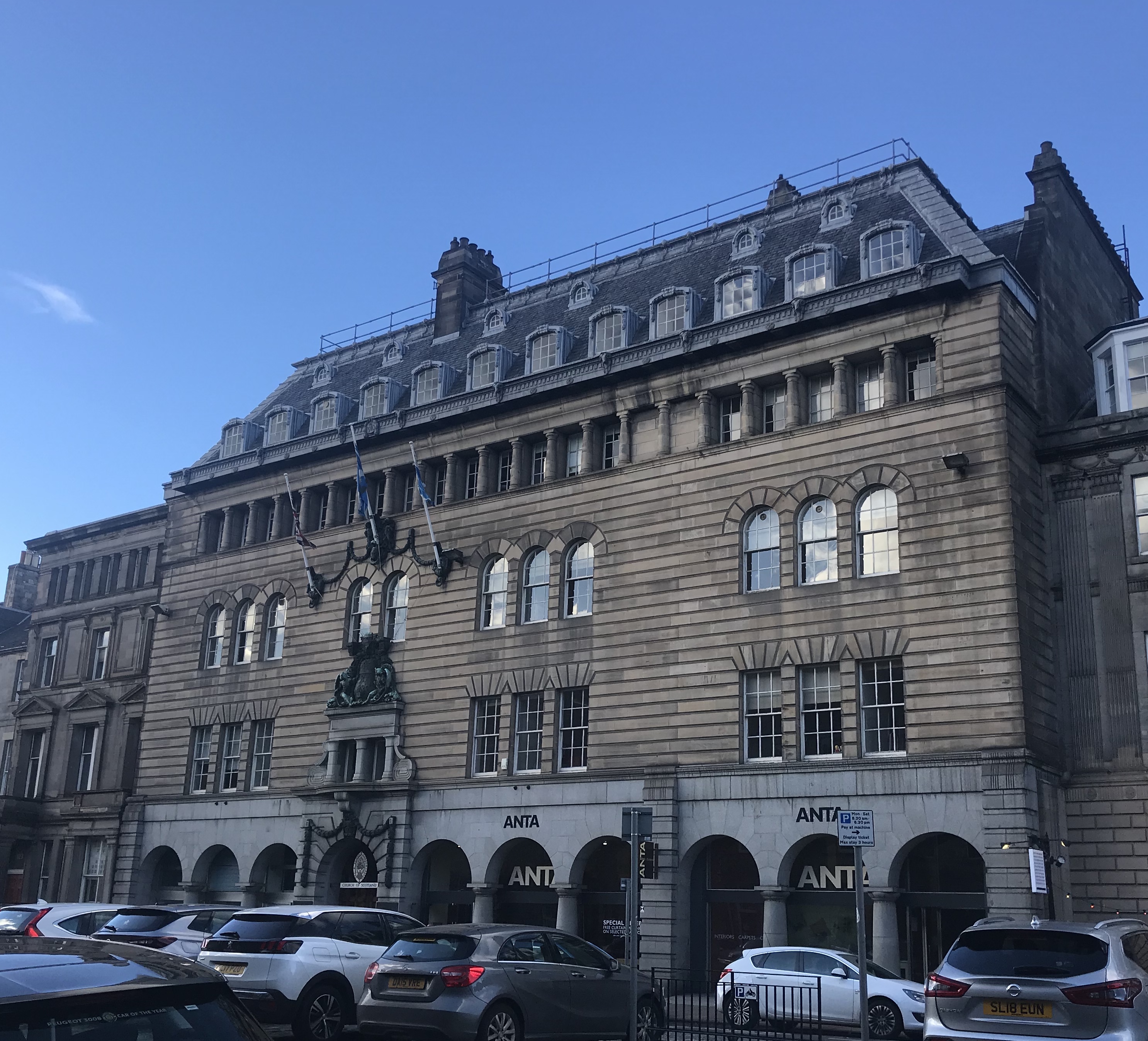


A powerful George Street office block gives an institutional scale to Greek, Egyptian and bronze decorative motifs.
Quick facts
- Date
- Built 1909–1911; extended east in 1932
- Architect / designer
- Sydney Mitchell and Wilson; Auldjo Jamieson and Arnott
- Type
- Monumental stone office block with granite arcade, bronze ornament and internal chapel
- Designation
- Listed building, Category A (LB28855)
- OS grid reference
- NT 24864 73946
Architecture and continuing use
A polished granite ground-floor arcade supports channelled cream ashlar and a deep mansard roof. A central doorway rises to an Egyptian-inspired glazed colonnade and a huge bronze escutcheon, while a hypostyle hall and chapel survive inside.
Its story
Sydney Mitchell and Wilson designed the national offices in 1909–1911. Auldjo Jamieson and Arnott added an eastern bay in 1932, carefully matching the original exterior.
Why it is included
It gives architectural form to the national administration of Scotland’s established church and is an unusually rich early-twentieth-century office building.
What to notice
- The polished granite Doric arcade at street level.
- Bronze festoons, shields and winged supporters.
- The mansard roof and long line of lead dormers.
Reading the surroundings
These are working offices. Public access follows published contact and accessibility arrangements for appointments or organised events.
Timeline
- Built 1909–1911 Sydney Mitchell and Wilson designed the national offices in 1909–1911.
- Present National administrative offices of the Church of Scotland.
What we know — and what remains uncertain
Office departments and internal layouts can change; the published current use confirms the national administrative role rather than public access to all rooms.
Sources & further reading
- Historic Environment Scotland: Church of Scotland Offices, LB28855 — Designation category, mapped location, construction phases, fabric, authorship and architectural interest.
- Church of Scotland: contact and office information — Current national-office use, 121 George Street address, opening pattern and accessibility information.
Location
OS grid reference NT 24864 73946 · Location confidence: High: the statutory designation supplies a mapped National Grid Reference and a current official operator, responsible public body or institutional source confirms the Place relationship and present identity. · Select the marker to open its satellite view in Google Maps. On desktop, drag Pegman (the yellow figure) onto a blue road. On mobile, turn on the Street View layer and tap a blue road. Other photo markers may be user-contributed.
Suggest a marker correction
Suggest a more accurate position
The teal marker is the current published position. The orange marker starts slightly to its right so both remain visible; this is only a visual starting position. Tap the correct place on the map or drag the orange marker. Sending this form creates a private review entry only; it does not move the published marker.
Check this area in Google Maps Choose the Satellite layer there if useful.
Map: © OpenStreetMap contributors. You can also enter checked coordinates below.