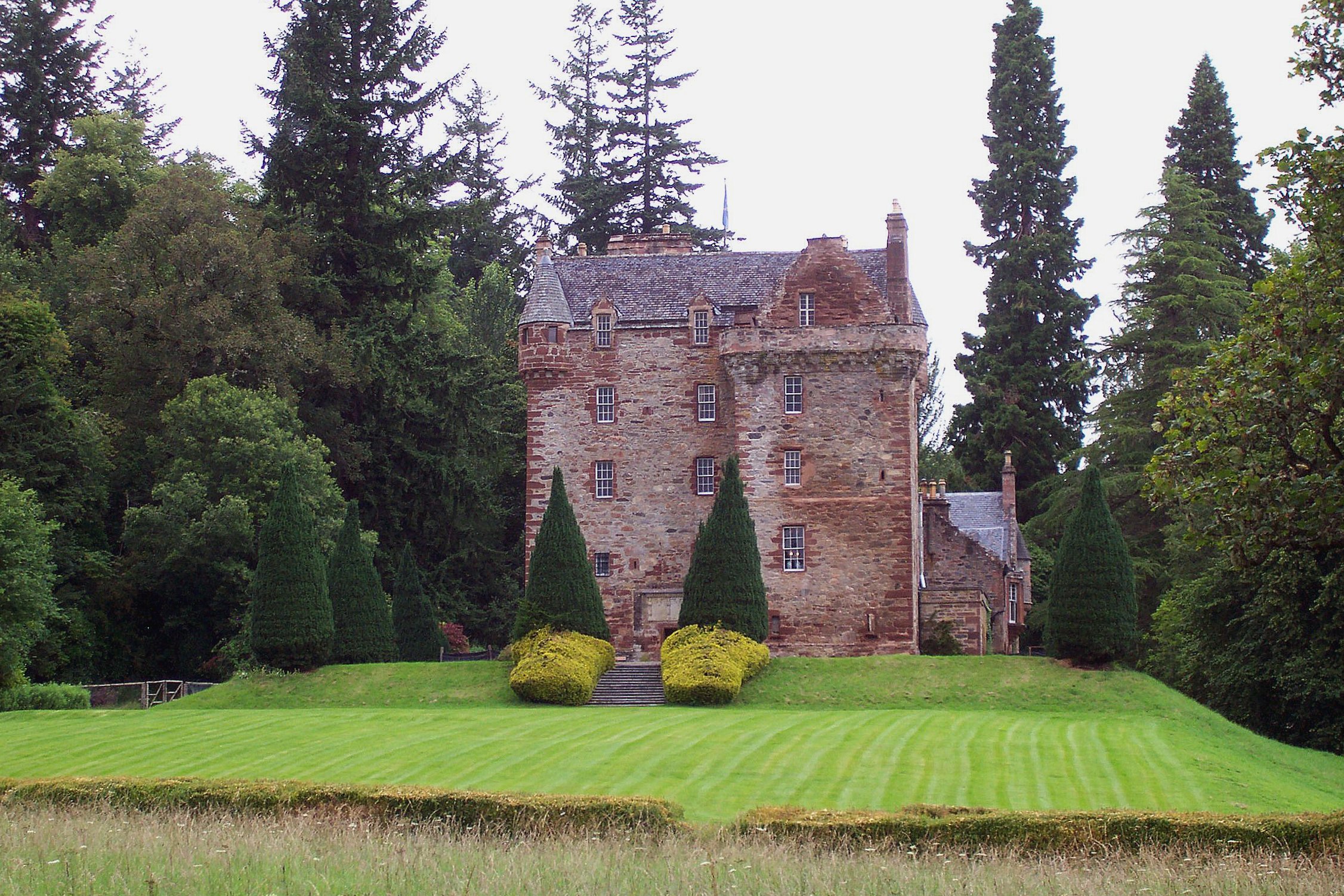
Image: Castle Leod by Colin Hepburn, sourced from Wikimedia Commons and licensed under CC BY-SA 2.0.

At Castle Leod, new masonry filled the inside corner of an L-shaped tower in 1616. A broad stair behind the new entrance led directly to the first-floor hall.
Quick facts
- Date
- Tower probably predates 1600. Entrance range dated 1616, with later additions.
- Architect / designer
- Built for Sir Roderick Mackenzie of Coigach; individual masons unrecorded
- Type
- Fortified tower house enlarged as a clan residence
- Designation
- Listed building, Category A (LB7826)
- OS grid reference
- NH 48603 59325
Fitting a new entrance into the tower
The two arms of the earlier house met at the south-west corner. Filling most of that angle gave Sir Roderick Mackenzie a regular entrance front. A broad stair with landings took visitors up to the hall. Smaller spiral stairs continued to the upper rooms. Above, projecting stone brackets still mark stretches of the earlier wall-walk, with small roofed turrets at the corners.
History
Archaeologists working at Castle Leod in 2014 noted documentary evidence for Mackenzie ownership in the fifteenth century. The tower itself appears to predate the work associated with Sir Roderick around 1600. Later generations altered the fittings. One south room has mid-eighteenth-century panelling and the hall has early nineteenth-century details. A two-storey Baronial wing extended the house at the rear in the later nineteenth century.
A curious detail
The entrance of 1616 still has the large stone panel intended to display the family arms. Its worn carving sits immediately above the doorway, at the foot of the route to the hall.
What to notice
- Follow the paired roof ridges to the stepped gables at their ends.
- Look below the corner turrets for the tiers of projecting stone that support them.
- The splayed gun openings belong to a different use of the walls from the evenly spaced windows of the entrance front.
Location and Photos
Castle Leod stands outside Strathpeffer. It is a family home with public open days and private tours advertised by the estate.
Sources & further reading
- Historic Environment Scotland: Castle Leod, LB7826 — 1616 infill, stair routes, armorial panel, wall-walk, surviving room fittings and later rear wing.
- Castle Leod: official website — Current ownership, visitor arrangements, events and the castle’s family history.
- Ross and Cromarty Archaeological Services, Castle Leod evaluation, 2014 — Documentary evidence for early Mackenzie ownership and the case for an older tower, especially page 6.
Location
OS grid reference NH 48603 59325 · Location confidence: High: the national designation supplies an official mapped National Grid Reference; the independent source confirms the Place relationship, history or current identity. · Select the marker to open its satellite view in Google Maps. On desktop, drag Pegman (the yellow figure) onto a blue road. On mobile, turn on the Street View layer and tap a blue road. Other photo markers may be user-contributed.
Suggest a marker correction
Suggest a more accurate position
The teal marker is the current published position. The orange marker starts slightly to its right so both remain visible; this is only a visual starting position. Tap the correct place on the map or drag the orange marker. Sending this form creates a private review entry only; it does not move the published marker.
Check this area in Google Maps Choose the Satellite layer there if useful.
Map: © OpenStreetMap contributors. You can also enter checked coordinates below.