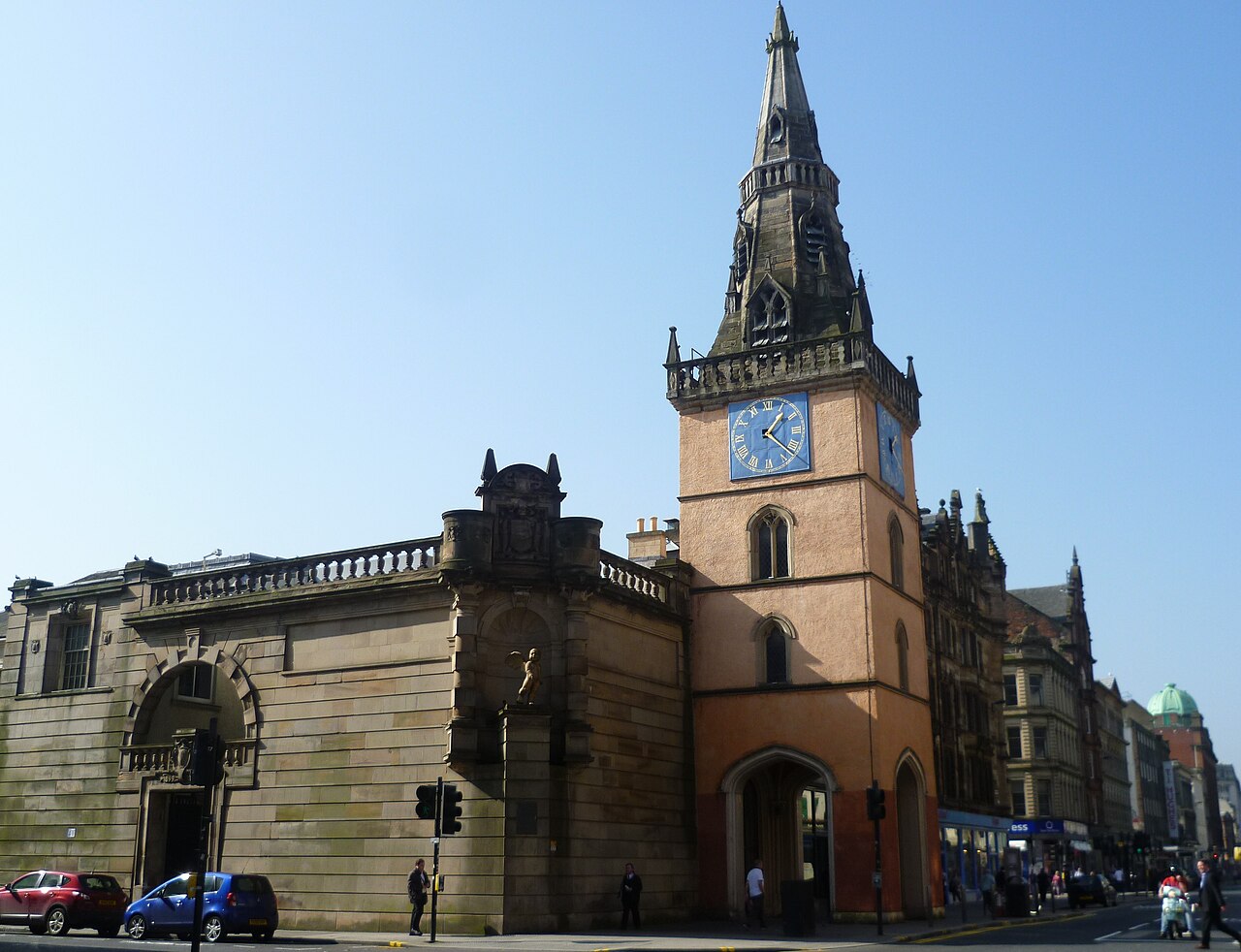
Image: Tron Theatre, Glasgow by Kim Traynor, sourced from Wikimedia Commons and licensed under CC BY-SA 3.0.

A former city church now houses a producing theatre, with the old worship space, steeple and Burnet’s exuberant screen still legible within a busy arts venue.
Quick facts
- Date
- Church built 1793–1794; Baroque screen added 1899–1900; converted to theatre in 1981
- Architect / designer
- James Adam; screen by John James Burnet; later theatre conversion
- Type
- Former classical church adapted as a theatre complex
- Designation
- Listed building, Category A (LB32812)
- OS grid reference
- NS 59526 64880
Architecture and continuing use
James Adam’s classical church body is fronted by J. J. Burnet’s richly modelled Baroque stone screen. The surviving dome and historic volumes are incorporated into later auditorium and public spaces.
Its story
The church was built in 1793–1794 after an earlier Tron Kirk fire. Burnet added the Trongate screen in 1899–1900; the complex was adapted for theatre use in 1981 and continues to support new performance work.
Why it is included
It combines several strong architectural phases with a sustained cultural reuse that keeps the historic structure publicly active rather than detached from city life.
What to notice
- Burnet’s deep, sculptural screen facing Trongate.
- The contrast between Baroque frontage and earlier church fabric.
- Inside during authorised access, the surviving dome and adapted historic volumes.
Reading the surroundings
This is a working theatre. Public access follows box-office, café-bar, performance and event hours; check current access services and arrival information.
Timeline
- Church built 1793–1794 The church was built in 1793–1794 after an earlier Tron Kirk fire.
- Present Active producing theatre, performance venue, café-bar and cultural charity.
What we know — and what remains uncertain
The site is a layered complex and not every visible element dates from James Adam’s church. The record separates the principal phases where evidence allows.
Sources & further reading
- Historic Environment Scotland: Tron Theatre, LB32812 — Designation category, exact grid reference, construction phases, fabric, authorship and significance.
- Tron Theatre: visiting us — Current producing-theatre, café-bar and performance use, official address, access guidance and visitor arrangements.
Location
OS grid reference NS 59526 64880 · Location confidence: High: the statutory designation supplies an exact National Grid Reference and the current operator confirms the building and address. · Select the marker to open its satellite view in Google Maps. On desktop, drag Pegman (the yellow figure) onto a blue road. On mobile, turn on the Street View layer and tap a blue road. Other photo markers may be user-contributed.
Suggest a marker correction
Suggest a more accurate position
The teal marker is the current published position. The orange marker starts slightly to its right so both remain visible; this is only a visual starting position. Tap the correct place on the map or drag the orange marker. Sending this form creates a private review entry only; it does not move the published marker.
Check this area in Google Maps Choose the Satellite layer there if useful.
Map: © OpenStreetMap contributors. You can also enter checked coordinates below.