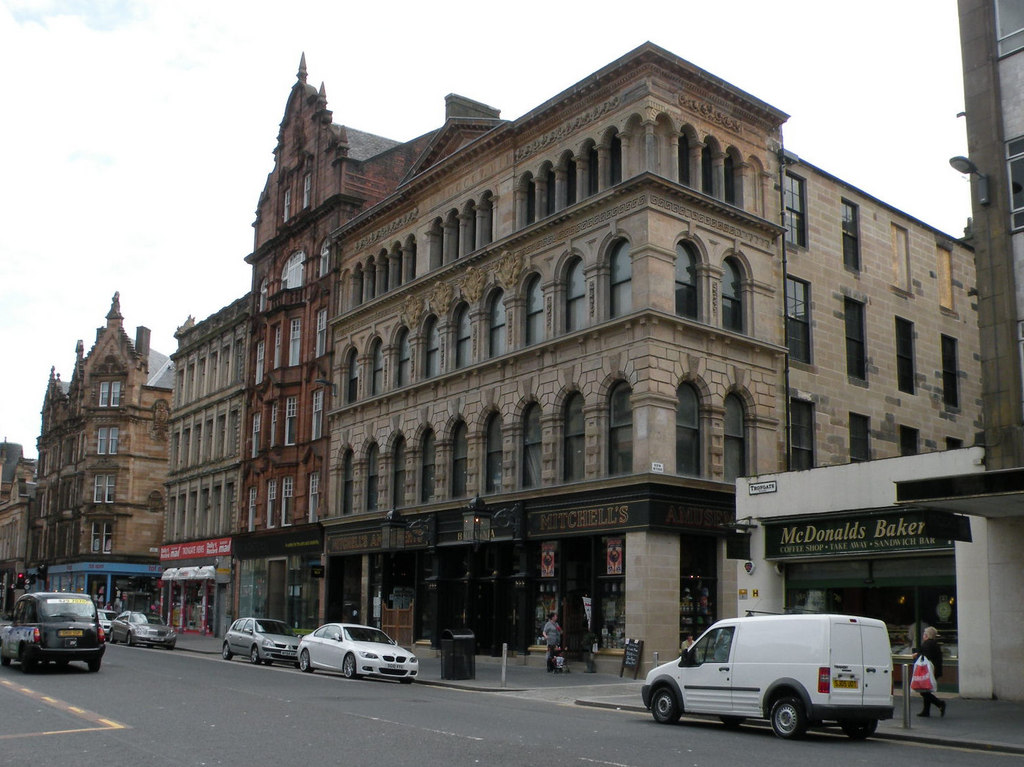
Above the shops of Glasgow’s Trongate survives an extraordinarily early music-hall auditorium: a timber-galleried room shaped by variety entertainment, early film, commercial reinvention and a volunteer-led conservation campaign.
Quick facts
- Date
- 1857; rear stair 1869; cinema-related alterations 1904–1910
- Architect / designer
- Gildard and MacFarlane; rear stair by Hugh Barclay; later alterations by Boswell and McIntyre
- Type
- Classical commercial building containing an early music-hall auditorium and later cine-variety venue
- Designation
- Listed building, Category A (LB32774)
- OS grid reference
- NS 59452 64918
Architecture and continuing use
The listed property occupies 109–121 Trongate and 9 New Wynd. Its four-storey, ashlar-faced commercial front is organised in a richly detailed Classical manner. Modern shopfronts occupy the ground floor; above them are rusticated masonry, round-headed openings, moulded archivolts and vermiculated keystones. Pilasters divide the principal bays, with banding at first-floor level and swags above, while decorated friezes, cornices and a deep bracketed eaves course give each stage a strong horizontal line. The New Wynd return continues the formal treatment at its front before becoming plainer to the rear.
The hall itself is concealed within the upper floors. Its U-plan timber gallery retains bench seating and is carried on slender cast-iron columns. A simple timber proscenium frames the high stage. Above, the coombed ceiling preserves decorative plasterwork and a flat central panel enriched with an applied timber lattice. These relatively direct materials and arrangements are central to the room’s character: this is not a grand West End theatre, but a rare survivor of the close, mixed commercial and entertainment buildings in which early music hall developed.
The auditorium now operates as a volunteer-run heritage and performance venue. Exhibitions, talks, comedy, music, film and special events keep performance active while conservation proceeds. The wider listed building continues to include commercial premises, so the protected ensemble is larger than the auditorium alone.
From warehouse scheme to music hall
The building is dated 1857 and was conceived speculatively as warehousing, possibly incorporating earlier fabric. That purpose was quickly set aside: Gildard and MacFarlane adapted the first and second floors as Campbell’s Music Salon, which opened in 1857. The hall was licensed and renamed the Britannia in 1859. Hugh Barclay added a rear staircase in 1869.
Music halls offered songs, comic turns, dancing and speciality acts to the rapidly expanding industrial city. The Britannia’s place above shops and its connection with a ground-floor public house belong to that social history. Audiences could drink and smoke during performances, and the hall served working people who had limited leisure and often lived in severe overcrowding. That context explains both its popularity and the moral criticism directed at east-end entertainment in the nineteenth century.
Moving pictures and the Panopticon
The building repeatedly adjusted to new entertainment. Historic Environment Scotland records changing names and uses, including Hubner’s Animatograph, and states that moving pictures were shown from August 1896. The venue’s own history says film had become a regular part of the programme by January 1897. Boswell and McIntyre carried out alterations for cinema use between 1904 and 1910.
A. E. Pickard revived the premises as the Panopticon in 1906. “Panopticon” promised an attraction in which everything might be seen: live turns, films, carnival displays, waxworks and other novelties shared the building. Sixteen-year-old Stan Laurel’s 1906 appearance is the best-known association, but the hall’s importance is broader than one performer. Pickard’s surviving scrapbooks—digitised through a University of Glasgow project—document programmes, publicity and the business of popular entertainment with unusual richness. The premises were called the Tron Cinema from 1922 before the Panopticon name returned; they finally closed in 1938.
Why it matters
Historic Environment Scotland identifies the Britannia as Scotland’s earliest and sole surviving example of its music-hall type, and notes that it has a claim to be the earliest in the United Kingdom. The venue describes itself more expansively as the world’s oldest surviving music hall. This record keeps those claims distinct: the statutory assessment establishes the exceptional Scottish survival, while the wider superlative remains the operator’s description.
Its significance lies in the combination of architecture, use and survival. Timber interiors made many nineteenth-century halls vulnerable to fire; others disappeared through redevelopment or conversion. Here, the commercial façade, concealed auditorium, gallery, columns, stage and ceiling still allow the spatial relationship between performers and audience to be read. The hall also links Victorian variety, early cinema and present-day community performance within one continuing place.
Conservation and return to public life
The present campaign began in 1997 and has been sustained by volunteers, charitable activity, performances and fundraising. The venue reports that more than £3 million has been spent on the building: a new roof was provided in 2006, and the Trongate front was restored in 2008, including recreated putti where earlier sculptural figures had been removed. Conservation is continuing rather than complete, which is part of the visitor experience but also places practical limits on comfort and access.
What to notice
- The elaborate Classical stone front: the hall gives almost no outward warning of the large performance room above the shops.
- The U-shaped timber gallery and its surviving bench seating, carried on unusually slender cast-iron columns.
- The direct relationship between the high stage, plain timber proscenium and compact audience space.
- The coombed ceiling, decorative plaster and central timber lattice.
- The building’s layers of use: commercial frontage, music hall, early cinema and present conservation venue.
Visiting and access
Current venue information checked on 26 September 2026 advertises general viewing on Fridays and Saturdays from 12 noon, with last general admission at 4.30pm; the published charge is £2 for adults and £1 for children. Shows, tours and special events have their own times and tickets, so visitors should check the live programme before travelling. The hall has no modern heating and the operator advises dressing warmly.
The historic approach involves stairs. The charity now has a powered stair-climber and evacuation chairs, but use must be arranged in advance so that a trained person is present. The equipment can attach to many self-propelled and transit wheelchairs and some powered models, but the operator states that it is not suitable for bariatric wheelchairs. Anyone who needs it, or who has questions about seating, toilets or evacuation arrangements, should contact the venue before visiting rather than assuming spontaneous step-free access.
Timeline
- 1857 The speculative commercial building was adapted by Gildard and MacFarlane; Campbell’s Music Salon opened in the upper floors.
- 1859 The licensed hall took the Britannia name.
- 1869 Hugh Barclay added the rear staircase.
- 1896–1897 Moving pictures appeared and then became a regular attraction.
- 1904–1910 Boswell and McIntyre made cinema-related alterations; A. E. Pickard reopened the attraction as the Panopticon in 1906.
- 1922–1938 The premises operated first as the Tron Cinema and then again under the Panopticon name before closing.
- 1997 The modern volunteer-led conservation campaign began.
- 2006–2008 A new roof was followed by restoration of the Trongate frontage.
- Present The hall combines conservation, interpretation and live performance.
What we know — and what remains uncertain
The legal listing applies to the address and includes more than the music-hall room; the descriptive account is not a complete inventory of every space or fitting. Sources agree on the hall’s exceptional age and survival but frame the superlative differently, so the strongest claim is attributed rather than stated as uncontested fact. Public opening, heating, access equipment and conservation work can also change, and current arrangements should be checked with the venue.
Sources & further reading
- Historic Environment Scotland: 109–121 Trongate and 9 New Wynd, including Britannia Panopticon Music Hall, LB32774 — statutory address, Category A designation, construction phases, exterior and auditorium description, chronology and statement of special interest.
- Britannia Panopticon: official website — current general opening, admission, events, access equipment, visitor conditions and charitable purpose.
- Britannia Panopticon: Our History — the venue’s account of audiences, performers, entertainment and the arrival of moving pictures.
- Britannia Panopticon: About — conservation campaign, completed works, present uses and the operator’s description of the hall.
- Britannia Panopticon: Skyline stair-climber — equipment limits and the requirement to arrange trained assistance in advance.
- University of Glasgow: Pickard’s Papers — provenance and significance of A. E. Pickard’s digitised entertainment scrapbooks.
Explore further
Britannia Panopticon Music Hall on Trongate. Photograph: Keith Edkins, 5 June 2011. CC BY-SA 2.0.
