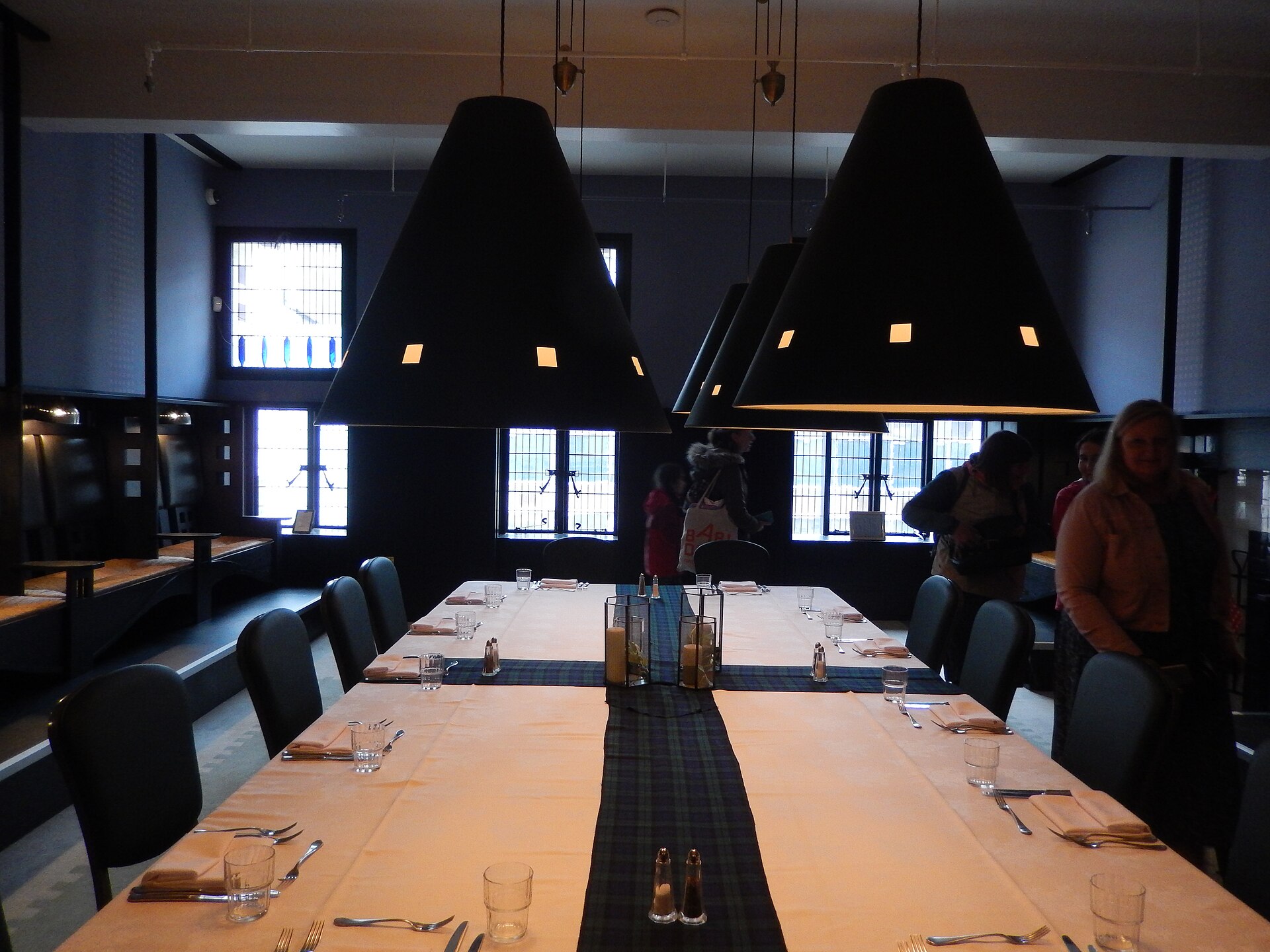
The Mackintosh Tearooms. Photograph: AlasdairW, 21 September 2024. CC BY-SA 4.0.

For Catherine Cranston, Charles Rennie Mackintosh and Margaret Macdonald created a complete social interior in which frontage, rooms, furniture, light and decoration work as one composition.
Quick facts
- Date
- Designed and completed 1903; comprehensively conserved and restored 2014–2018
- Architect / designer
- Charles Rennie Mackintosh with Margaret Macdonald Mackintosh for Catherine Cranston
- Type
- Purpose-designed tearooms with integrated façade, interiors, furniture and decorative art
- Designation
- Listed building, Category A (LB33173)
- OS grid reference
- NS 58594 65839
Why it matters
The building completed in 1903 for the entrepreneur Catherine Cranston is the fullest surviving expression of the tearoom as a total work of design. Charles Rennie Mackintosh shaped the architecture, spatial sequence and furnishings; Margaret Macdonald Mackintosh’s decorative work contributed decisively to the atmosphere and meaning of the interiors. Cranston’s commission made this collaboration possible and linked advanced design to a new kind of respectable urban sociability.
The tearooms offered different settings rather than one undivided hall. Their variety—public and intimate, light and shadowed, restrained and luxurious—allowed the building to accommodate different customers and occasions. That makes it important to read the rooms as a sequence and to credit the several people whose patronage and design work created them.
Design and construction
The narrow Sauchiehall Street frontage is treated as a tall, pale screen. Its broad window and delicate linear details distinguish the tearooms from heavier neighbouring commercial fronts. Inside, Mackintosh organised the deep urban plot through changes in level, light, enclosure and furniture. The long tea gallery draws movement into the building; other rooms offer different degrees of privacy.
The Salon de Luxe is the most concentrated interior. High-backed furniture, controlled lighting, reflective and coloured surfaces and Macdonald’s decorative panels create an environment in which fine and applied art cannot easily be separated. Chairs, screens, doors, light fittings and wall decoration establish proportion and rhythm at the scale of the body.
The surviving place is also a conservation reconstruction. Features were lost or altered during decades of changing use. The 2014–2018 project conserved original fabric where it survived and recreated missing elements through research and skilled making. Visitors should therefore distinguish between the 1903 conception, surviving original material and carefully documented replacement work.
What to notice
- The pale street front: its vertical emphasis and shallow ornament act as an invitation rather than a conventional shop façade.
- The sequence of rooms: changes in ceiling height, light and furniture give each space a different social character.
- The tall-backed chairs: furniture helps make smaller enclosures within larger rooms.
- Macdonald’s contribution: symbolic figures, texture and colour are integral to the Salon de Luxe.
- Evidence of restoration: interpretation on site can help distinguish conserved originals from recreated fittings and finishes.
Change and conservation
After alteration and fragmented uses, the building underwent comprehensive conservation between 2014 and 2018 and reopened in 2018. The National Trust for Scotland acquired it in 2024 and now presents it as The Mackintosh Tearooms. Changes of name and ownership should not obscure the longer identity of the place as Cranston’s Willow Tea Rooms or the collaborative authorship of its interiors.
Visiting and access
The building operates as tearooms, exhibition and learning venue with tours. Access to particular rooms may depend on bookings, events or service arrangements; current opening and accessibility information should be checked with the National Trust for Scotland.
Sources & further reading
- Historic Environment Scotland: The Mackintosh Tearooms, LB33173 — designation, fabric and significance.
- National Trust for Scotland: The Mackintosh Tearooms — current use and interpretation.
- National Trust for Scotland: a new era — ownership, naming and conservation context.
Location
OS grid reference NS 58594 65839 · Location confidence: High: the statutory designation supplies an exact National Grid Reference and the current operator confirms the building and address. · Select the marker to open its satellite view in Google Maps. On desktop, drag Pegman (the yellow figure) onto a blue road. On mobile, turn on the Street View layer and tap a blue road. Other photo markers may be user-contributed.
Suggest a marker correction
Suggest a more accurate position
The teal marker is the current published position. The orange marker starts slightly to its right so both remain visible; this is only a visual starting position. Tap the correct place on the map or drag the orange marker. Sending this form creates a private review entry only; it does not move the published marker.
Check this area in Google Maps Choose the Satellite layer there if useful.
Map: © OpenStreetMap contributors. You can also enter checked coordinates below.