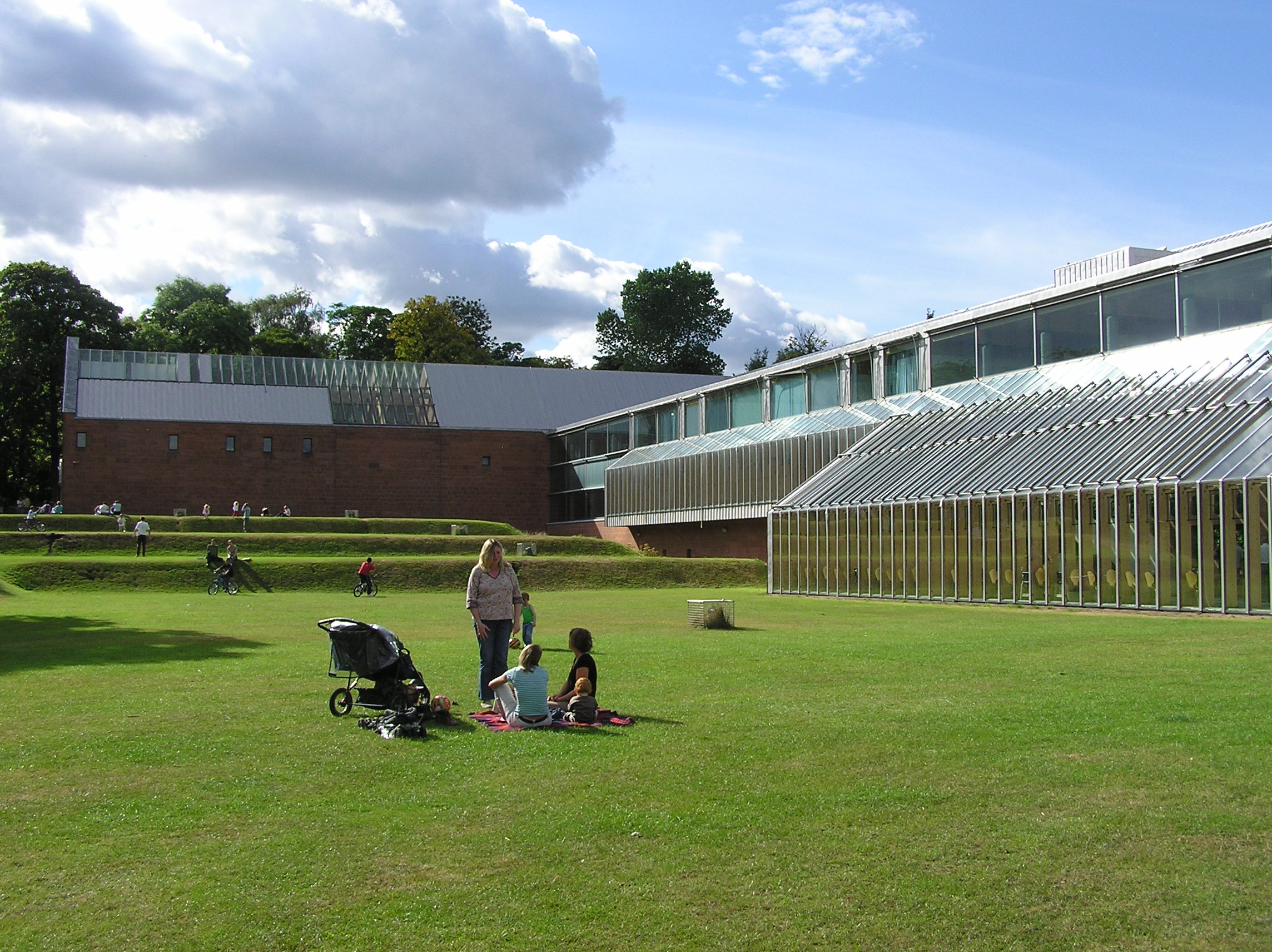

A low sandstone-and-glass museum makes landscape, collection and architecture inseparable, while its 2022 renewal carefully reworked a major post-war building for wider access and lower energy use.
Quick facts
- Date
- Designed 1971–1972 and built 1978–1983; refurbished 2016–2022
- Architect / designer
- Barry Gasson Architects; refurbishment by John McAslan + Partners
- Type
- Post-war museum composed as linked galleries, glazed courts and reconstructed historic interiors
- Designation
- Listed building, Category A (LB52002)
- OS grid reference
- NS 55553 62154
Why it matters
The Burrell Collection is important both as a home for Sir William and Constance Burrell’s gift and as a carefully judged response to it. The collection ranges from medieval sculpture and stained glass to tapestries, paintings, furniture and objects from many cultures. Its home had to accommodate that variety while meeting the donors’ wish for a setting protected from the polluted air of the industrial city. Pollok Country Park became part of the architectural idea: art, daylight and trees are repeatedly brought into the same field of view.
The competition-winning design by Barry Gasson Architects was developed in the early 1970s and realised between 1978 and 1983. It is now recognised as one of Scotland’s outstanding late-20th-century public buildings. The refurbishment completed in 2022 demonstrates a second layer of significance: how a much-loved modern building can be upgraded without replacing the spatial character that made it exceptional.
Design and construction
The building is a low, spreading composition of sandstone, glass and dark roofs. Its roughly triangular plan responds to the edge of woodland rather than imposing a formal urban front. From the entrance, galleries unfold as a sequence of compressed and expanded spaces. Long glazed walls and courts admit controlled daylight and frame the surrounding trees; more enclosed rooms protect light-sensitive works.
Historic interiors and architectural fragments are integrated with the museum route. Doorways, windows, stonework and reconstructed rooms are built into the museum’s circulation, so visitors pass through the collection as well as looking at it. The materials are deliberately restrained. Warm stone, timber, glass and carefully modulated light support the objects while making the building feel continuous with the park.
John McAslan + Partners’ 2016–2022 refurbishment retained that essential organisation while renewing services, improving environmental performance and increasing access to the building and collection. New and altered elements form part of a conservation-led adaptation that keeps the 1983 scheme legible.
What to notice
- The low silhouette: the museum sits beneath the tree canopy rather than competing with it.
- The long glazed elevations: views of woodland accompany the movement between galleries.
- The changes of scale: intimate rooms, tall courts and broad circulation spaces suit very different objects.
- Architecture as exhibit: historic doorways, windows and rooms are incorporated into the route.
- Old and new work: look for how the recent interventions improve access and servicing while keeping the original palette and spatial rhythm legible.
Change and conservation
The museum closed in 2016 for its most extensive renewal since opening and reopened in March 2022. The project addressed the building envelope, energy use, accessibility, display capacity and visitor circulation. Glasgow Life reported that the renewed museum made substantially more of the building accessible. This matters because conservation here involves both fabric and experience: the purpose is to retain the original relationship between objects, light and landscape while allowing the museum to function to current standards.
Visiting and access
The Burrell Collection is an operating, free museum managed by Glasgow Life. Opening arrangements, gallery closures, accessibility information and travel or parking restrictions within Pollok Country Park should be checked with the operator before a visit.
Sources & further reading
- Historic Environment Scotland: The Burrell Collection, LB52002 — designation, construction, authorship and architectural interest.
- Glasgow Life: The Burrell Collection — current operation and visitor information.
- Glasgow Life: 2022 reopening — refurbishment scope, access and environmental improvements.
Location
OS grid reference NS 55553 62154 · Location confidence: High: the HES designation supplies a mapped National Grid Reference and a current operator, council, court, school, congregation or institutional source confirms the Place relationship and present identity. · Select the marker to open its satellite view in Google Maps. On desktop, drag Pegman (the yellow figure) onto a blue road. On mobile, turn on the Street View layer and tap a blue road. Other photo markers may be user-contributed.
Suggest a marker correction
Suggest a more accurate position
The teal marker is the current published position. The orange marker starts slightly to its right so both remain visible; this is only a visual starting position. Tap the correct place on the map or drag the orange marker. Sending this form creates a private review entry only; it does not move the published marker.
Check this area in Google Maps Choose the Satellite layer there if useful.
Map: © OpenStreetMap contributors. You can also enter checked coordinates below.
In these guides: The Burrell Collection: Renewing a Modern Museum · Contemporary Scottish Architecture · Contemporary and Sustainable Architecture