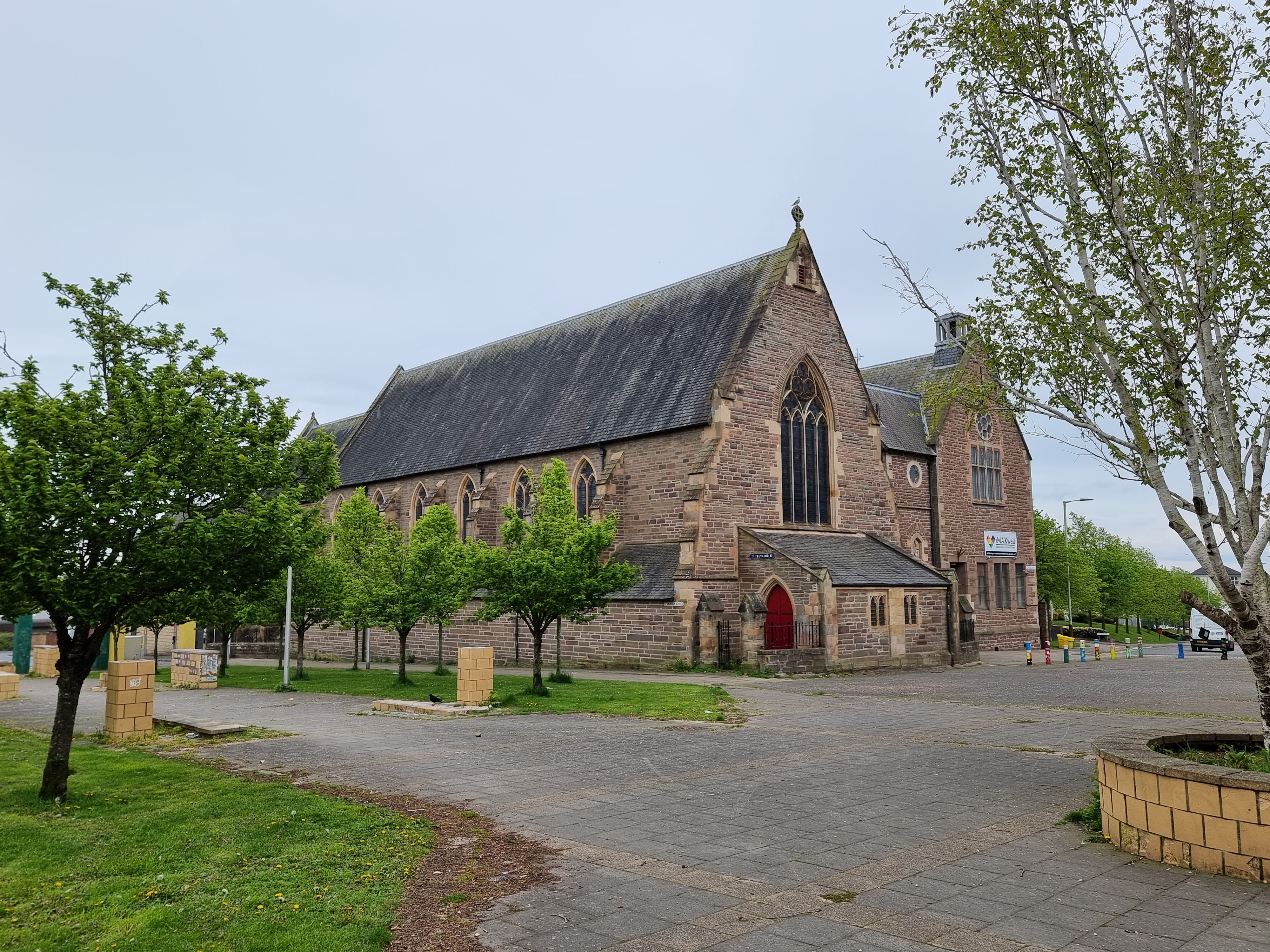
St Salvador’s is G. F. Bodley’s richly coloured Hilltown mission church: a Category A Gothic Revival landmark whose architecture, worship, music and food outreach remain inseparable from its social purpose.
Quick facts
- Date
- Hall 1857; nave 1865–1868; chancel and narthex 1874
- Architect
- George Frederick Bodley; glass and decorative work principally by Burlison and Grylls
- Type
- Scottish Episcopal mission church and hall
- Designation
- Listed building, Category A (LB25314)
- OS grid reference
- NO 40257 31310
A quiet exterior and an extraordinary interior
From St Salvador Street the church appears deliberately restrained: coursed rubble walls, ashlar dressings, steep slate roofs and strong buttresses form a simple Early English Gothic composition. The west gable is the principal public face, centred on a large four-light window with intersecting cusped tracery. Flush buttresses rise into the gable, which is finished by a niche and Celtic-cross finial. Nave, lower chancel, narthex and attached hall form a tightly grouped mission complex.
Inside, restraint gives way to a complete decorative environment. Stencilled colour spreads across walls and roof surfaces, becoming richer towards the chancel. Painted and gilded screens, a figured reredos, choir fittings, organ case, statuary and stained glass form a single theological and architectural composition. Historic Environment Scotland regards the work as an early application of Pre-Raphaelite principles to architecture and an important point in Bodley’s development from French towards English Gothic sources.
Built for Hilltown
The project began with a school and mission hall in 1857. Its upper floor was used for worship while the permanent church was planned. Bishop Alexander Penrose Forbes and the Reverend James Nicholson intended the mission for the mill-working population of Hilltown, linking sacramental worship with practical service in a densely inhabited industrial district.
The nave was built between 1865 and 1868, allowing worship to move from the hall. The chancel and narthex followed in 1874. These phases show how St Salvador’s developed from an active mission. That social purpose survives in the congregation’s present food support and welcome to visitors.
Decoration and craftsmanship
The flat patterned surfaces are central to the church’s significance. Historic Environment Scotland notes that Bodley’s stencilling was more refined than A. W. N. Pugin’s and influenced William Morris. Much of the stained glass was painted in a fifteenth-century manner by Burlison and Grylls; the wheel window in the west gable of the Lady Chapel, transferred from the school, is by Clayton and Bell. Simple timber choir stalls and sedilia are associated with John Sutton working with Bodley.
The paintwork was retouched in 1907 and 1936 and restored in 1972 by J. and T. Harvey, Rab Snowden and Colin McWilliam. Those interventions mean the interior is both Victorian in conception and the product of continuing conservation. The congregation’s own guide explains how colour, images, candles, incense, music and movement still animate the architecture during worship.
Why it matters
St Salvador’s is a rare Scottish work by Bodley and a particularly complete example of the Gothic Revival’s attempt to shape sight, sound and ritual as one experience.
What to notice
- The large west window and the contrast between its flowing tracery and the plain rubble wall.
- The increasing density of colour and ornament as the eye moves from nave to chancel.
- The painted reredos, screens, choir fittings and organ case as parts of a planned ensemble.
- The stained glass by Burlison and Grylls and the transferred Clayton and Bell wheel window.
- The attached hall, which preserves the mission’s educational and social origins.
Worship, music and access
St Salvador’s remains an active Scottish Episcopal church. Its September 2026 programme advertised Wednesday services at 10am and Sunday services at 11am, with Sung Mass or a lay-led service depending on clergy availability. Visitors are explicitly welcomed, whether attending worship, interested in the building or supporting the congregation’s outreach. The food cupboard operates after Sunday worship, and the church’s organ and acoustic also support concerts.
This is not advertised as a daily walk-in museum. Check the congregation’s current notices or make contact before a special visit, particularly outside service or concert times. During worship and food distribution, respect the congregation’s activities and ask before photographing people or the interior.
Timeline
- 1857 Bodley’s school and mission hall opens; the upper floor is used for worship.
- 1865–1868 The permanent nave is built.
- 1874 The chancel and narthex complete the principal Victorian sequence.
- 1907 and 1936 The painted decoration is retouched.
- 1972 A major restoration addresses the decorative scheme.
- Today The building continues as a church, music venue and base for food outreach.
What we know — and what remains uncertain
The statutory record securely establishes the design sequence, principal craftsmen and national architectural interest. Individual layers of paint have been restored and renewed, so present colours should not automatically be treated as untouched 1870s fabric. Service patterns can also vary when a priest is unavailable; the congregation’s live notices are the authority for current access.
Sources & further reading
- Historic Environment Scotland: St Salvador’s Episcopal Church and Hall, LB25314 — designation, phasing, fabric, decoration and statement of special interest.
- St Salvador’s Church — current service notices, welcome and outreach.
- A guide to St Salvador’s Church — congregation’s explanation of the interior, worship and music.
Location
OS grid reference NO 40257 31310 · Location confidence: High: the HES designation provides an official mapped National Grid Reference and the current source confirms the Place relationship or present identity. · Select the marker to open its satellite view in Google Maps. On desktop, drag Pegman (the yellow figure) onto a blue road. On mobile, turn on the Street View layer and tap a blue road. Other photo markers may be user-contributed.
Suggest a marker correction
Suggest a more accurate position
The teal marker is the current published position. The orange marker starts slightly to its right so both remain visible; this is only a visual starting position. Tap the correct place on the map or drag the orange marker. Sending this form creates a private review entry only; it does not move the published marker.
Check this area in Google Maps Choose the Satellite layer there if useful.
Map: © OpenStreetMap contributors. You can also enter checked coordinates below.