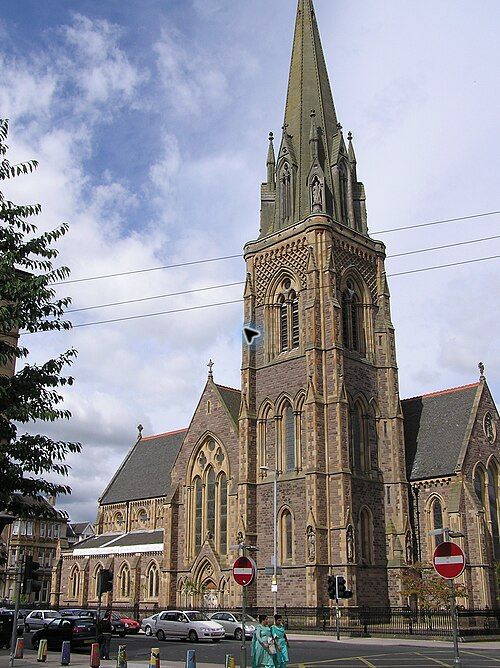
Image: St Mary’s Episcopal Cathedral, Glasgow by Finlay McWalter, sourced from Wikimedia Commons and licensed under CC BY-SA 3.0.

St Mary’s is a major west-end Gothic Revival church by George Gilbert Scott, completed with his son’s landmark spire and enriched by stained glass, Lorimer woodwork and an active tradition of worship and music.
Quick facts
- Date
- Opened 1871; completed 1871–78; consecrated 1884; spire 1893; cathedral from 1907–08
- Architect / designer
- Sir George Gilbert Scott; spire by John Oldrid Scott; later chancel work by Sir Robert Lorimer
- Type
- Cruciform Early English Gothic church with aisles, crossing tower and tall spire
- Designation
- Listed building, Category A (LB32198)
- OS grid reference
- NS 57760 66827
An Early English composition
The cathedral is built in stugged and snecked sandstone with polished freestone dressings. Its five-bay nave is flanked by buttressed aisles; round clerestory windows are linked by a blind arcade beneath the steep slate roof. Three tall lancets and a deeply recessed portal give the west front a clear hierarchy, while the low spread of nave and transepts makes the crossing tower and faceted spire especially commanding.
John Oldrid Scott completed the spire in 1893 above his father’s square tower. Ornament is concentrated in the louvred belfry stage, diapered stonework, corner bartizans, lucarnes and sculpted saints. This vertical addition transformed both the church’s silhouette and its contribution to Great Western Road.
A congregation older than the building
St Mary’s traces its history to Glasgow’s Episcopalian community before the abolition of episcopal church government in 1689. The congregation survived the eighteenth-century Penal Laws in private houses and meeting rooms. After their repeal in 1792 it grew more openly, moving to a Renfield Street chapel in 1825 before commissioning George Gilbert Scott for a new church in the expanding west end.
The church opened for worship in 1871 and was consecrated in 1884. Its cathedral role followed at the beginning of the twentieth century: Historic Environment Scotland gives 1907, while the cathedral’s own history gives 1908. That one-year difference is retained rather than silently resolved.
Interior craft and later change
Clustered columns carry the nave arcade and an open timber roof. At the crossing, fan vaulting provides a more elaborate focus. The octagonal stone pulpit and font stand on polished granite colonnettes; an ornate carved canopy covers the font. Wrought iron, carved oak and coloured glass add successive layers, including late nineteenth-century windows by Hardman and by Clayton & Bell.
After the First World War, Sir Robert Lorimer refitted the chancel. His carved oak reredos incorporates painted panels by Phoebe Anna Traquair, joining two major Scottish Arts and Crafts figures in one liturgical ensemble. Repairs in 1985 were followed by restoration and internal improvement from 1989 to 1996; further stonework, interior conservation, a nave altar and choir stalls, and a new entrance porch were completed in 2002.
Worship, music and diocesan life
St Mary’s remains the cathedral church of the Scottish Episcopal Diocese of Glasgow and Galloway and a gathering place for the diocese. Its official material presents worship, choral music, artistic activity and social engagement as continuing parts of cathedral life. The building is therefore not simply a preserved Scott church: its arrangement, sound and daily care continue to be shaped by congregational and diocesan use.
What to notice
- The horizontal spread of nave and aisles against the sharply rising crossing spire.
- Round clerestory windows linked by blind arches, above the pointed aisle openings.
- Diapered stonework, bartizans, lucarnes and sculpted saints on the upper tower and spire.
- The fan-vaulted crossing and contrast between stone arcades and the open timber nave roof.
- Lorimer’s carved oak reredos with Traquair’s painted panels, alongside Hardman and Clayton & Bell glass.
Visiting and access
The cathedral’s official information checked on 27 September 2026 says that visitors are welcome at service times. Its current regular-service page lists Sunday worship at 9am, 11am and 5pm. A visit at another time may be possible with advance notice if someone is available to open the building; the office asks visitors to make contact and publishes weekday office hours of 10am–2pm.
This is an active place of worship, so a service is not an unrestricted architectural viewing session and access to non-public or operational areas should not be assumed. Service arrangements and building availability may change; check the cathedral’s current information or contact the office before making a special journey.
Timeline
- Before 1689–1792 Glasgow’s Episcopalian congregation survives political and legal change, often worshipping in private or temporary premises.
- 1825 St Mary’s Episcopal Chapel opens in Renfield Street.
- 1871 Scott’s Great Western Road church opens for worship.
- 1884 The church is consecrated.
- 1893 John Oldrid Scott completes the tower spire.
- 1907–08 St Mary’s becomes the cathedral of the Diocese of Glasgow and Galloway.
- After 1918 Lorimer refits the chancel, including the reredos with Traquair panels.
- 1985–2002 Roof, stonework, interior, organ and entrance projects restore and adapt the cathedral.
What remains uncertain
The statutory and cathedral accounts differ by one year over cathedral status, giving 1907 and 1908 respectively. Both are cited. The broader sequence is secure: the church opened in 1871, was consecrated in 1884, gained its spire in 1893 and assumed diocesan cathedral functions shortly afterwards.
Sources & further reading
- Historic Environment Scotland: St Mary’s Episcopal Cathedral, Glasgow, LB32198 — designation, fabric, fittings, architects and cathedral-status date.
- St Mary’s Cathedral: history — congregational origins, construction, spire, diocesan role and restoration.
- St Mary’s Cathedral: about and visiting — current identity, visitor arrangements, contact and office hours.
- St Mary’s Cathedral: regular services — current advertised Sunday service pattern.
Location
OS grid reference NS 57760 66827 · Location confidence: High: the statutory designation supplies a mapped National Grid Reference and a current official operator, responsible public body or institutional source confirms the Place relationship and present identity. · Select the marker to open its satellite view in Google Maps. On desktop, drag Pegman (the yellow figure) onto a blue road. On mobile, turn on the Street View layer and tap a blue road. Other photo markers may be user-contributed.
Suggest a marker correction
Suggest a more accurate position
The teal marker is the current published position. The orange marker starts slightly to its right so both remain visible; this is only a visual starting position. Tap the correct place on the map or drag the orange marker. Sending this form creates a private review entry only; it does not move the published marker.
Check this area in Google Maps Choose the Satellite layer there if useful.
Map: © OpenStreetMap contributors. You can also enter checked coordinates below.