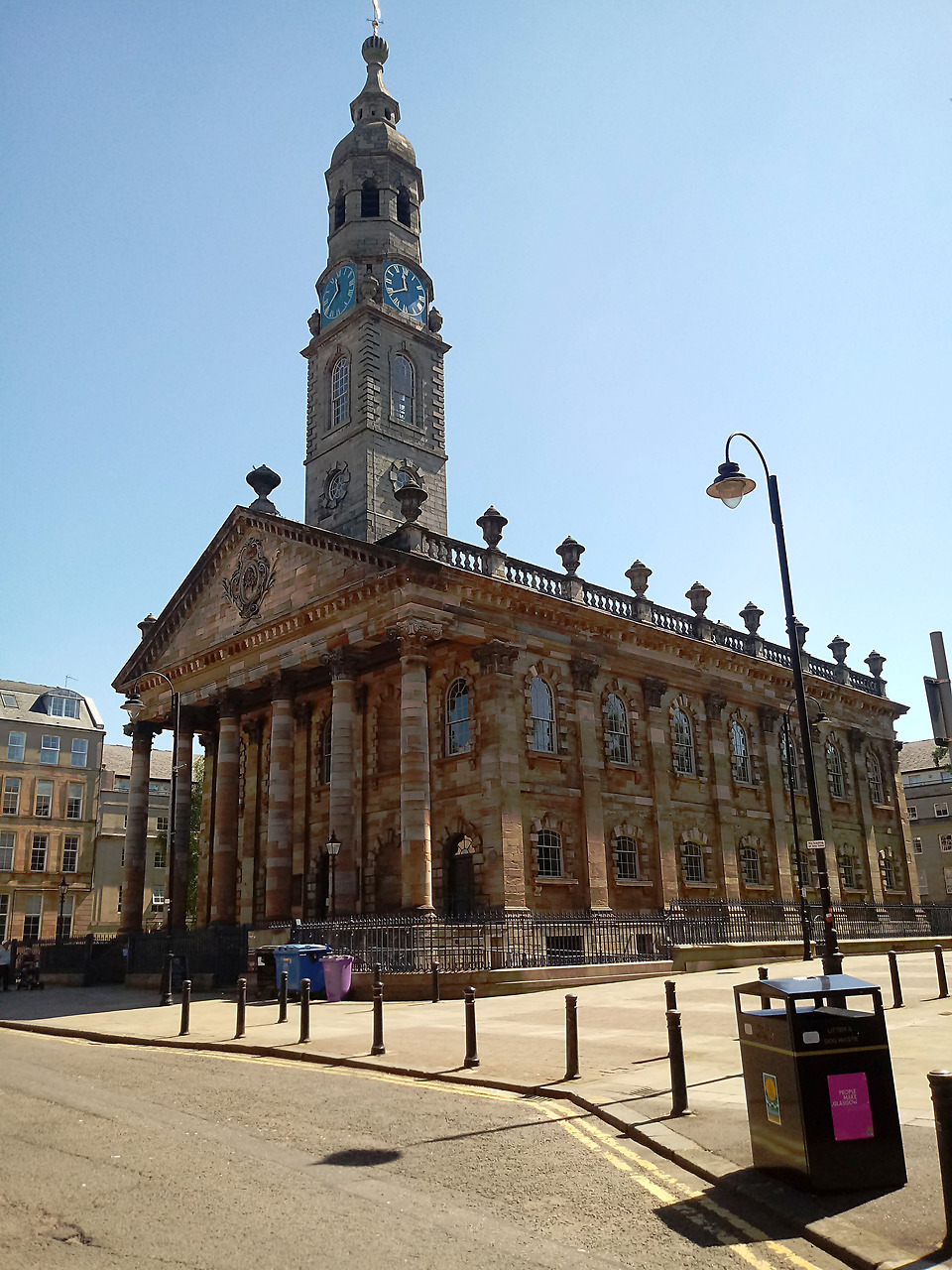
St Andrew’s in the Square is a landmark of eighteenth-century Glasgow: a monumental classical church whose portico, steeple and exceptionally rich interior survived through an ambitious conversion to cultural use.
Quick facts
- Date
- Built 1739–56; altered 1874 and 1921; restored and adapted 1993–2000
- Architect / designer
- Allan Dreghorn; master mason Mungo Naismith; rococo plasterwork by Thomas Clayton
- Type
- Monumental classical former parish church with galleried interior, five-stage steeple and inserted lower-ground facilities
- Designation
- Listed building, Category A (LB32830)
- OS grid reference
- NS 59702 64678
A new classical language for Glasgow
Allan Dreghorn’s design drew strongly on James Gibbs’s St Martin-in-the-Fields in London, adapting its portico-and-steeple composition for Presbyterian worship. A giant six-column Corinthian portico projects from the west front. Behind it, the polished-ashlar body is ordered by colossal Corinthian pilasters, Gibbsian rusticated window surrounds, a dentilled cornice, balustraded parapet and urn finials. The five-stage steeple changes from a square clock tower to an octagonal colonnaded drum and dome.
The church became the centrepiece of a formally planned residential square developed from the 1760s. Much of that setting was later demolished or altered, but the building still demonstrates how a single civic monument could organise a new piece of the expanding city.
An exceptional interior
The three-sided galleries and giant fluted Corinthian columns give the interior both clarity and theatrical richness. Thomas Clayton’s rococo plasterwork flows across the barrel-vaulted ceiling, while carved mahogany gallery fronts, gilded capitals, the octagonal pulpit and civic seating retain the social hierarchy of the eighteenth-century church. John Carrick’s 1874 work introduced pews and a Willis organ; stained glass by Stephen Adam also belongs chiefly to that phase. Peter MacGregor Chalmers undertook further alterations in 1921.
The finest fabric is therefore not a frozen record of 1756. It combines Dreghorn and Clayton’s Georgian scheme with carefully legible Victorian and early-20th-century interventions.
Decline, rescue and adaptation
The congregation’s final service took place in 1993. Glasgow Building Preservation Trust then led a major rescue, repairing the historic fabric and creating the supporting spaces needed for a viable secular use. A deep lower-ground insertion provided a café, rehearsal and service accommodation without overwhelming the principal volume. The restored building opened on St Andrew’s Day 2000 as a centre for Scottish music, song and dance and received several conservation and design awards, including a Europa Nostra diploma.
The separate St Andrew’s in the Square Trust later managed the cultural operation, but the Scottish Charity Register records that charity as removed on 8 April 2020. Its former website and historic trust descriptions should therefore not be read as proof of a present operator, opening hours or programme.
What to notice
- The sequence from giant portico to square tower, octagonal drum and dome.
- Gibbsian window surrounds, parapet urns and the surviving relationship with the square.
- The original carved gallery fronts and Clayton’s rococo ceiling.
- The contrast between the principal historic volume and the discreetly inserted lower-ground facilities.
Access
No dependable routine opening timetable could be verified on 27 September 2026. The exterior and setting can be appreciated from public streets and the square. Interior access should be assumed only when a current event listing, booking confirmation or authorised arrangement expressly names this venue; the former charity’s archived material is historical evidence, not current permission.
Timeline
- 1739–56 The church is built to Allan Dreghorn’s design, with Thomas Clayton’s plasterwork begun in 1753.
- From the 1760s A formal residential square develops around the church.
- 1874 John Carrick alters the interior; pews, organ work and much of the stained glass belong to this period.
- 1921 Peter MacGregor Chalmers undertakes further alterations.
- 1993 Worship ends and the preservation-led conversion begins.
- 30 November 2000 The restored building opens as a cultural centre.
- 8 April 2020 OSCR records the St Andrew’s in the Square Trust as ceased and removed.
Sources & further reading
- Historic Environment Scotland: St Andrew’s in the Square, LB32830 — designation, exterior, interior, alterations and significance.
- Glasgow Building Preservation Trust: Our Story — completion of the conservation project and creation of the basement café.
- National Lottery Heritage Fund: restoration project — preservation-led conversion context.
- OSCR: St Andrew’s in the Square Trust — former charitable purpose, ceased date and removed status.
St Andrew’s in the Square. Photograph: Rudi Winter, 27 June 2019. CC BY-SA 2.0.
.jpg)