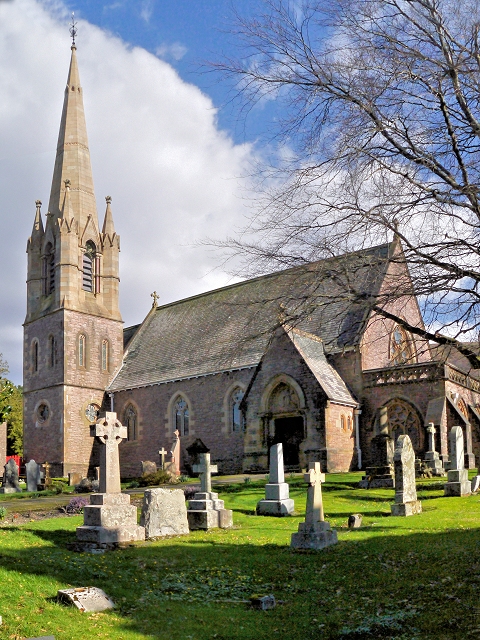
Image: Stone Gothic Revival church of St Andrew in Fort William, with a tall broach spire and churchyard memorials by David Dixon, licensed under CC BY-SA 2.0.
.jpg)
Alexander Ross’s church of 1880 is a complete High Gothic ensemble of red Highland granite, spire, burial ground and lych gate, with an interior enriched by Harry Hems’s woodwork, Salviati mosaics and stained glass.
Quick facts
- Date
- Built and consecrated in 1880 on the site of the 1817–1876 Rosse Episcopal Chapel
- Architect / designer
- Alexander Ross; woodwork by Harry Hems; mosaics by Salviati
- Type
- Cruciform Scottish Episcopal church with tower and spire, burial ground, lych gate and Bank Street entrance
- Designation
- Category A listed building (LB31788)
- OS grid reference
- NN 10361 74005
- Current use
- Active Scottish Episcopal church
A High Gothic landmark in Highland stone
St Andrew’s stands just off the High Street within its walled burial ground. Alexander Ross designed the present church in 1880 on a cruciform east–west plan, with a nave, chancel, south transept used as a vestry and a tower to the north. Bullfaced, sneck-coursed red Abriachan granite gives the building a rugged texture, sharpened by contrasting tooled and polished sandstone dressings.
The north-west porch has a shouldered lintel and polished granite nook shafts with stiff-leaf capitals. Above, a pointed tympanum carries a figure of St Andrew, while thistles and roses fill the spandrels. The west baptistery is a low rectangular projection with squat traceried windows, angle buttresses and a carved balustrade. Larger traceried windows light the east and west gables.
The three-stage tower changes character as it rises: quatrefoil oculi mark the lowest stage, paired round-headed lancets the second, and louvred openings with gablets and pinnacled corners the third. A slender faceted spire finishes in a ball finial and weathervane, with small lucarnes and quatrefoil detail animating the transition. Its height makes St Andrew’s one of the centre’s clearest vertical landmarks.
Craft and colour inside
Historic Environment Scotland describes the interior as a richly detailed work of considerable quality. The baptistery is entered through a traceried screen and has a bossed vault. At its centre stands a white Caen-stone font beneath an ornate carved timber canopy by Harry Hems, set over a rich mosaic floor by Salviati.
Stained-glass windows form a New Testament sequence along the nave. The Caen-stone pulpit is carried on arches and polished marble columns with stiff-leaf capitals; its stair balustrade continues the same language. Hems also supplied the carved oak choir stalls with poppy-head ends and the church doors. Their panels range from a Good Shepherd scene at the porch to linenfold and a carving of St Columba on the vestry doors.
The sanctuary contains a brass altar rail, sedilia, bishop’s throne and aumbry. Across the east wall, an arcaded reredos culminates in a crocketed gable and Salviati mosaic of the Crucifixion. Stone, timber, iron, glass and mosaic are therefore not isolated ornaments but parts of an unusually coherent Victorian interior.
Church, burial ground and entrances
The statutory designation is wider than the church alone. Red granite walls and sandstone copings enclose the burial ground; ornamental spearhead railings face the High Street. The timber lych gate has bench seats, wooden gates and a red-tiled jerkin-headed roof with ridge decoration and finials. On Bank Street, a pointed entrance arch is crowned by a small bellcote-like feature. Together these elements shape the transition from a busy town street to the sheltered churchyard.
From the Rosse Chapel to the present church
The earlier Rosse Episcopal Chapel occupied the site from 1817 until 1876. The present church followed in 1880, built largely through the generosity of George Baynton Davey of Spean Bridge. Ross, an Inverness architect responsible for churches across the Highlands, combined local granite with a confident High Gothic design and commissioned specialist craft from beyond the region.
St Andrew’s remains an active congregation of the Scottish Episcopal Church. That continuity matters: the building has not become a museum, even though its fabric and fittings reward close architectural attention.
Why it matters
Category A status reflects the completeness and quality of the whole ensemble. The church preserves its Gothic massing and spire, extensive interior decoration, burial ground walls and railings, lych gate and secondary entrance. It also demonstrates how a nationally connected Victorian church could remain materially specific to the Highlands through the use of Abriachan granite.
What to notice
- The St Andrew figure, thistles and roses over the north-west porch.
- The tower’s progression from oculi to paired lancets, pinnacles and slender spire.
- The bossed baptistery vault, Hems font canopy and Salviati floor.
- The narrative carving and ironwork on the several church doors.
- The east-wall reredos and Crucifixion mosaic.
- The lych gate and Bank Street arch as designed parts of the listed ensemble.
Worship, visiting and access
The National Churches Trust currently lists Sunday worship at 10.45am and says the church is usually open daily from 10am to 5pm. Its directory also warns that opening information can change, so a special visit should be confirmed with the church or current clergy contact published by the Scottish Episcopal Church.
The same visitor source records steps at the church or churchyard and does not advertise a step-free entrance. Anyone with mobility requirements should therefore contact the congregation before travelling. During worship, funerals and private prayer, the church’s religious use takes priority. Visitors should respect the burial ground and obtain permission before photographing people, services or restricted areas.
Timeline
- 1817–1876 The Rosse Episcopal Chapel occupied the site.
- 1880 Alexander Ross’s present church was built and consecrated, supported substantially by George Baynton Davey.
- 1971 The church, burial ground, lych gate and entrances were added to the statutory list.
- Present St Andrew’s remains an active Scottish Episcopal congregation and is normally available for worship and advertised visitor opening.
What we know — and what remains uncertain
The designation supplies a detailed architectural account and identifies the principal craftsmen, but routine opening and service information is maintained by church directories and can change. This record therefore distinguishes the enduring fabric from current access arrangements and advises confirmation before a special journey.
Sources & further reading
- Historic Environment Scotland: St Andrew’s Episcopal Church, LB31788 — designation, grid reference, architect, predecessor chapel, stonework, fittings, burial ground, lych gate and entrances.
- Scottish Episcopal Church: St Andrew, Fort William — current church identity, address and clergy contact.
- National Churches Trust: St Andrew, Fort William — current reported opening, Sunday service, access limitation and visitor overview; arrangements should be confirmed before a special trip.
Location
OS grid reference NN 10361 74005 · Location confidence: High: the statutory designation supplies an official mapped National Grid Reference and the current source confirms the Place relationship or present identity. · Select the marker to open its satellite view in Google Maps. On desktop, drag Pegman (the yellow figure) onto a blue road. On mobile, turn on the Street View layer and tap a blue road. Other photo markers may be user-contributed.
Suggest a marker correction
Suggest a more accurate position
The teal marker is the current published position. The orange marker starts slightly to its right so both remain visible; this is only a visual starting position. Tap the correct place on the map or drag the orange marker. Sending this form creates a private review entry only; it does not move the published marker.
Check this area in Google Maps Choose the Satellite layer there if useful.
Map: © OpenStreetMap contributors. You can also enter checked coordinates below.