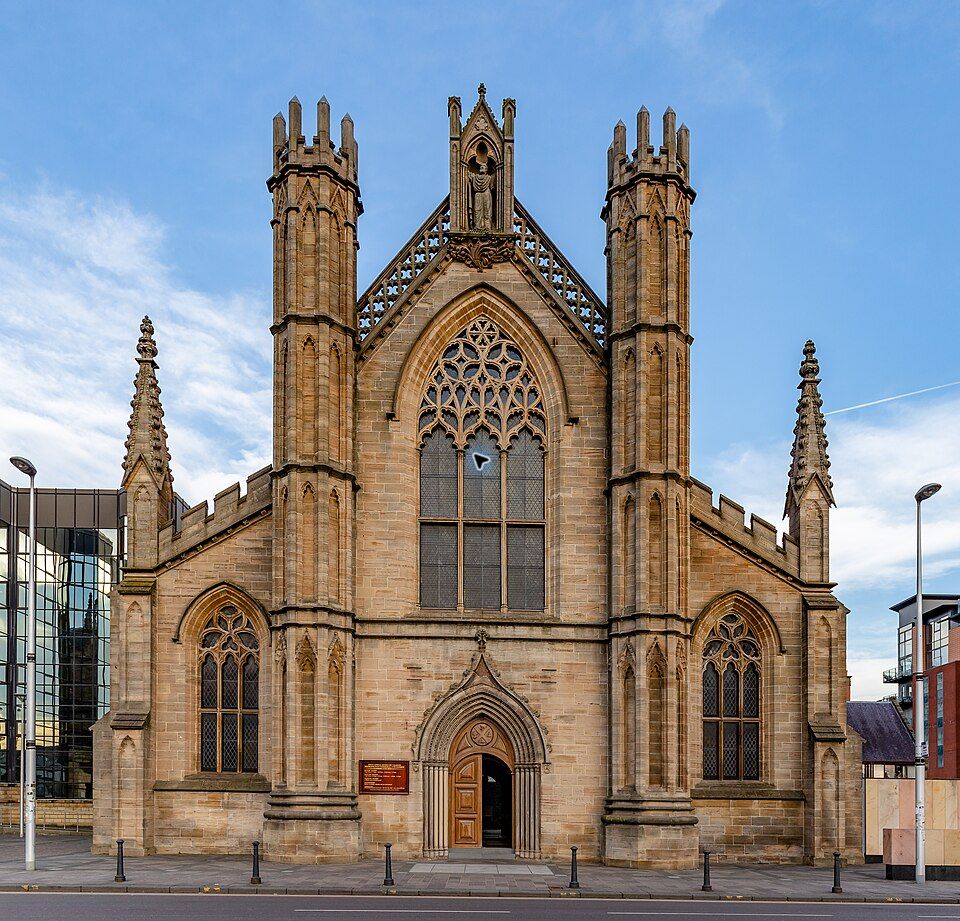
Image: St Andrew’s Cathedral, Glasgow by Michal Klajban, sourced from Wikimedia Commons and licensed under CC BY-SA 4.0.

St Andrew’s is a compact Neo-Perpendicular cathedral built for Glasgow’s rapidly growing Catholic community in 1814–17, still serving daily worship while holding a remarkably rich interior within a narrow Clyde-side site.
Quick facts
- Date
- Foundation stone 1814; first Mass 22 December 1816; completed 1817; cathedral from the late 1880s
- Architect / designer
- James Gillespie Graham; later interior work by Pugin & Pugin
- Type
- Neo-Perpendicular Roman Catholic cathedral on a constrained riverside site
- Designation
- Listed building, Category A (LB32666)
- OS grid reference
- NS 59080 64793
A cathedral fitted to a narrow site
James Gillespie Graham arranged the church as a rectangular nave and aisles rather than attempting a sprawling cathedral plan. Cream ashlar gives the Clyde Street front a civic clarity. Its tall three-light window, crocketed ogee hood, figure of St Andrew, pinnacled buttresses and polygonal turrets concentrate the Gothic display on the public face. Six disciplined bays run north along each side; clerestory windows rise behind the aisle parapets, and the shallow canted apse closes the north end.
The Historic Environment Scotland description calls the narrow-site solution notably successful. The unbuilt college planned in a matching Gothic manner is an important reminder that the present cathedral was one part of a larger Catholic institutional ambition curtailed by cost.
From tolerated chapel to metropolitan cathedral
The parish traces its public beginnings to 1792, when Mass for about two hundred people was celebrated in a rented Mitchell Street hall after centuries in which Catholic worship had little open presence in Glasgow. Industrial growth then drew Catholic workers from Ireland and the Highlands. By 1814 the parish recorded about 3,000 communicants, and the priest Andrew Scott drove the project for a permanent church. The foundation stone was laid that June and the first Mass was celebrated inside on 22 December 1816.
The restoration of Scotland’s Catholic hierarchy in 1878 changed the church’s institutional place. The cathedral history records the re-establishment of a Chapter of Canons in 1884; Historic Environment Scotland gives 1889 for cathedral status. In 1947 St Andrew’s became a Metropolitan Cathedral when Glasgow recovered metropolitan rank after the creation of the dioceses of Motherwell and Paisley.
Interior, alteration and continuity
The central and side aisles are divided by keel-shaped clustered columns beneath a plaster fan vault with ornate bosses. Historic fittings include the painted and gilded chancel arch, marble reredos and altar, Caen-stone chapel altars, bronze gates, polychrome marble pulpit and stained glass. Pugin & Pugin altered the interior in 1871 and again in 1892, so it should not be read as an untouched 1810s scheme.
Later work continues the cathedral’s living history. A Carrara-marble font by Tim Pomeroy was installed in 2011; contemporary mosaics, paintings and carved doors introduce St Andrew, St Mungo, St John Ogilvie and other Scottish saints into the restored interior. These works sit beside nineteenth-century glass and reordered sanctuary fittings rather than imitating them.
What to notice
- The way the tall south gable creates a cathedral-scale address without a transept or freestanding tower.
- Quatrefoil tracery, crocketed pinnacles and the figure of St Andrew above the entrance.
- The fan-vaulted interior, coloured bosses and contrast between pale stone, marble and gilding.
- The changing layers: nineteenth-century Pugin work, later stained glass and the 2010s font, mosaics and carved doors.
- The close relationship between the cathedral, Clyde Street, the river and the modern paved square.
Visiting and access
The cathedral’s official visitor information checked on 27 September 2026 states that it is normally open daily from 8am to 6pm, with free entry. Visitors are welcome throughout the day, but movement is restricted during services. Groups should contact the Cathedral Office in advance; volunteer guides may be arranged. The building remains first and foremost a place of worship, and the weekly bulletin should be checked for special liturgies or altered arrangements.
The current official pages do not provide a detailed building-access statement covering every level and facility. Anyone with particular mobility, sensory or group requirements should contact the cathedral before travelling rather than assume that all historic areas are freely accessible.
Timeline
- 1792 Public Catholic worship resumes in rented Glasgow premises.
- June 1814 The foundation stone is laid for the Clyde Street church.
- 22 December 1816 The first Mass is celebrated inside; building work concludes in 1817.
- 1871 and 1892 Pugin & Pugin undertake significant interior alterations.
- 1878–89 The Catholic hierarchy and Glasgow chapter are restored; the church becomes the archdiocesan cathedral.
- 1947 St Andrew’s becomes a Metropolitan Cathedral.
- 2011 Tim Pomeroy’s Carrara-marble font forms part of the renewed interior.
What the dates mean
The official cathedral history records the first Mass in December 1816, while the statutory record dates the building 1814–17. Those statements describe opening and completion rather than a contradiction. The cathedral history places the restored Chapter in 1884; the statutory record gives 1889 for cathedral status, so the transition is best understood as a sequence rather than reduced to one unsupported date.
Sources & further reading
- Historic Environment Scotland: St Andrew’s Cathedral, Glasgow, LB32666 — designation, plan, exterior, interior, later alterations and significance.
- St Andrew’s Cathedral: history — parish origins, construction, Catholic hierarchy and continuing role.
- St Andrew’s Cathedral: visiting — current opening, group visits, free entry and restrictions during services.
- St Andrew’s Cathedral: current programme — current opening, Masses, reconciliation and weekly-programme advice.
Location
OS grid reference NS 59080 64793 · Location confidence: High: the statutory designation supplies a mapped National Grid Reference and a current official operator, responsible public body or institutional source confirms the Place relationship and present identity. · Select the marker to open its satellite view in Google Maps. On desktop, drag Pegman (the yellow figure) onto a blue road. On mobile, turn on the Street View layer and tap a blue road. Other photo markers may be user-contributed.
Suggest a marker correction
Suggest a more accurate position
The teal marker is the current published position. The orange marker starts slightly to its right so both remain visible; this is only a visual starting position. Tap the correct place on the map or drag the orange marker. Sending this form creates a private review entry only; it does not move the published marker.
Check this area in Google Maps Choose the Satellite layer there if useful.
Map: © OpenStreetMap contributors. You can also enter checked coordinates below.