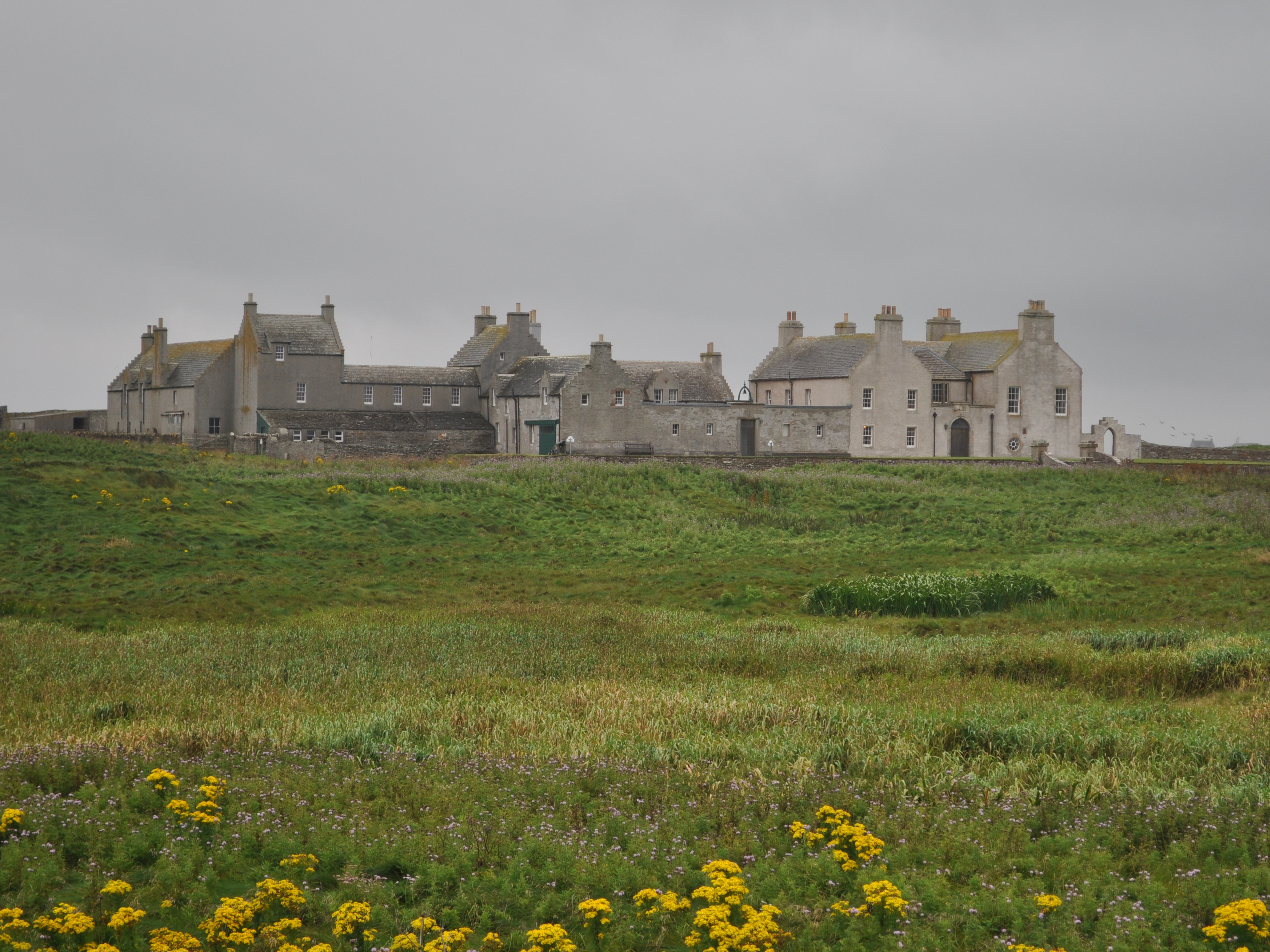
Image: Skaill House, Orkney by Stevekeiretsu, 6 August 2014, sourced from Wikimedia Commons and licensed under CC BY-SA 4.0.


Orkney’s most complete seventeenth-century country mansion grew around a courtyard and now interprets four centuries of estate life beside Skara Brae.
Quick facts
- Date
- Early 17th century core; altered 1676 and repeatedly enlarged
- Architect / designer
- Successive Graeme and Graham-Watt owners and their builders
- Type
- Multi-period courtyard country house
- Designation
- Listed building, Category A (LB18704)
- OS grid reference
- HY 23419 18614
Architecture, archaeology and continuing use
The oldest harled ranges form three sides of a court, with crowsteps on one arm and later infill accommodating a stair. Stables, brewhouse and harness room lie by the house, while nineteenth- and twentieth-century additions record continued occupation.
Its story
A house was established here in the early seventeenth century and altered in 1676. Generations of the Graeme, later Graham-Watt, family expanded it. The laird William Watt began investigating Skara Brae after the 1850 storm; restoration enabled seasonal public opening in 1997.
Why it is included
Category A listing recognises the most complete seventeenth-century country house in Orkney and its unusually close historical relationship with the discovery of Skara Brae.
What to notice
- Crowstepped masonry on the older range.
- The enclosed court and later stair infill.
- Estate service buildings showing how the house functioned as a working centre.
Reading the surroundings
Skaill House is privately owned and opens seasonally through the joint Skara Brae visitor arrangement. Check current times and tickets; do not enter residential or service areas beyond the visitor route.
Timeline
- Circa 1620 The early mansion was established beside the Bay of Skaill.
- 1676 A dated campaign altered the seventeenth-century ranges.
- 1850 William Watt began investigating the storm-exposed settlement nearby.
- 1997 The restored house opened to public visitors.
What we know — and what remains uncertain
The earliest fabric is generally dated to the early seventeenth century, but the precise sequence before and around 1676 is not fully secure.
Sources & further reading
- Historic Environment Scotland: Skaill House, LB18704 — Designation status, mapped location, date, fabric and architectural or archaeological interest.
- Skaill House: the house — Ownership history, development, public opening and present visitor arrangements.
- Historic Environment Scotland: Skaill designed landscape — Estate setting and relationships among the house, service buildings and surrounding landscape.
Location
OS grid reference HY 23419 18614 · Location confidence: High: the national designation supplies an official mapped National Grid Reference; an additional source confirms the Place relationship, history or current identity. · Select the marker to open its satellite view in Google Maps. On desktop, drag Pegman (the yellow figure) onto a blue road. On mobile, turn on the Street View layer and tap a blue road. Other photo markers may be user-contributed.
Suggest a marker correction
Suggest a more accurate position
The teal marker is the current published position. The orange marker starts slightly to its right so both remain visible; this is only a visual starting position. Tap the correct place on the map or drag the orange marker. Sending this form creates a private review entry only; it does not move the published marker.
Check this area in Google Maps Choose the Satellite layer there if useful.
Map: © OpenStreetMap contributors. You can also enter checked coordinates below.