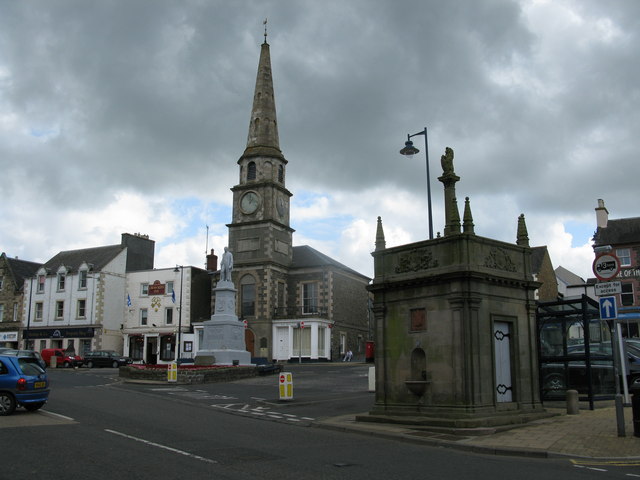
Image: Selkirk Town House and Sir Walter Scott’s Courtroom by G Laird, sourced from Wikimedia Commons and licensed under CC BY-SA 2.0.

A stone town house and soaring spire contain the courtroom where Walter Scott served as sheriff, joining burgh government, law and literature.
Quick facts
- Date
- 1803–04; later 19th-century alterations
- Architect / designer
- Burgh commissioners; architect not securely identified
- Type
- Classical town house, courthouse and steeple
- Designation
- Listed building, Category A (LB40569)
- OS grid reference
- NT 47026 28477
Architecture, archaeology and continuing use
The two-storey classical frontage combines polished ashlar, whinstone and a central arched entrance. A staged clock tower rises into an octagonal stone spire, giving the small Market Place building a commanding vertical presence.
Its story
Selkirk’s new Town House opened in 1804 with rooms for burgh government, court business and a library. Sheriff functions later moved, and the courtroom was re-presented as a museum interpreting Walter Scott’s legal and literary associations.
Why it is included
Category A architecture, civic function and an unusually direct association with Scott make this foundational to understanding Selkirk.
What to notice
- Whinstone and ashlar classical frontage.
- Clock stages and octagonal stone spire.
- Historic courtroom fittings and Scott displays when open.
Reading the surroundings
The museum has seasonal opening hours. Check Live Borders information before visiting, follow staff guidance and do not assume access to closed rooms or the steeple.
Timeline
- 1803–04 The burgh completed a new town house with court and library rooms.
- 1800–32 Walter Scott served as Sheriff-Depute and heard cases in Selkirk.
- 1870s Sheriff business transferred to the new Ettrick Terrace courthouse.
- 2026 Live Borders operates the restored courtroom as a seasonal museum.
What we know — and what remains uncertain
Seasonal opening and event arrangements change, so the current museum page is authoritative for access.
Sources & further reading
- Historic Environment Scotland: Selkirk Town House and Sir Walter Scott’s Courtroom, LB40569 — Designation status, mapped location, date, fabric and architectural or archaeological interest.
- Live Borders: Sir Walter Scott’s Courtroom — Current museum identity, opening information, displays and Scott association.
Location
OS grid reference NT 47026 28477 · Location confidence: High: the national designation supplies an official mapped National Grid Reference; the independent source confirms the Place relationship, history or current identity. · Select the marker to open its satellite view in Google Maps. On desktop, drag Pegman (the yellow figure) onto a blue road. On mobile, turn on the Street View layer and tap a blue road. Other photo markers may be user-contributed.
Suggest a marker correction
Suggest a more accurate position
The teal marker is the current published position. The orange marker starts slightly to its right so both remain visible; this is only a visual starting position. Tap the correct place on the map or drag the orange marker. Sending this form creates a private review entry only; it does not move the published marker.
Check this area in Google Maps Choose the Satellite layer there if useful.
Map: © OpenStreetMap contributors. You can also enter checked coordinates below.