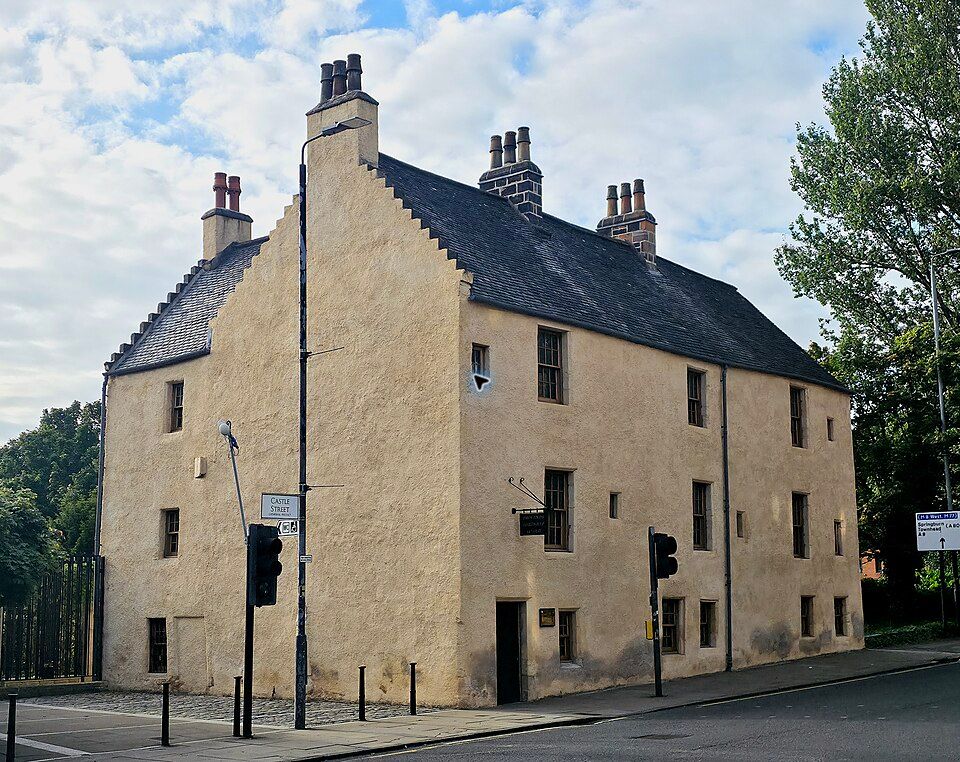
Image: Provand’s Lordship by TSP, sourced from Wikimedia Commons and licensed under CC BY 4.0.

Provand’s Lordship is Glasgow’s last surviving late-medieval urban house: a 1471 cathedral manse whose low rooms, massive fireplaces and later ranges now form a free museum beside Glasgow Cathedral.
Quick facts
- Date
- Built 1471; enlarged in the seventeenth century, including a dated 1670 stair block; major repairs completed 2024
- Architect / designer
- Medieval builders unknown; built for Andrew Muirhead, Prebend of Barlanark; 1670 work associated with William Bryson
- Type
- Late-medieval prebendal manse, later house and shop, now a furnished historic-house museum
- Designation
- Listed building, Category A (LB32648)
- OS grid reference
- NS 60096 65506
A medieval house assembled over time
The Castle Street front is more orderly than the building’s history. Three storeys and an attic rise in rubble sandstone, with squared stone at quoins and openings. Eighteenth-century windows regularised the east elevation, but the rear remains deliberately legible as a sequence of additions: gabled ranges, an external stair block, irregular openings and wall-head chimneys. Crowsteps, chamfered margins, broad fireplaces and heavy roughly hewn ceiling beams preserve the scale and construction of a house formed long before Glasgow became an industrial city.
The southern gable carries the weathered arms of Andrew Muirhead. A sundial on the 1670 stair addition bears the initials of William Bryson, linking a visible change in the fabric to a known later occupant. The iron railings and small gate are included in the statutory designation.
From cathedral manse to city museum
Historic Environment Scotland identifies the 1471 core as a prebendal manse built for Andrew Muirhead, then Bishop of Glasgow. It later served the neighbouring Hospital of St Nicholas. Extensions accumulated during the seventeenth century, while later centuries brought domestic and commercial lives: Glasgow Life records uses including a shop, public house and family home.
The Provand’s Lordship Society began the building’s modern rescue in 1906. Later work included reroofing in 1978 and restoration in 1983. A further £1.6 million programme begun in 2022 repaired roofs, chimneys and rainwater goods, renewed doors and windows in historically appropriate forms, addressed rising damp and reinstated protective lime harling. The museum reopened on 29 March 2024.
Interiors and interpretation
Inside, low ceilings, wide hearths and deep masonry openings convey the physical character of the medieval house. Displays combine the building’s own story with seventeenth-century Scottish furniture, royal portraits and interpretation of the Cathedral Precinct. These furnished rooms are a museum presentation rather than an intact interior belonging to one documented household or period.
Behind the house, St Nicholas Garden extends the visit with the sculpted Tontine Heads. It is best understood as a modern garden beside a medieval survival, not evidence for the house’s original domestic landscape.
What to notice
- The contrast between the regular Castle Street façade and the piecemeal gabled rear.
- Chamfered stone openings, low rooms and unusually broad fireplace lintels.
- The Muirhead arms and the dated, initialled sundial marking separate phases of occupation.
- How closely the house sits within the Cathedral Precinct, recalling the clerical settlement around medieval Glasgow Cathedral.
Visiting and access
Provand’s Lordship is a free Glasgow Life museum. At the access check on 27 September 2026, the published hours were Monday–Thursday and Saturday 10am–5pm, Friday and Sunday 11am–5pm. Hours can change, so check the operator page before travelling.
This is a compact historic house with low ceilings, small rooms and changes of level. Glasgow Life publishes an autism-friendly storyboard, welcomes guide and assistance dogs, and provides a British Sign Language introduction. It also states that exhibits are not audio-described and that there is no hearing-assistance system. The current floor plan and operator guidance are the safest sources for individual access planning.
Timeline
- 1471 The core house is built for Andrew Muirhead, Prebend of Barlanark.
- Seventeenth century Western ranges are added; William Bryson’s dated stair block follows in 1670.
- 1906 The newly formed Provand’s Lordship Society begins the first major preservation campaign.
- 1978–83 The building is reroofed and restored.
- 2022–24 A £1.6 million repair and improvement programme addresses the envelope, damp and visitor facilities.
- 29 March 2024 The museum reopens to the public.
Sources & further reading
- Historic Environment Scotland: Provand’s Lordship, LB32648 — statutory designation, fabric, phases and significance.
- Glasgow Life: Provand’s Lordship — current museum interpretation, opening hours, facilities and access information.
- Glasgow Life: 2024 reopening — scope and timing of the £1.6 million repair programme.
- Glasgow Life: facts about the house — collections and later uses.
Location
OS grid reference NS 60096 65506 · Location confidence: High: the statutory designation supplies a National Grid Reference and the current official operator, congregation or responsible public body confirms the Place relationship. · Select the marker to open its satellite view in Google Maps. On desktop, drag Pegman (the yellow figure) onto a blue road. On mobile, turn on the Street View layer and tap a blue road. Other photo markers may be user-contributed.
Suggest a marker correction
Suggest a more accurate position
The teal marker is the current published position. The orange marker starts slightly to its right so both remain visible; this is only a visual starting position. Tap the correct place on the map or drag the orange marker. Sending this form creates a private review entry only; it does not move the published marker.
Check this area in Google Maps Choose the Satellite layer there if useful.
Map: © OpenStreetMap contributors. You can also enter checked coordinates below.