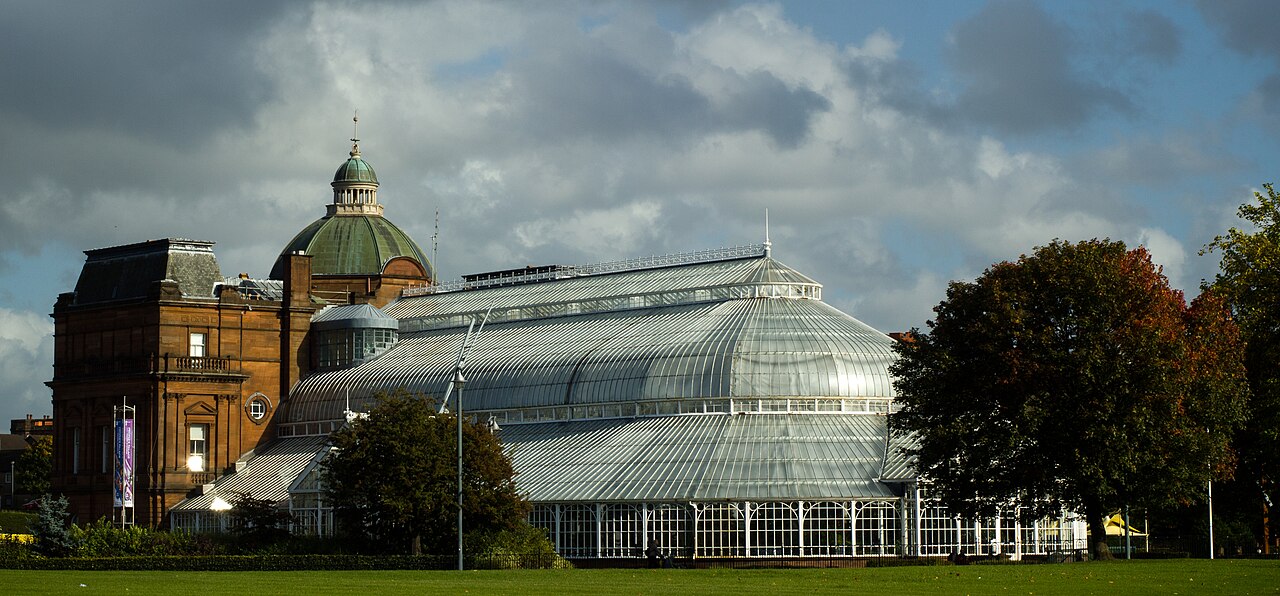
Image: People’s Palace and Winter Gardens, Glasgow by Emmi Hakka, sourced from Wikimedia Commons and licensed under CC BY-SA 4.0.

Built for public learning and recreation on Glasgow Green, the People’s Palace joins a richly modelled red-sandstone museum to a vast iron-and-glass winter garden.
Quick facts
- Date
- Built 1894–1898
- Architect / designer
- A. B. McDonald, Glasgow City Engineer
- Type
- Civic museum and winter garden in Renaissance and iron-and-glass traditions
- Designation
- Listed building, Category A (LB33838)
- OS grid reference
- NS 60029 64265
Why it matters
The People’s Palace was conceived as a civic institution for the East End: a place where history, education, recreation and sociability could meet. Its position on Glasgow Green is fundamental. It was placed within the city’s oldest public open space and paired with a winter garden that offered light, planting and shelter.
A. B. McDonald, Glasgow’s City Engineer, designed the complex, which was built between 1894 and 1898. The combination of an imposing stone museum and an immense glazed conservatory expressed late-Victorian confidence in municipal culture and public improvement. It remains closely associated with the social history of Glasgow and with the idea that the city’s own people and everyday life deserve a museum.
Design and construction
The palace is a symmetrical, three-storey composition in red ashlar, handled in an elaborate Renaissance manner. A strongly advanced centre and projecting end bays give the long elevation depth. The channelled ground floor forms a weighty base; above it, Corinthian detail, statuary, balustrades and steep French roofs build a more ceremonial skyline around the central dome.
Inside, the grand stair is a major element, with decorative wrought-iron work that introduces a lighter, more fluid note. Behind the masonry block, the winter garden changes the architectural language completely. It is a long, bow-ended volume of iron, steel and glass on a red-stone base. Repeated ribs, lattice work, decorative columns and brackets turn an engineered enclosure into a public room of considerable scale.
The two parts should be read together. The museum gives the institution civic presence; the winter garden opens it towards leisure, climate and the landscape of the Green.
What to notice
- The central emphasis: entrance, dome and stair create a clear ceremonial axis.
- The layered stonework: rustication, orders, sculpture and balustrades make the façade increasingly elaborate as it rises.
- The junction of solid and transparent: heavy red sandstone meets the repetitive iron-and-glass frame of the winter garden.
- The bow-ended conservatory: its curved termination softens the great linear volume.
- The park setting: the building’s public meaning draws on its relationship with Glasgow Green as well as its façades.
Change and conservation
The complex is closed for a major renewal project. Glasgow Life describes the work as both restoration and a wider rethinking of displays, access, environmental performance and the building’s role in culture-led regeneration. Public consultation has informed the project. Because the programme is active, dates and the eventual visitor route should be checked against current official updates.
Visiting and access
The museum and winter garden are not currently open as a normal visitor attraction. The exterior can be understood from Glasgow Green, but construction boundaries and access arrangements may change. Check Glasgow Life’s current page before making a special journey.
Sources & further reading
- Historic Environment Scotland: People’s Palace and Winter Gardens, LB33838 — designation, fabric, authorship and special interest.
- Glasgow Life: People’s Palace — current closure and official refurbishment information.
Location
OS grid reference NS 60029 64265 · Location confidence: High: the statutory designation supplies an exact National Grid Reference and the current operator confirms the building and address. · Select the marker to open its satellite view in Google Maps. On desktop, drag Pegman (the yellow figure) onto a blue road. On mobile, turn on the Street View layer and tap a blue road. Other photo markers may be user-contributed.
Suggest a marker correction
Suggest a more accurate position
The teal marker is the current published position. The orange marker starts slightly to its right so both remain visible; this is only a visual starting position. Tap the correct place on the map or drag the orange marker. Sending this form creates a private review entry only; it does not move the published marker.
Check this area in Google Maps Choose the Satellite layer there if useful.
Map: © OpenStreetMap contributors. You can also enter checked coordinates below.