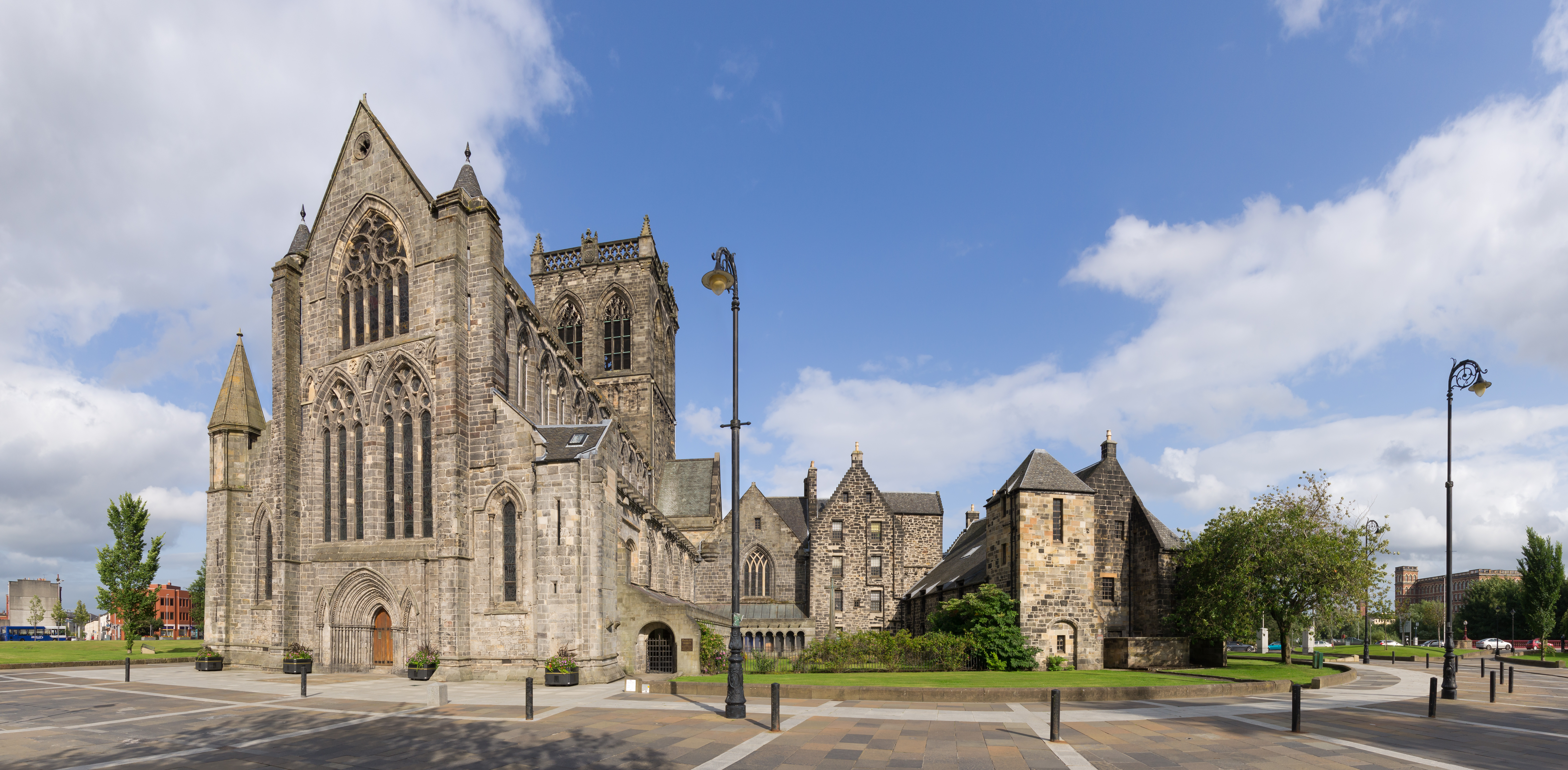
Image: Paisley Abbey and the Place of Paisley seen from the west by Colin / Wikimedia Commons, licensed under CC BY-SA 3.0.

Paisley Abbey is at once a medieval monastery, a Stewart burial place, a bold sequence of later reconstructions and a living parish church open to worshippers and visitors.
Quick facts
- Date
- Founded in 1163; surviving fabric from about 1190 onward; major restoration and reconstruction from 1788 to 1928; nave roof renewed in 1980–1981
- Architect / designer
- Medieval builders; later work by James Salmon, Robert Rowand Anderson, Peter MacGregor Chalmers and Robert Lorimer
- Type
- Former Cluniac abbey church; now a Church of Scotland parish church and visitor destination
- Designation
- Listed building, Category A (LB38910)
- OS grid reference
- NS 48559 63954
A medieval church recovered in stages
The present abbey has the cruciform scale of a major medieval monastery: a six-bay nave with aisles, an aisleless six-bay choir, transepts and a central tower. Yet it is not a single-period survival. Historic Environment Scotland identifies the three eastern bays of the south aisle, dating from about 1190, as the oldest substantial fabric. The west bay of the nave and lower west front are thirteenth-century; much of the remainder is fifteenth-century. St Mirin’s Aisle, projecting from the south transept, was added in 1499.
The architecture moves between round-arched Romanesque work and pointed Gothic forms. In the aisles, sexpartite and ridge-and-panel stone vaulting contrasts with the open timber nave roof. St Mirin’s Aisle has a pointed barrel vault crossed by decorative ribs, while the present stone vaults over choir, transepts and crossing belong largely to the modern reconstruction. Changes in masonry, moulding, roof form and finish are therefore evidence of the building’s long interruption and recovery rather than flaws in a supposedly uniform medieval whole.
Foundation, royal patronage and loss
Walter FitzAlan, the first High Steward of Scotland, founded a Cluniac priory here in 1163. Thirteen monks came from Much Wenlock in Shropshire to establish it on a site associated by tradition with the sixth-century missionary St Mirin. Raised to abbey status in 1245, the house became wealthy through royal and aristocratic patronage and trade. Fire and destruction in 1307 during the Wars of Independence were followed by major fourteenth-century rebuilding.
The abbey’s relationship with the hereditary High Stewards made it a place of dynastic memory. Six High Stewards were buried here. Marjory Bruce, daughter of Robert the Bruce and wife of Walter Stewart, died in 1316; her son became Robert II, the first Stewart king. Robert III was buried near the high altar in 1406. This connection supports the Abbey’s familiar description as the “cradle of the Royal House of Stewart”, while the exact medieval burial places and identities of displaced effigies are not all secure.
The central tower collapsed in the mid-sixteenth century. After the Reformation of 1560 the monastery was dissolved, its property passed to the Hamilton family and a reduced, walled-off nave continued as Paisley’s parish church. The ruined transepts and choir remained incomplete for centuries.
Restoration became part of the monument
The nave was repaired in 1788–1789. James Salmon undertook further work there and partial repair of the transepts in 1859–1862. From 1888 to 1907 Robert Rowand Anderson reconstructed the transepts and lower central tower. Peter MacGregor Chalmers continued the campaign from 1912 to 1922, rebuilding the choir walls, adding a vestry and beginning a partial cloister reconstruction. Robert Lorimer then altered details of Chalmers’s scheme and completed the choir vault and upper tower by 1928.
Lorimer also designed choir stalls and the stone communion table, and his replacement bosses and vaulting were carved by James A. Young and his team. Thomas Graham Abercrombie designed the pulpit in 1904; John Craig Barr designed the lectern. In 1980–1981 the eighteenth-century plaster nave ceiling was removed and replaced by the present open timber roof with tie beams. The abbey’s significance therefore includes changing ideas of conservation: repair, archaeological recovery and confident reconstruction are all visible.
Monuments, glass and the Barochan Cross
Among the monuments is a late-thirteenth-century female effigy placed on a later tomb base. It has been used for a nineteenth-century memorial to Marjory Bruce, but the identification is not archaeologically certain. John Hutchison’s memorial to Robert III was commissioned after Queen Victoria’s 1888 visit and installed around 1890. At the west end of the south aisle is John Flaxman’s 1816 monument to William McDowall. Nineteenth- and twentieth-century stained glass by several artists and workshops gives colour to the rebuilt spaces.
The Barochan Cross, moved into the abbey for protection in 1981, predates the monastery. Created between about AD 900 and 1100 in the British kingdom of Strathclyde, the free-standing sandstone cross is almost two metres high. Interlace and key patterns frame figures including a mounted warrior, a horn-bearer, axe-bearer, animals, trumpeters and spear-carriers. It is both a major work of early medieval sculpture and evidence that Paisley’s Christian story extends beyond the surviving abbey fabric.
Why it is included
Category A status reflects the abbey’s exceptional architectural, archaeological, religious and national importance. It preserves medieval work of several periods, royal and civic memory, early Strathclyde sculpture and a remarkable sequence of restoration campaigns by leading Scottish architects. Just as importantly, it remains a functioning Church of Scotland parish church whose worship, music, hospitality and visitor programme continue the site’s communal life.
What to notice
- The change from Romanesque work in the oldest south-aisle bays to later pointed Gothic fabric.
- The relationship between the long nave, transepts, reconstructed choir and central tower.
- The open timber nave roof contrasted with medieval and modern stone vaulting elsewhere.
- St Mirin’s Aisle of 1499 and its ribbed pointed barrel vault.
- The Lorimer fittings, Abercrombie pulpit and John Craig Barr lectern.
- The carved figures and interlace on all four sides of the Barochan Cross.
- The difference between medieval tomb sculpture and later commemorative reconstruction.
Visiting and access
The Abbey’s current visitor page states that the church, shop and café normally open Monday to Saturday from 10am to 4pm, with last admission at 3.30pm. Guided tours normally run at 2pm on Tuesday, Thursday and Saturday; tickets cost £5 and are sold in the shop. Large groups and outside tour companies should contact the Abbey in advance. Sunday worship is normally at 11am.
Services, weddings, funerals, concerts and other events can close the church or cancel a tour while the shop and café remain open, so the Abbey’s live visitor notice should be checked before a special journey. There is no on-site car park; the official page directs drivers to nearby public parking. Visitors needing a particular step-free route, seating or other adjustment should contact the Abbey, because historic floor levels and temporary event arrangements may affect access.
Timeline
- 1163 Walter FitzAlan founded a Cluniac priory served by monks from Much Wenlock.
- c.1190 The earliest substantial surviving south-aisle fabric was built.
- 1245 The priory was raised to abbey status.
- 1307 Fire and destruction during the Wars of Independence preceded major rebuilding.
- 1499 St Mirin’s Aisle was added to the south transept.
- 1560 The monastery was dissolved; a reduced nave continued as the parish church.
- 1788–1862 Successive campaigns repaired the nave and began recovery of the transepts.
- 1888–1907 Robert Rowand Anderson reconstructed the transepts and lower tower.
- 1912–1928 Peter MacGregor Chalmers and Robert Lorimer completed the choir, tower and related work.
- 1980–1981 The nave received its present open timber roof, and the Barochan Cross was moved inside.
- Present Paisley Abbey remains a parish church and normally opens six days a week to visitors.
What we know — and what remains uncertain
The statutory record provides a detailed sequence for surviving fabric and modern reconstruction, but not every stone can be assigned confidently from a visitor’s inspection. The traditional sixth-century church of St Mirin and William Wallace’s education at the abbey are important parts of the site’s story, yet the surviving evidence does not support treating every detail of those traditions as established fact. The female effigy used in Marjory Bruce’s memorial and the rediscovered royal burial places also require caution. Current opening hours and tours are dependable only when no service or event intervenes.
Sources & further reading
- Historic Environment Scotland: Abbey Close, Paisley Abbey, LB38910 — Statutory designation, medieval fabric, restoration phases, furnishings, monuments and Barochan Cross.
- Paisley Abbey: history — Foundation, Cluniac community, royal patronage and Stewart associations.
- Paisley Abbey: visit — Current opening hours, tours, group arrangements, transport and temporary closure notices.
- Scotland’s Churches Trust: Paisley Abbey — Architectural overview, post-Reformation survival, restoration, furnishings, glass and church life.
- Historic Environment Scotland: Barochan Cross history — Date, original setting, move to the Abbey and interpretation of the sculpture.
Location
OS grid reference NS 48559 63954 · Location confidence: High: catalogue point derived from a national heritage record or current official mapping; it is not a site boundary. · Select the marker to open its satellite view in Google Maps. On desktop, drag Pegman (the yellow figure) onto a blue road. On mobile, turn on the Street View layer and tap a blue road. Other photo markers may be user-contributed.
Suggest a marker correction
Suggest a more accurate position
The teal marker is the current published position. The orange marker starts slightly to its right so both remain visible; this is only a visual starting position. Tap the correct place on the map or drag the orange marker. Sending this form creates a private review entry only; it does not move the published marker.
Check this area in Google Maps Choose the Satellite layer there if useful.
Map: © OpenStreetMap contributors. You can also enter checked coordinates below.