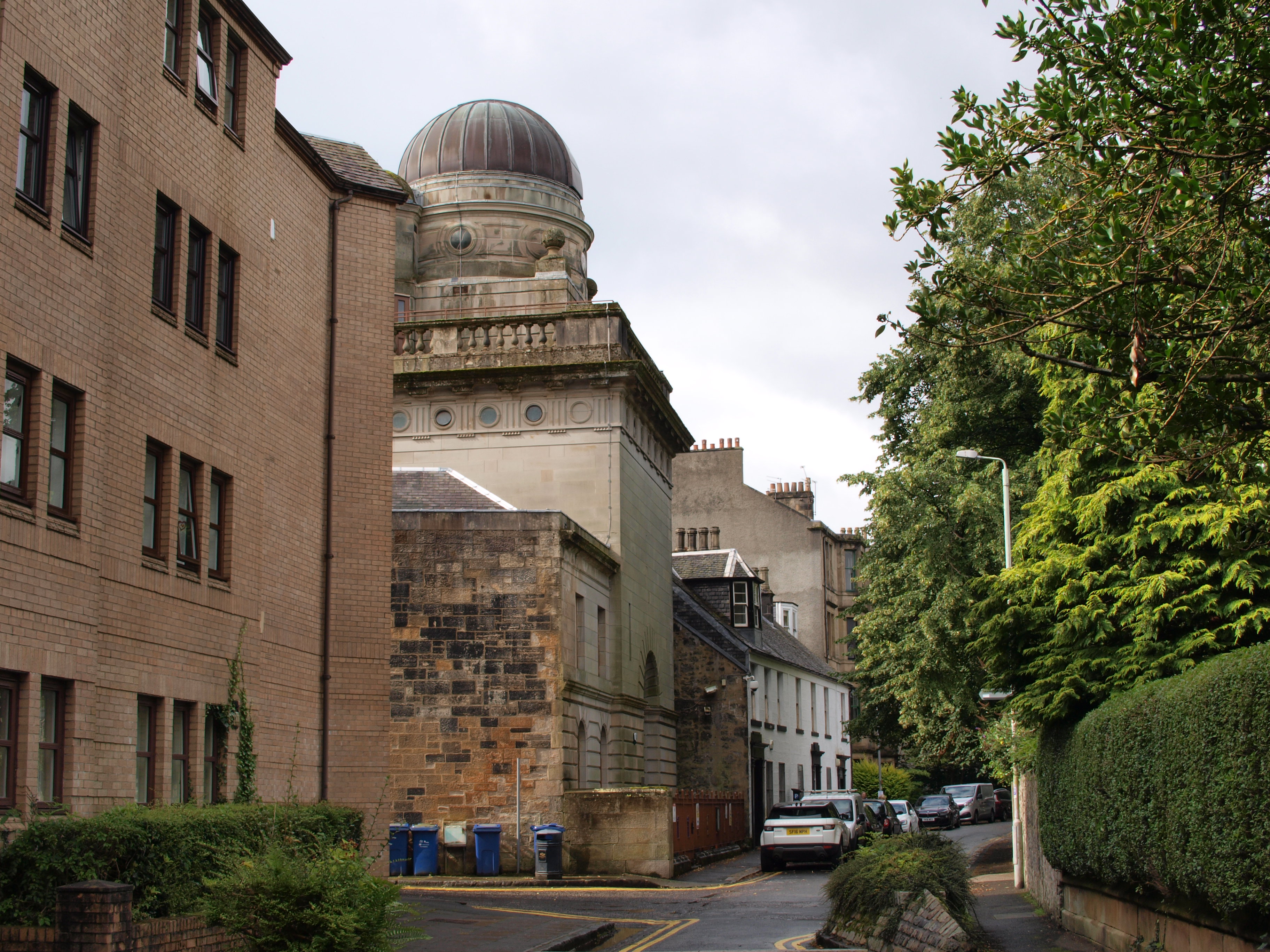
Image: Coats Observatory by Alec MacKinnon, sourced from Wikimedia Commons and licensed under CC BY-SA 2.0.

Scotland’s oldest surviving purpose-built public observatory combines a compact classical tower with working Victorian instruments, a long record of weather observation and an unusual role as Paisley’s civic timekeeper.
Quick facts
- Date
- Opened 1 October 1883; building dated 1884; major repair and museum-campus integration completed structurally in 2026
- Architect / designer
- John Honeyman for Thomas Coats and the Paisley Philosophical Institution
- Type
- Purpose-built public astronomical, meteorological and scientific observatory
- Designation
- Listed building, Category A (LB39072)
- OS grid reference
- NS 47892 64060
A civic tower made for looking outward
The observatory is composed as a small but emphatic classical landmark. Its square tower rises from a plinth in channelled ashlar to the impost level of a recessed, round-arched entrance. Above, polished ashlar walls lead to a Doric frieze, mutule cornice and balustrade. A circular observation drum, punctured by oculi, carries the copper dome. The progression from square tower to round drum gives the scientific function a clear architectural silhouette.
An attached octagonal domed turret and a slightly recessed two-storey side wing make the building more than a single vertical shaft. The wing repeats the tower’s lower detailing, with a round-headed doorway, sash windows, cornice and blocking course beneath a piended slate roof. The careful stonework expresses the status attached to public science in industrial Paisley.
Its story
The project began in 1880, when the Paisley Philosophical Institution proposed acquiring a telescope. Thomas Coats of Ferguslie offered to meet the cost. Once the need for a purpose-built home became clear, land beside the expanding museum and library complex was used for John Honeyman’s design. Coats funded the telescope and building and provided a £2,000 endowment; the institution named the observatory after him. It opened to the public on 1 October 1883, although the building bears an 1884 date.
The observatory was conceived as a working scientific institution, not merely a viewing tower. Transit House, built to its south, held a telescope that moved vertically to observe stars crossing the meridian. These observations allowed clocks to be corrected with great precision. Paisley Town Hall and other local clocks were connected to the observatory, turning astronomical measurement into an everyday civic service.
Astronomical equipment was joined by weather instruments, magnetometers, spectroscopes and seismometers. Daily meteorological observations began soon after opening and form a remarkable long-running record. A larger telescope was installed in 1898 alongside the original instrument; OneRen states that both Victorian telescopes remain operational and that their associated apparatus forms the core of Paisley Museum’s science collection.
Repair and renewed public use
Coats Observatory is now part of the transformed Paisley Museum campus. The Category A museum and observatory have received extensive internal and external repairs, while a new garden and public space reveal views of the tower that were formerly obscured. The redesigned campus provides ramped connections towards the observatory and is intended to restore public access to Transit House after decades of restricted use.
Construction was reported complete in February 2026, but exhibition fit-out and object installation continue. Renfrewshire Council’s July 2026 update still anticipated a public reopening in late 2026. Until an opening date and arrangements are formally confirmed, the observatory should be treated as closed rather than as a walk-in attraction.
Why it is included
The building is nationally important both as architecture and as evidence of civic scientific culture. Its tower, dome and instruments bring together philanthropy, astronomy, meteorology, precision timekeeping and public education. The survival of its original scientific role makes it more than a picturesque Victorian observatory.
What to notice
- The carefully staged transition from square ashlar tower to circular drum and copper dome.
- The Doric frieze, mutule cornice and balustrade below the observation level.
- The small oculi lighting the circular drum.
- The attached octagonal turret and lower side wing, which balance the tower.
- The relationship with Transit House, the museum buildings and the new observatory garden.
Reading the surroundings
The renewed museum campus is designed to reconnect the observatory with Paisley’s High Street cultural buildings and to make its scientific story more accessible. During fit-out, public routes may remain controlled and must not be inferred from the completed landscaping. Once reopened, OneRen intends to resume public viewing nights and display more of the science collection, but future hours, booking and telescope access should be checked directly before travelling.
Timeline
- 1880 The Paisley Philosophical Institution proposed acquiring a telescope; Thomas Coats offered financial support.
- 1882 Coats formally presented the project to the institution.
- 1 October 1883 Coats Observatory opened to the public.
- 1884 The date carried by John Honeyman’s observatory building.
- 1898 A larger telescope was installed beside the original instrument.
- 2018–2019 The observatory and museum complex closed for redevelopment.
- February 2026 The principal construction phase was reported complete and fit-out began.
- Late 2026 planned Public reopening is anticipated but remains subject to formal confirmation.
What we know — and what remains uncertain
Historic Environment Scotland dates the building to 1884, while OneRen records its public opening on 1 October 1883. These statements are retained together rather than forced into a single date. The late-2026 reopening remains a published intention, not a confirmed visitor timetable.
Sources & further reading
- Historic Environment Scotland: Coats Observatory, LB39072 — Statutory designation, architect, date, stonework and architectural form.
- OneRen: Coats Observatory — Opening date, foundation, endowment, scientific work, instruments, civic timekeeping and present closure.
- OneRen: Paisley Museum science collection — Observatory instruments, meteorological record and institutional history.
- Renfrewshire Council: construction completed on Paisley Museum transformation — Repairs, campus design, fit-out and planned reopening.
Location
OS grid reference NS 47892 64060 · Location confidence: High: the designation supplies an exact grid reference and the current museum project identifies the same observatory building. · Select the marker to open its satellite view in Google Maps. On desktop, drag Pegman (the yellow figure) onto a blue road. On mobile, turn on the Street View layer and tap a blue road. Other photo markers may be user-contributed.
Suggest a marker correction
Suggest a more accurate position
The teal marker is the current published position. The orange marker starts slightly to its right so both remain visible; this is only a visual starting position. Tap the correct place on the map or drag the orange marker. Sending this form creates a private review entry only; it does not move the published marker.
Check this area in Google Maps Choose the Satellite layer there if useful.
Map: © OpenStreetMap contributors. You can also enter checked coordinates below.