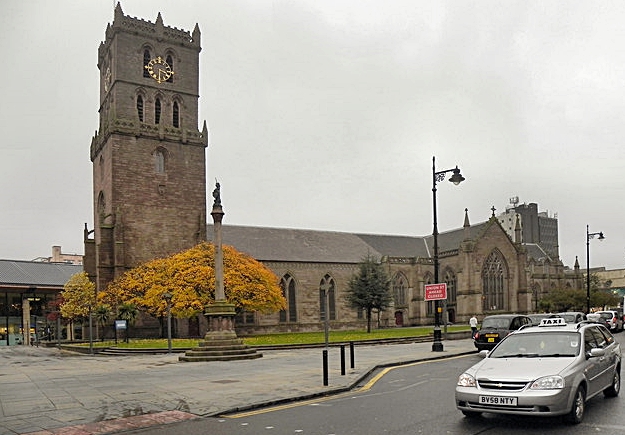
Image: Old St Paul’s and St David’s, City Churches by David Dixon, 25 October 2011, sourced from Wikimedia Commons and licensed under CC BY-SA 2.0.

Old St Paul’s and St David’s preserves a richly detailed Gothic rebuilding of Dundee’s historic parish-church transepts, now used as halls within an active city-centre worship and community complex.
Quick facts
- Date
- Designed 1841–1842; executed 1847
- Architect / designer
- William Burn; executed by David Bryce
- Type
- Decorated Gothic former church section, now ecclesiastical halls
- Designation
- Listed building, Category A (LB25378)
- OS grid reference
- NO 40166 30128
A Gothic rebuilding within the City Churches
William Burn designed this part of the City Churches in 1841–1842, and David Bryce carried out the work in 1847 on the site of the medieval parish church’s transepts. The listed section stands between St Mary’s and the Steeple Church, completing an exceptional linked group whose parts share a long parish history.
The exterior is faced in ashlar and treated in a Decorated Gothic manner. On the south, a gabled transept is dominated by a tall pointed window with Y- and curvilinear tracery. Pinnacled angle buttresses, a crocketed gable and a cross finial give the elevation a strongly vertical outline. The east and west returns continue the traceried windows and add parapets pierced with quatrefoils. Two basket-arched doorways lead respectively into the former South Church and through a pend.
Interior and continuing use
Inside, timber-and-plaster ribs imitate a stone vault and spring from ashlar pilaster piers. Historic Environment Scotland also records twentieth-century stained glass, inserted partitions and a mezzanine at the south end, together with a concealed plaster-panelled ceiling in rooms that once formed a gallery. These adaptations explain how a space designed for congregational worship could continue in ecclesiastical use as halls.
The wider complex is now the Steeple Centre of Dundee Law Parish Church, a congregation formed on 1 July 2024 by the union of the Steeple Church Dundee and Coldside Parish Church. The church describes the centre as a base for city-centre worship, mission and weekday activity. This record therefore distinguishes the active complex from the precise listed section: worship and public events do not mean that every hall or linked interior is open at all times.
A long parish history
The building occupies ground with a much longer ecclesiastical history than its nineteenth-century fabric. Historic Environment Scotland identifies it with the transepts of Dundee’s former parish church and records that the south transept was rebuilt as a church in its own right in 1588. It later became known as the South Church, while the north transept served as a burial place before becoming the Cross Church in 1759. The present Gothic work is therefore one visible layer in a sequence of division, reuse and rebuilding rather than a single-period monument.
The designation also repeats the historical tradition that General Monck stabled horses here. That episode belongs to the recorded history of the site, but the surviving fabric described above is principally the result of Burn and Bryce’s nineteenth-century campaign and later internal changes.
Architecture and the City Churches
Elaborate tracery, pinnacles and a ribbed interior distinguish the former South Church within Dundee’s Category A-listed City Churches ensemble. Its position among adjoining church ranges preserves the accumulated plan of the central parish complex. The former worship space now serves church and community activities as a hall.
What to notice
- The large curvilinear-traceried south transept window and the related windows on the returns.
- The contrast between crocketed south gable and the plainer north elevation.
- The quatrefoil-pierced parapets and pinnacled angle buttresses.
- During authorised interior access, the timber-and-plaster rib vault designed to resemble stone.
- How the listed section fits between St Mary’s and the Steeple Church rather than standing alone.
Visiting and access
The exterior can be appreciated from the public realm around Nethergate. Dundee Law Parish Church currently advertises Sunday worship at the Steeple Centre at 10.30am, a Friday service on the first and third Friday of each month at 5.30pm, and a range of weekday activities. These are opportunities to enter the active complex, not a promise that the listed halls will be freely accessible. Check the church’s current programme or contact it before making a special journey; worship, booked activities and safeguarding needs take priority. Limited on-street parking is available nearby, while the city-centre site is served by buses and public car parks.
Timeline
- 1588 Historic Environment Scotland records the south transept of the earlier parish church being rebuilt as a church in its own right.
- 1759 The north transept, previously used for burial, became the Cross Church.
- 1841–1842 William Burn designed the Gothic rebuilding.
- 1847 David Bryce executed the work.
- Twentieth century Stained glass and internal adaptations, including partitions and a mezzanine, formed part of the continuing use of the space.
- 1 July 2024 Dundee Law Parish Church was created through the union of the Steeple Church Dundee and Coldside Parish Church.
- Present The listed section serves as ecclesiastical halls within the active Steeple Centre.
What we know — and what remains uncertain
The designation securely identifies the architects, dates, principal fabric and historical sequence, while the congregation confirms current worship and community activity. Room-by-room occupation and access can change, so this record does not assume that every linked section is open during a service or event. Historic Environment Scotland’s supplementary account is an authoritative designation source, but it also cautions that such descriptions are not complete building histories.
Sources & further reading
- Historic Environment Scotland: Old St Paul’s and St David’s, City Churches, LB25378 — Category A designation, plan relationship, dates, architects, exterior and interior fabric, historical sequence and group value.
- Dundee Law Parish Church: Steeple Centre — Current worship times, weekday activity, transport context and continuing city-centre use.
- Dundee Law Parish Church: background — Formation of the present congregation on 1 July 2024 and its continuing community role.
Location
OS grid reference NO 40166 30128 · Location confidence: High: the statutory designation supplies an official mapped National Grid Reference and the current source confirms the Place relationship or present identity. · Select the marker to open its satellite view in Google Maps. On desktop, drag Pegman (the yellow figure) onto a blue road. On mobile, turn on the Street View layer and tap a blue road. Other photo markers may be user-contributed.
Suggest a marker correction
Suggest a more accurate position
The teal marker is the current published position. The orange marker starts slightly to its right so both remain visible; this is only a visual starting position. Tap the correct place on the map or drag the orange marker. Sending this form creates a private review entry only; it does not move the published marker.
Check this area in Google Maps Choose the Satellite layer there if useful.
Map: © OpenStreetMap contributors. You can also enter checked coordinates below.