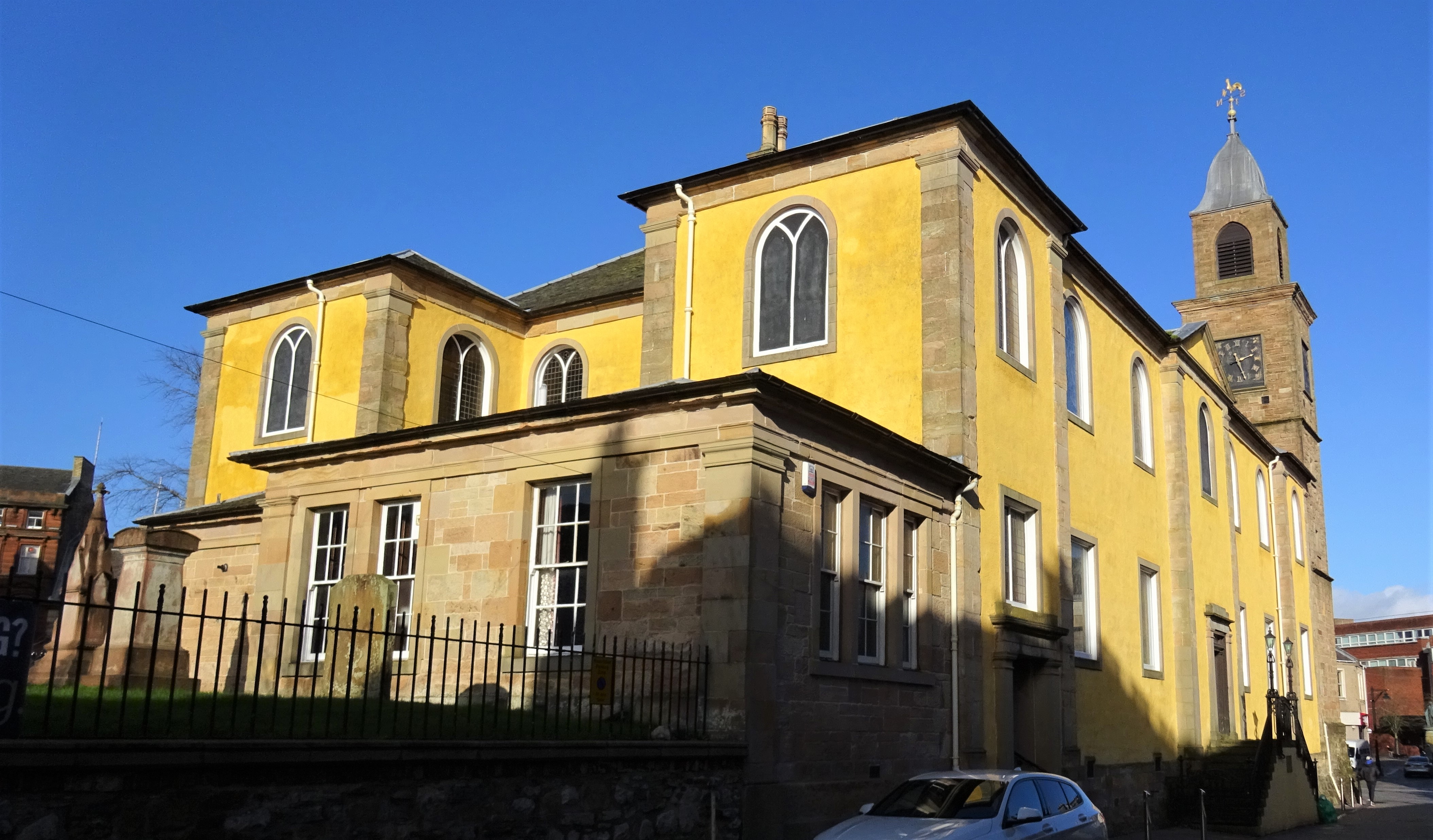
Image: New Laigh Kirk by Rosser1954, 22 February 2022, sourced from Wikimedia Commons and licensed under CC BY-SA 4.0.

An older tower anchors Kilmarnock’s rebuilt classical parish church at the heart of the town.
Quick facts
- Date
- Tower of seventeenth-century origin; church rebuilt 1802, enlarged 1831 and renovated 1903–1904
- Architect / designer
- Robert Johnstone; later work by Andrew and Newlands
- Type
- Classical parish church with an older four-stage tower
- Designation
- Listed building, Category A (LB35875)
- OS grid reference
- NS 42767 37948
Architecture and continuing use
The compact rectangular church is set behind a sturdy rubble tower. Painted walls, ashlar dressings and projecting stair bays distinguish the early nineteenth-century body from the older masonry.
Its story
The present church followed the collapse panic of 1801 and was subsequently enlarged and renewed. It remains a worshipping congregation and a regular town-centre presence.
Why it is included
Its layered fabric, Category A status and continuing civic and religious role make it fundamental to Kilmarnock’s story.
What to notice
- Change in masonry between tower and church body.
- Classical proportions and corner stair bays.
- Relationship with the historic graveyard and Bank Street.
Reading the surroundings
Use advertised opening and worship times; respect services, graves and private prayer.
Timeline
- Tower of seventeenth-century origin The present church followed the collapse panic of 1801 and was subsequently enlarged and renewed. It remains a worshipping congregation and a regular town-centre presence.
- Present Active Church of Scotland parish church.
What we know — and what remains uncertain
Opening arrangements can change; the congregation’s current information takes precedence.
Sources & further reading
- Historic Environment Scotland: New Laigh Kirk, LB35875 — Designation status, mapped location, construction phases, fabric, authorship and architectural or historical interest.
- Presbytery of the South West: New Laigh Kirk — Current congregation, location and worship information.
- National Churches Trust: Laigh Kirk — Architectural overview and visitor context.
Location
OS grid reference NS 42767 37948 · Location confidence: High: the statutory designation supplies an official mapped National Grid Reference and the current source confirms the Place relationship or present identity. · Select the marker to open its satellite view in Google Maps. On desktop, drag Pegman (the yellow figure) onto a blue road. On mobile, turn on the Street View layer and tap a blue road. Other photo markers may be user-contributed.
Suggest a marker correction
Suggest a more accurate position
The teal marker is the current published position. The orange marker starts slightly to its right so both remain visible; this is only a visual starting position. Tap the correct place on the map or drag the orange marker. Sending this form creates a private review entry only; it does not move the published marker.
Check this area in Google Maps Choose the Satellite layer there if useful.
Map: © OpenStreetMap contributors. You can also enter checked coordinates below.