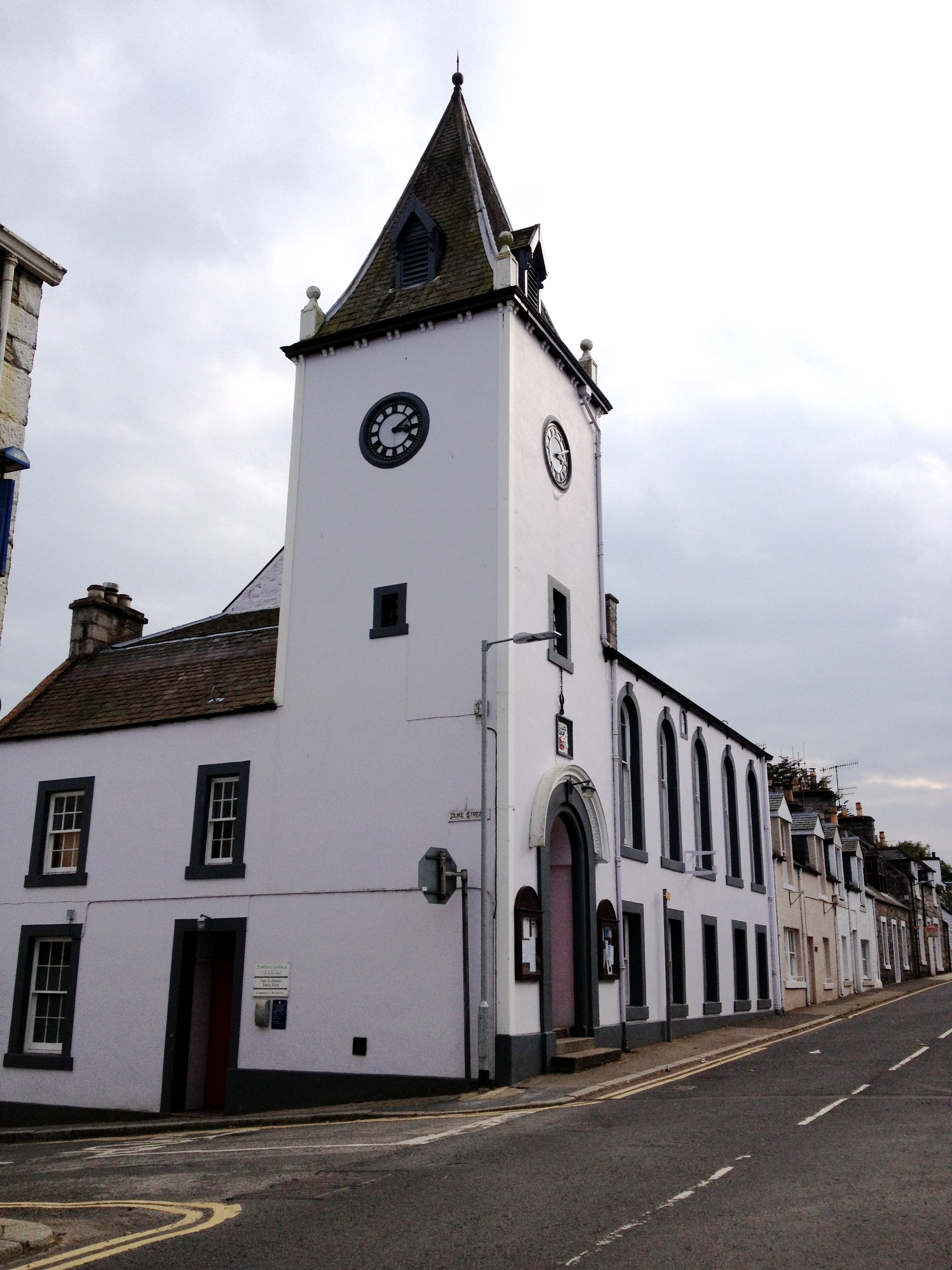


Scotland’s smallest royal burgh retains a community-owned hall whose clock tower and former prison embody more than three centuries of civic life.
Quick facts
- Date
- Earlier fabric; rebuilt and enlarged 1875
- Architect / designer
- Francis Armstrong, 1875 remodelling
- Type
- Town hall and former tolbooth with clock tower
- Designation
- Listed building, Category B (LB38475)
- OS grid reference
- NX 63412 77506
Architecture, archaeology and continuing use
The long, white-rendered two-storey façade faces the High Street, with its principal clock tower marking the junction with East Port. The ground floor has square-headed sash windows and a round-arched entrance through the tower. The upper storey is animated by taller arched openings, an inscription recording the 1875 rebuilding, and a carved panel of the burgh arms above the entrance.
The square three-stage tower contains the clock and retains a compartment associated with the town’s former prison. Its steep pyramidal slated roof has small louvred openings — lucarnes — and finials at the corners and peak. Although the tower gives the building a strongly Victorian outline, earlier civic fabric may survive behind the cement render applied soon after the rebuilding.
The community building contains two halls. The larger upper room has a high vaulted ceiling and a series of Victorian moral maxims around the upper edge of its timber panelling, recorded by the Architectural Heritage Fund. The mixture of civic inscription, historic prison, timekeeping mechanism and meeting rooms illustrates how one building performed several roles for a small burgh.
Its story
A tolbooth stood here by 1711, when bells were made for the tower. The building served the town council and also housed detention facilities: nineteenth-century accounts distinguish a small cell for people accused or convicted of crimes from a larger one used for debtors. It was at once a seat of local government and a place where the burgh exercised legal authority.
Francis Armstrong of Dalbeattie rebuilt and enlarged the hall in 1875, retaining some earlier features. The bell and clock arrangements were altered in the nineteenth century, and the outer walls were cement rendered in 1878, concealing much of the evidence for the age of the masonry beneath. The round-arched tower entrance also belongs to a later phase of alteration.
The town hall ceased to be a local seat of government after the 1975 reorganisation. Local Initiatives in New Galloway (LING) later took responsibility for community use, and a Community Asset Transfer placed the building in local ownership in 2022. Architectural Heritage Fund support assisted planning for repairs, improved accessibility, better heating and continued use as a flexible community venue.
What to notice
- The burgh coat of arms above the round-arched entrance in the clock tower.
- The clock stage, steep slated roof and small louvred roof openings known as lucarnes.
- The nineteenth-century inscription recording the rebuilding and enlargement of 1875.
- The historic prison space in the tower, contrasting with the hall’s continuing community role.
Reading the surroundings
Use advertised events, lunches or hall-hire arrangements. Community activity does not imply that every room, the former prison or the clock mechanism is routinely open.
Timeline
- By 1711 A tolbooth and bell tower occupied the site.
- 1837 Accounts describe separate prison rooms for offenders and debtors.
- 1875 Francis Armstrong rebuilt and enlarged the civic hall.
- 1878 Cement rendering concealed much of the older wall fabric.
- 1975 Reorganisation ended the town hall’s role as a local-government seat.
- 2022 Community asset transfer placed ownership with LING.
Sources & further reading
- Historic Environment Scotland: New Galloway Town Hall, LB38475 — Designation status, mapped location, date, fabric and architectural or archaeological interest.
- Dumfries and Galloway Council: New Galloway Town Hall — Current community venue, hire function, address and contact route.
- Architectural Heritage Fund: New Galloway Town Hall — Community transfer, historic function and capital-renewal programme.
- Local Initiatives in New Galloway — First-party confirmation of management since 2012 and community ownership from 2022.
Location
OS grid reference NX 63412 77506 · Location confidence: High: the national designation supplies an official mapped National Grid Reference; the independent source confirms the Place relationship, history or current identity. · Select the marker to open its satellite view in Google Maps. On desktop, drag Pegman (the yellow figure) onto a blue road. On mobile, turn on the Street View layer and tap a blue road. Other photo markers may be user-contributed.
Suggest a marker correction
Suggest a more accurate position
The teal marker is the current published position. The orange marker starts slightly to its right so both remain visible; this is only a visual starting position. Tap the correct place on the map or drag the orange marker. Sending this form creates a private review entry only; it does not move the published marker.
Check this area in Google Maps Choose the Satellite layer there if useful.
Map: © OpenStreetMap contributors. You can also enter checked coordinates below.