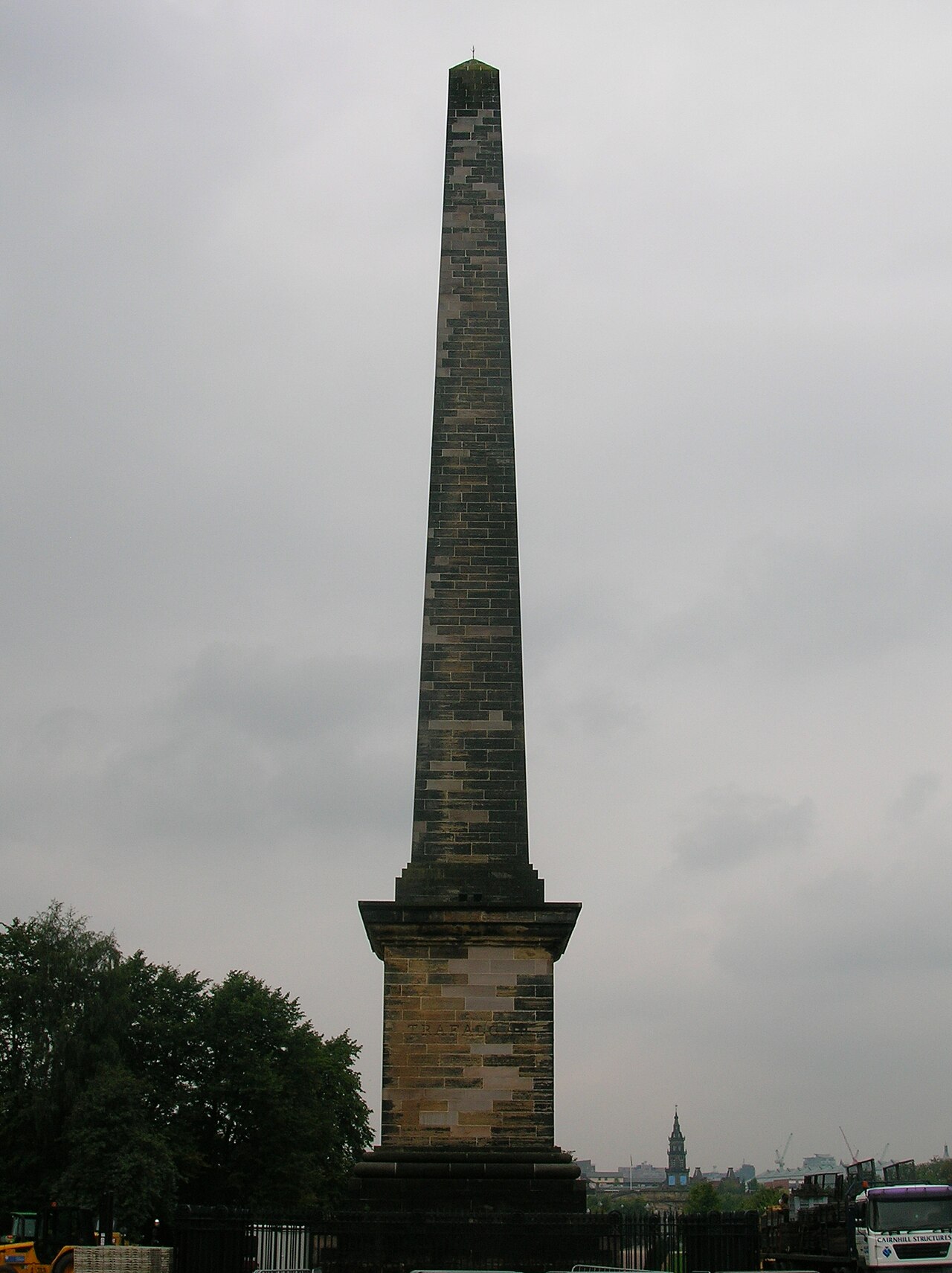
Image: Nelson Monument, Glasgow Green by Rosser1954 (Roger Griffith), sourced from Wikimedia Commons and licensed under Public domain (PD-self).

David Hamilton’s 144-foot obelisk has marked Glasgow Green since 1806, carrying an early national commemoration of Nelson through lightning damage, repair and later reinterpretation.
Quick facts
- Date
- Erected 1806; struck by lightning in 1810; James Watt tablet added 1965
- Architect / designer
- David Hamilton
- Type
- Monumental polished-ashlar obelisk on a square plinth, enclosed by cast-iron railings
- Designation
- Listed building, Category A (LB33837)
- OS grid reference
- NS 59824 64303
Architecture
The monument is a giant polished-ashlar obelisk, 144 feet (about 44 metres) high, rising from a square plinth within cast-iron railings. Its effect depends on exceptionally simple geometry and scale: a broad base, an unbroken tapering shaft and a sharp silhouette visible across the open ground of Glasgow Green.
The long structural crack recorded in the designation account is physical evidence of the lightning strike that damaged the monument soon after construction. The enclosure railings are part of the Category A designation and help define the monument as a commemorative precinct rather than an object intended for climbing or entry.
Its story
Hamilton designed the obelisk in 1806, the year after Horatio Nelson was killed at the Battle of Trafalgar. Historic Environment Scotland describes it as being said to be the first monument in the United Kingdom erected to commemorate Nelson’s victories. It was funded by public subscription, placing a national naval commemoration within Glasgow’s principal common ground.
In August 1810 lightning struck the shaft and brought down the upper 20 feet of masonry. John Knox’s painting of the event, now associated with Glasgow Museums, turned structural failure into part of the monument’s public history. The damage was repaired, but the crack remains legible.
A tablet added to the plinth in 1965 commemorates James Watt’s account of conceiving the separate condenser while walking on Glasgow Green in 1765. The later inscription introduces a different civic story—scientific and industrial innovation—beside the original naval and military commemoration.
Why it matters
The obelisk is important for its early date, exceptional height and authorship by one of nineteenth-century Glasgow’s leading architects. It also reveals how public monuments accumulate meanings: Nelson’s victories, the drama of the lightning strike and the later commemoration of Watt now coexist on one structure.
What to notice
- The severe contrast between the plain tapering shaft and its low square plinth.
- The long repaired crack associated with the 1810 lightning strike.
- The cast-iron railings included in the statutory designation.
- The 1965 James Watt tablet and the way it adds a second commemorative subject.
- Long views towards the obelisk across the open Green.
Visiting and access
The monument is an outdoor landmark within Glasgow Green and can be appreciated from surrounding public park paths. Glasgow City Council publishes a Glasgow Green heritage trail that includes the park’s historic features. Event compounds, maintenance or temporary park restrictions can sometimes change the closest approach.
There is no visitor interior or advertised public access inside the railings. Remain on public paths, stay outside the enclosure and do not attempt to climb the plinth or shaft. The People’s Palace and other nearby facilities have their own opening arrangements.
Timeline
- 1805 Nelson was killed during the British victory at Trafalgar.
- 1806 Hamilton’s publicly subscribed monument was erected on Glasgow Green.
- August 1810 Lightning struck the obelisk and the upper 20 feet of masonry fell.
- After 1810 The shaft was repaired, with evidence of the structural damage remaining visible.
- 1965 A tablet was added to commemorate James Watt’s reported insight on Glasgow Green two centuries earlier.
- Present The obelisk remains a major park landmark and outdoor commemorative monument.
What we know — and what remains uncertain
The architect, date, height, materials and lightning damage are well documented. The statutory account cautiously says that this was “said to be” the first UK monument commemorating Nelson’s victories; that precedence claim should therefore remain qualified. The monument is not an accessible viewing tower and no interior visitor route is claimed.
Sources & further reading
- Historic Environment Scotland: Nelson Monument including railings, LB33837 — Designation, form, height, architect, lightning damage and the James Watt tablet.
- The Glasgow Story: Nelson’s Monument struck by lightning — Glasgow Museums-supported account of the 1810 strike and John Knox’s painting.
- Glasgow City Council: Glasgow Green Heritage Trail — Official public heritage trail and park context.
Location
OS grid reference NS 59824 64303 · Location confidence: High: the statutory designation supplies an official mapped National Grid Reference and the current source confirms the Place relationship or present identity. · Select the marker to open its satellite view in Google Maps. On desktop, drag Pegman (the yellow figure) onto a blue road. On mobile, turn on the Street View layer and tap a blue road. Other photo markers may be user-contributed.
Suggest a marker correction
Suggest a more accurate position
The teal marker is the current published position. The orange marker starts slightly to its right so both remain visible; this is only a visual starting position. Tap the correct place on the map or drag the orange marker. Sending this form creates a private review entry only; it does not move the published marker.
Check this area in Google Maps Choose the Satellite layer there if useful.
Map: © OpenStreetMap contributors. You can also enter checked coordinates below.